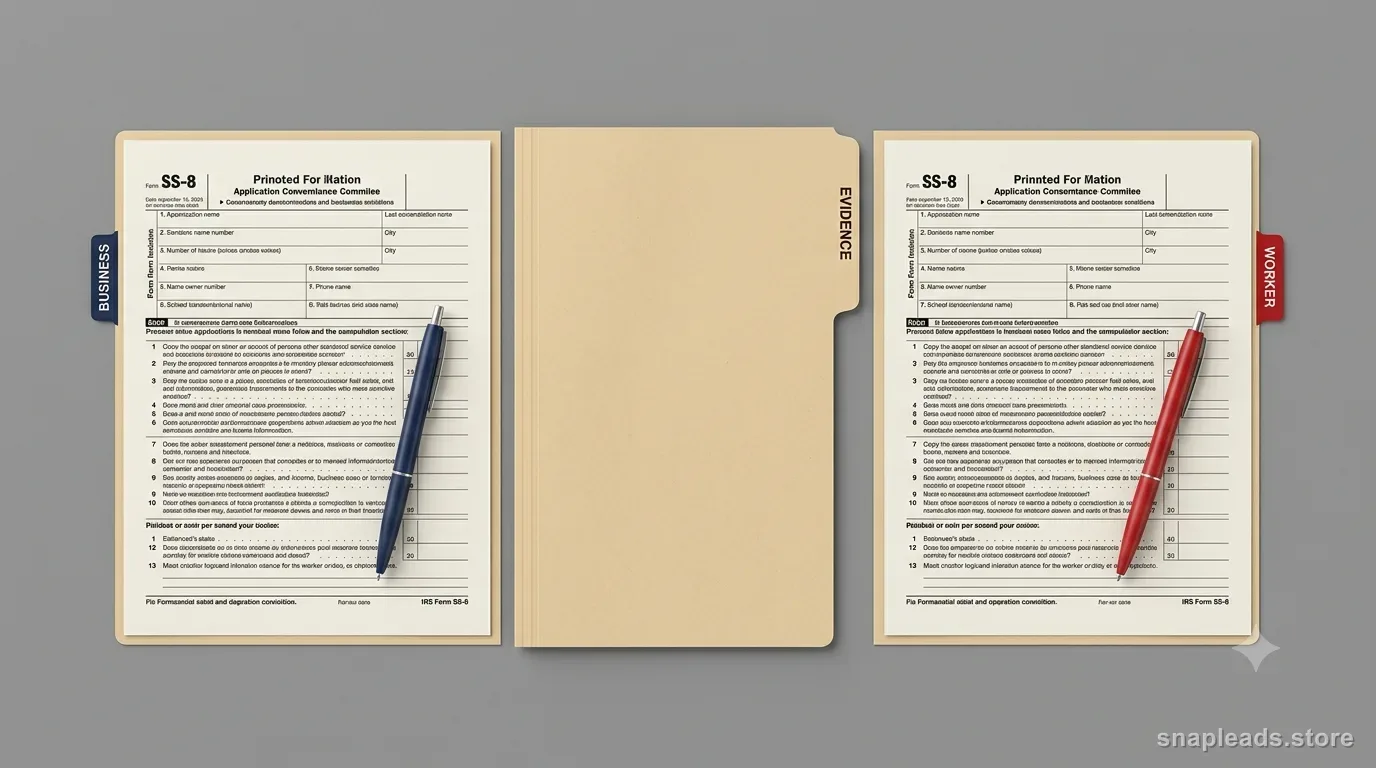
SS-8 is available to both sides of the relationship
The IRS worker-status process is not limited to employers. A firm or a worker can submit Form SS-8 to ask for a determination for federal employment-tax and income-tax withholding purposes. This matters because a business can learn about a classification dispute through an IRS request even when it never chose to file on its own.
An employer compliance process should therefore include a route for tax or HR teams to recognize SS-8 correspondence quickly. It should not be left in a generic mailbox with ordinary vendor paperwork.
A worker filing is not proof that the company was wrong
A filing means the worker has asked the IRS to determine status. The conclusion still depends on facts and law. Responding defensively can make the business record worse: deleting messages, pressuring the worker, or rewriting agreements does not change the historical relationship and can create separate problems.
The professional response is to preserve records, identify the period and services at issue, and gather accurate information from managers and finance.
A second filing does not “outvote” the first
If the business learns that the worker filed SS-8, the useful question is what the IRS needs from the business, not how to create a competing narrative. In many cases the agency can solicit information from both parties in the same determination process. Whether a separate employer submission is appropriate depends on the procedural facts and professional advice.
A company should avoid duplicative paperwork that creates inconsistent answers. One internal coordinator should track every piece of correspondence related to the matter.
If a class of workers is involved, keep the filing structure straight
Current IRS guidance gives businesses specific instructions when the request concerns a class of workers: identify all affected workers for that class, and use a separate SS-8 when more than one class of worker is being presented. That is another reason not to answer a worker filing with a stack of hastily duplicated forms. First determine what relationship and worker group the IRS is already examining.
There is also an important boundary: the IRS says it does not accept Form SS-8 when the worker and business are in litigation with one another. If a dispute has moved into litigation, do not assume a second SS-8 filing remains available as a parallel strategy. Route the procedural question to the appropriate adviser and keep the factual record preserved.
Expect factual differences and explain them with dates
Workers and managers often remember the relationship from different vantage points. A worker may focus on fixed hours; a manager may focus on the ability to decline projects. Both facts can be true. The job is to document the complete operating pattern, including changes over time, rather than treating every difference as dishonesty.
When facts conflict, use contemporaneous records—calendars, agreements, invoices, task instructions, expense records, and business communications—to establish what actually happened.
Separate the IRS process from workplace communication
If the worker is still providing services, routine operational communication can continue, but managers should not interrogate the person about what they told the IRS or condition future work on withdrawing a filing. Sensitive communication should be coordinated with appropriate HR or legal guidance.
This is also a good time to remind managers not to speculate in chat channels about taxes, penalties, or the worker’s motives. Keep the record professional and factual.
Current classification still needs a decision
A pending worker-initiated SS-8 does not create an automatic interim status. The business needs a current tax and payroll approach while the IRS reviews the matter. If the internal review already indicates that employee treatment is appropriate, the company may choose to change prospectively rather than waiting solely for the letter, subject to professional advice.
Document the date and reason for any change so later reviewers do not confuse current operations with the historical period under review.
State claims may run on a different track
A worker may simultaneously pursue unemployment benefits, wage claims, or other state remedies. An SS-8 determination is not the universal procedure for those systems. The company should identify each agency, each legal standard, and each deadline separately.
That separation prevents an employer from answering a state unemployment questionnaire with nothing more than “SS-8 pending.” The state may have its own authority and test.
Close the matter with a shared chronology
Once the determination arrives, create a chronology listing the initial relationship, any worker filing, company responses, later operational changes, the IRS result, and implementation steps. A clear chronology can be more valuable than a folder sorted only by document type.
Keep the chronology factual. Legal conclusions and privileged advice may belong in separate records, while the operational file should allow future finance and HR staff to understand what happened.
One factual record is more useful than dueling labels
When both sides have participated in the process, organize disputed facts by topic rather than by who said them. Put schedule evidence next to schedule statements, pricing records next to pricing statements, and dated role changes on one timeline. That format helps the business answer IRS questions without turning every disagreement into a credibility attack. It also makes it easier to identify situations where both accounts are partly accurate because they describe different periods or different aspects of the relationship.
The same rule applies to correspondence ownership. One person should maintain the master copy of every IRS letter and outgoing response, while subject-matter experts contribute facts through that owner. This does not prevent professional representation; it prevents the operational mistake of HR, finance, and a manager each answering the same classification question from different partial records.
RECORD RECONCILIATION
Resolve factual differences without turning two filings into a vote
When both sides submit information, build a neutral chronology. The useful question is which contemporaneous record explains the difference—not which filing uses stronger adjectives.
| Typical disagreement | Neutral evidence | How to record it |
|---|---|---|
| Who set hours | Calendars, shift/coverage messages, accepted or declined assignments | State the practice by date rather than choosing one label |
| Who set the rate | Proposals, rate-change emails, invoices | Identify who initiated each change and when |
| Ability to work elsewhere | Other-client records, exclusivity terms, actual conflicts | Separate contractual permission from actual market activity |
| How the role changed | Amendments, system access, manager assignments | Divide the relationship into factual phases when necessary |
WORKED EXAMPLE
Example: a worker filed after an unemployment claim
A delivery business first learned of a classification dispute when a former driver applied for unemployment benefits. Weeks later, the business received SS-8-related correspondence. Management wanted to file its own form immediately to “get our side in first.”
Instead, the company centralized the records, separated the state unemployment matter from the federal tax determination, and prepared consistent factual responses. That reduced the chance that two teams would describe the same schedule and payment system differently.