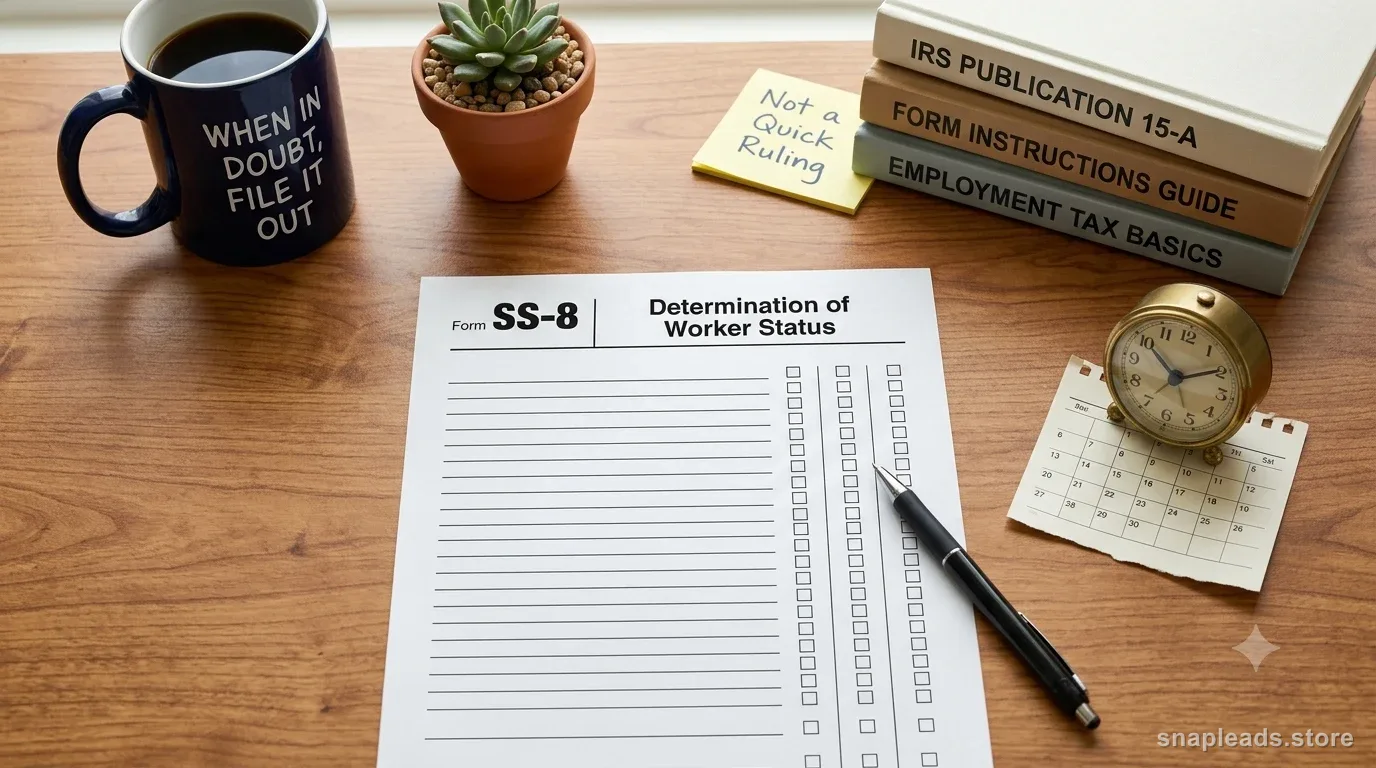
SS-8 is a determination process, not a contractor registration
Form SS-8 is titled “Determination of Worker Status for Purposes of Federal Employment Taxes and Income Tax Withholding.” Either a business or a worker can submit it when they want the IRS to analyze a particular work relationship. Filing the form does not make the worker an employee or an independent contractor on the filing date, and it does not replace the obligation to handle current tax reporting thoughtfully while the request is pending. It starts an administrative process in which the IRS gathers facts and applies federal tax law.
That makes SS-8 different from a checklist downloaded from a payroll site. The filer is asking the agency that administers the federal employment-tax rules to look at a real arrangement. The questions reach into instructions, training, expenses, equipment, benefits, agreements, how customers are obtained, and other facts. A business should expect to disclose the relationship rather than present only the facts that support the preferred label.
Consider filing after an internal review produces a real tie
The best time to discuss SS-8 is after the company has already organized the facts under the IRS common-law framework. If the evidence strongly supports one result, a business may be able to make and document its classification decision without asking for a determination. If important facts point in both directions and the role will continue or the dollars are meaningful, the value of an official answer increases.
Examples of genuine uncertainty include a specialist who owns a separate business but works inside a tightly controlled client process, or a long-running provider who has meaningful pricing risk but has become central to daily operations. The form is not intended to reward indecision; it is useful when the law must be applied to mixed facts and the parties want the IRS to resolve federal tax status.
Run the IRS acceptance screen before spending time on a filing
Current IRS instructions say to file SS-8 when, after reviewing the common-law rules, the filer still does not know whether a worker is an employee or independent contractor. The IRS also notes that a business that continually hires the same type of worker for particular services may want to consider the form. That is a more precise trigger than “we want extra paperwork for the file.”
The same IRS page lists situations in which it does not accept Form SS-8, including an incorrectly signed form, a submission without enough information or documents, a worker-business relationship already in litigation, certain supplemental-wage issues, closed tax periods, and business-to-business questions such as wholesaler-to-retailer status. Check those gates first so SS-8 is not used for a question the process is not designed to answer.
Do not wait until a deadline that assumes a quick response
IRS instructions warn that a determination can take at least six months. That is an important planning fact. A company should not discover on December 20 that it wants an answer before year-end information returns. Nor should a pending SS-8 be treated as permission to ignore payroll-tax decisions until the letter arrives.
Build a timeline before filing. Identify upcoming payroll quarters, W-2 or 1099 reporting dates, contract renewals, state filings, benefit decisions, and any worker dispute. Decide with the appropriate tax professional how the company will report during the pending period. SS-8 can clarify status, but the queue does not pause the rest of the calendar.
A worker dispute can make the record more important
A worker who believes they were treated incorrectly may also file Form SS-8. If the business knows a filing is likely, it should preserve contracts, invoices, schedules, manager instructions, expense records, and other contemporary evidence. Do not rewrite the relationship after the dispute appears. The IRS may contact the other party for information, so a one-sided narrative is unlikely to be the only record considered.
An employer-initiated filing can sometimes make sense before a conflict grows, but it should not be described as a tactic to prove “good faith” or guarantee relief. The form’s function is a federal status determination. Any separate relief provision has its own requirements.
SS-8 does not settle every worker-classification law
The form addresses federal employment taxes and income-tax withholding. It does not determine whether the worker is an employee under every federal or state statute. The Department of Labor’s FLSA analysis is separate, and state unemployment or wage-and-hour law can apply different tests. California’s ABC framework is a familiar example of a state standard that should not be replaced with an SS-8 conclusion.
Before filing, write the exact question the company expects the determination to answer: “federal employment-tax status for these services and this relationship.” That sentence prevents a later manager from treating the IRS letter as a universal classification license.
Filing is more useful when the facts are stable enough to evaluate
If the role is changing every month, the facts described on the form may become stale before the IRS finishes its review. A business that is about to redesign the relationship may prefer to first decide what future operating model it wants. By contrast, an ongoing stable arrangement can present a clearer factual record for determination.
This does not mean changes should be delayed to preserve a filing. If the business identifies a real compliance concern, it can correct operations and document the effective date. The point is simply to tell the IRS which period and relationship the filing describes rather than blending several versions of the role together.
Know what a formal answer can trigger operationally
Before sending SS-8, management should know who will own the response. If the determination says employee, payroll, tax reporting, benefits analysis, manager practices, and state issues may all require review. If the determination says independent contractor for federal tax purposes, the company still needs to check other laws and keep the relationship from drifting.
Assign a responsible person, preserve the submission and attachments, and calendar a follow-up interval. The worst SS-8 process is one owned by nobody, where the determination letter arrives months later and sits in a shared mailbox.
A decision tree keeps SS-8 from becoming a reflex
Ask four questions: Is the federal tax classification genuinely uncertain? Are the facts sufficiently documented and stable to present? Is an IRS determination valuable enough to justify a months-long process? Is the business prepared to act on the answer? A “no” at any step does not automatically mean “do not file,” but it identifies what must be resolved first.
For close or high-stakes situations, involve a qualified tax or legal adviser rather than using a web guide as the final decision maker. The value of SS-8 comes from a fact-specific agency determination, not from treating the form itself as a compliance badge.
WORKED EXAMPLE
Example: a clinic uses the same therapist two different ways
A small clinic engages a therapist who also has a private practice. For some patients the therapist schedules independently, bills a negotiated session rate, and uses personal clinical methods. For another program the clinic sets shifts, supplies a detailed protocol, assigns patients, and requires staff meetings. Management initially wants one 1099 answer for all services.
Before filing SS-8, the clinic separates the arrangements and documents which services and period are at issue. That makes the request more useful and avoids asking the IRS to analyze a blurred description that combines materially different facts.