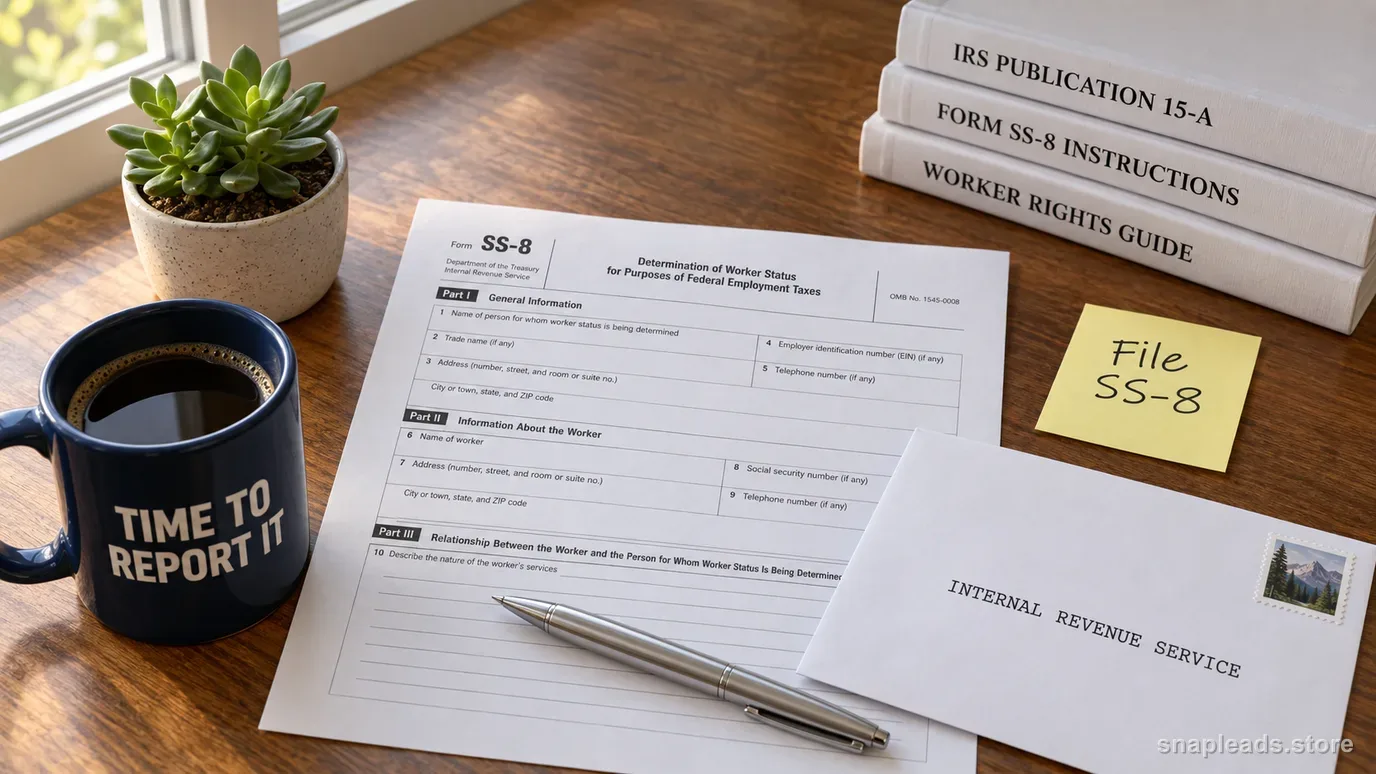
Misclassified as a 1099: how do you report it to the IRS?
A worker who believes pay reported as nonemployee compensation was actually employee wages has two federal forms that are often confused. Form SS-8 asks the IRS to determine whether the worker was an employee or independent contractor for federal employment-tax and income-tax-withholding purposes. Form 8919 is a tax-return form used to figure and report the worker's share of uncollected Social Security and Medicare taxes when the worker believes the compensation was wages and one of the form's listed reason codes applies.
Filing one form does not mean the other is automatically required in every case. The correct sequence depends on whether the IRS or another authority has already determined status, whether the employer has already filed an SS-8, and which Form 8919 reason code fits. The worker should preserve the Form 1099, contract, invoices, schedules, emails showing instructions, payment records, and any documents showing how the work was actually controlled. This is worker education, not legal or tax advice.
Form SS-8 is the status-determination request
Form SS-8 collects facts about the relationship between the firm and the worker. The IRS asks about instructions, training, work assignments, who determines methods, equipment and expenses, opportunity for profit or loss, benefits, termination rights, and other relationship facts. Either the worker or the firm may file. The form is not a complaint scorecard, and attaching more pages does not improve the case unless the documents clarify the actual working relationship.
A strong SS-8 submission is chronological and specific. Instead of writing “the company controlled everything,” describe who set the weekly schedule, whether the worker could reject assignments, who chose the tools or software, who set the customer price, whether the worker could serve competing clients, and what happened when work had to be redone. Attach representative documents, not an unindexed dump. Keep a complete copy of what was sent.
Form 8919 is about the worker's Social Security and Medicare tax
Form 8919 is attached to the worker's federal income-tax return when its filing conditions are met. The IRS describes the form as the way to figure and report the worker's share of uncollected Social Security and Medicare taxes on compensation when the worker was treated as an independent contractor but believes the pay was wages. It is not a substitute Schedule C and it is not the form used to report unreported tip income; Form 4137 serves a different purpose.
The current form lists specific reason codes rather than a continuous A-through-H set. The 2025 Form 8919 uses codes A, C, G, and H. Code G is the route for a worker who believes employee treatment applies but does not fit another listed determination code; the form directs that worker to file Form SS-8 on or before the date the tax return is filed. That detail is important because many secondary articles still describe older or incorrect code lists.
When SS-8 and 8919 are used together
A worker may need both forms because the forms answer different questions. One common pattern is a worker who has no prior IRS status determination, receives nonemployee compensation, believes the firm actually had the right to control the work as an employee relationship, and uses reason code G on Form 8919. In that situation, the current form instructs the worker to file Form SS-8 on or before filing the tax return. The worker should make sure the factual story on both filings matches.
Do not copy a legal conclusion from Form 8919 into SS-8 without the underlying facts. The IRS can evaluate status independently. Likewise, a pending SS-8 determination can take time, so the worker should review the current Form 8919 instructions for the return year rather than assuming the tax return must wait for a final SS-8 letter. If an employer has already filed SS-8, the reason-code analysis may be different.
What evidence makes the report usable
Build a short evidence index with four groups: control, financial facts, relationship terms, and tax records. Under control, include examples of required hours, approval processes, training, scripts, routing, or detailed work methods. Under financial facts, include unreimbursed expenses, equipment ownership, pricing authority, invoices, and evidence of other clients. Under relationship, include contracts, benefit eligibility, duration, renewal practice, and termination terms. Under tax records, include Forms 1099, any W-2 from the same firm, and payment statements.
Evidence cuts both ways. A worker should not omit facts showing independence, such as genuine ability to set price or serve multiple clients. Form SS-8 is intended to determine status, not to reward one-sided advocacy. A complete record also reduces the risk that the firm and worker describe the same event in incompatible ways.
What reporting to the IRS does not automatically do
An SS-8 determination is a federal employment-tax determination. It does not automatically decide every wage-and-hour, unemployment, workers' compensation, or state tax question because those systems can use different definitions. A worker who is also pursuing unemployment benefits or a wage claim should follow the separate agency procedure and deadlines that apply there. Keep copies of all agency submissions so factual descriptions remain consistent.
The worker should also distinguish a tax correction from a retaliation or wage dispute. Form 8919 computes tax; it is not a demand letter for unpaid overtime. Form SS-8 determines federal tax status; it is not an all-purpose labor complaint. Treating each process separately makes the filing clearer and helps the worker identify what additional remedy, if any, requires another agency.
Filing path
SS-8 and Form 8919 decision path
Use the current tax-year forms. Form SS-8 determines federal tax status; Form 8919 reports employee-side FICA when a listed reason code fits.
| Situation | Form action | Record to keep |
|---|---|---|
| No prior IRS determination; worker believes employee treatment applies | Review Form 8919 code G and file Form SS-8 on or before the return date when code G applies | Signed SS-8, delivery proof, 1099, work-control evidence |
| IRS already issued an SS-8 employee determination | Review Form 8919 code A | Determination letter and compensation reconciliation |
| Other written IRS correspondence says employee | Review Form 8919 code C | IRS correspondence and payment records |
| Same firm issued W-2 and 1099 for the same services | Review Form 8919 code H | Both tax forms plus a same-services comparison |
| None of the current reason codes appears to fit | Do not invent a code; review current instructions and the underlying classification facts | Full evidence index and tax-return workpapers |
WORKED EXAMPLE
Worked example: marketing coordinator paid on Form 1099-NEC
Jordan received $48,000 on Form 1099-NEC for 2025. The company required Jordan to work in its project system from 9 a.m. to 5 p.m., assigned client accounts, required manager approval for time off, and prohibited Jordan from setting client prices. Jordan did not have a prior status letter from the IRS.
Jordan organizes the contract, the Form 1099-NEC, representative scheduling messages, the client-assignment policy, and payment records. Before filing the 2025 return, Jordan checks the current Form 8919 reason codes and sees that code G requires Form SS-8 to be filed on or before the return date. Jordan files the forms consistently and keeps a complete evidence index rather than treating Form 8919 itself as the classification determination.
COMMON QUESTIONS
Frequently asked
- How do I tell the IRS my employer misclassified me?
- Form SS-8 is the IRS form used to request a federal worker-status determination. If you are also using Form 8919, follow the reason-code instructions for the tax year.
- Do I need to file Form SS-8 before Form 8919?
- It depends on the Form 8919 reason code. For current code G, the form instructs you to file Form SS-8 on or before the date you file the tax return.
- Can the employer also file Form SS-8?
- Yes. Either a firm or worker may request an IRS determination. When both sides can file Form SS-8
- What should I attach to Form SS-8?
- Attach representative records that explain the real working relationship, such as contracts, schedules, instructions, invoices, and evidence about tools, pricing, and other clients. Documents to attach to Form SS-8
 When Should a Small Business File Form SS-8?
 Form SS-8 vs. Form 8919: What Is the Difference?
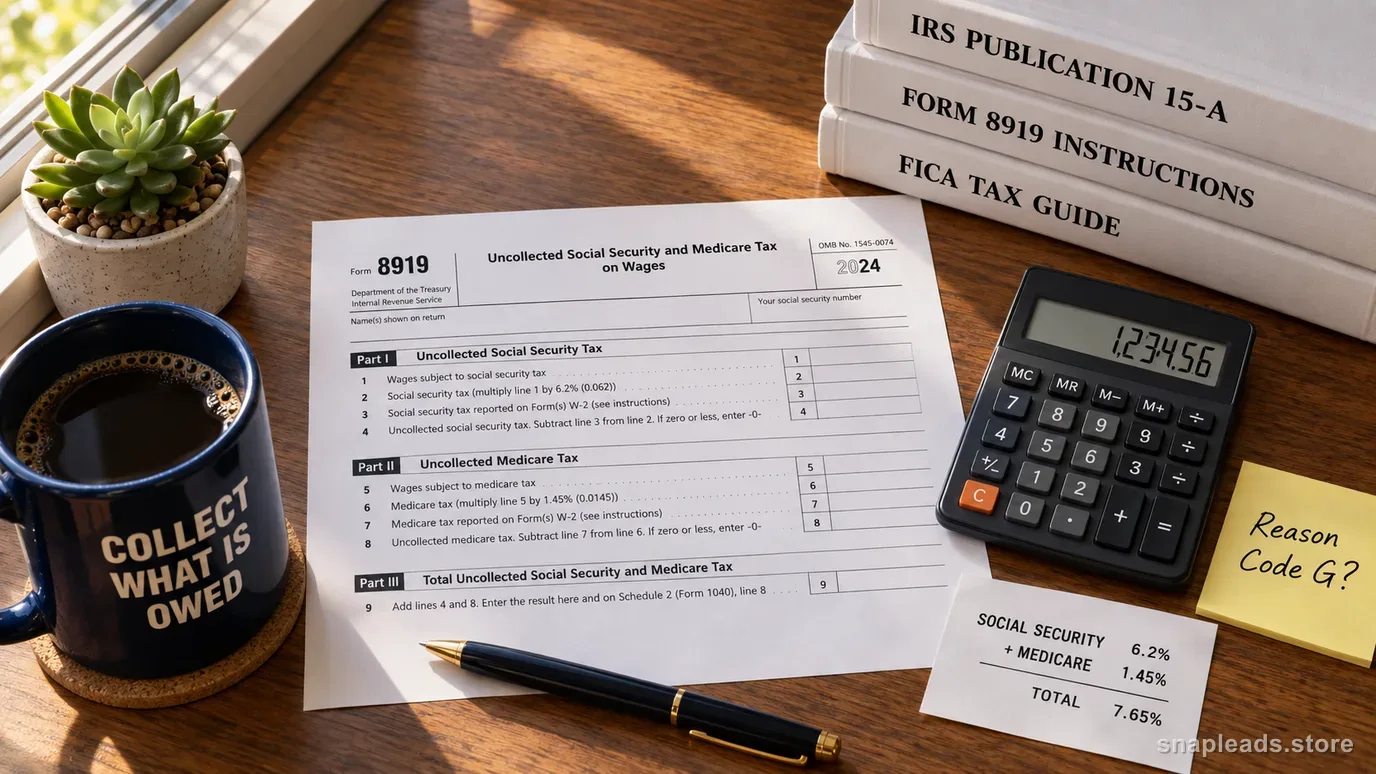 Form 8919: Uncollected Social Security and Medicare Tax
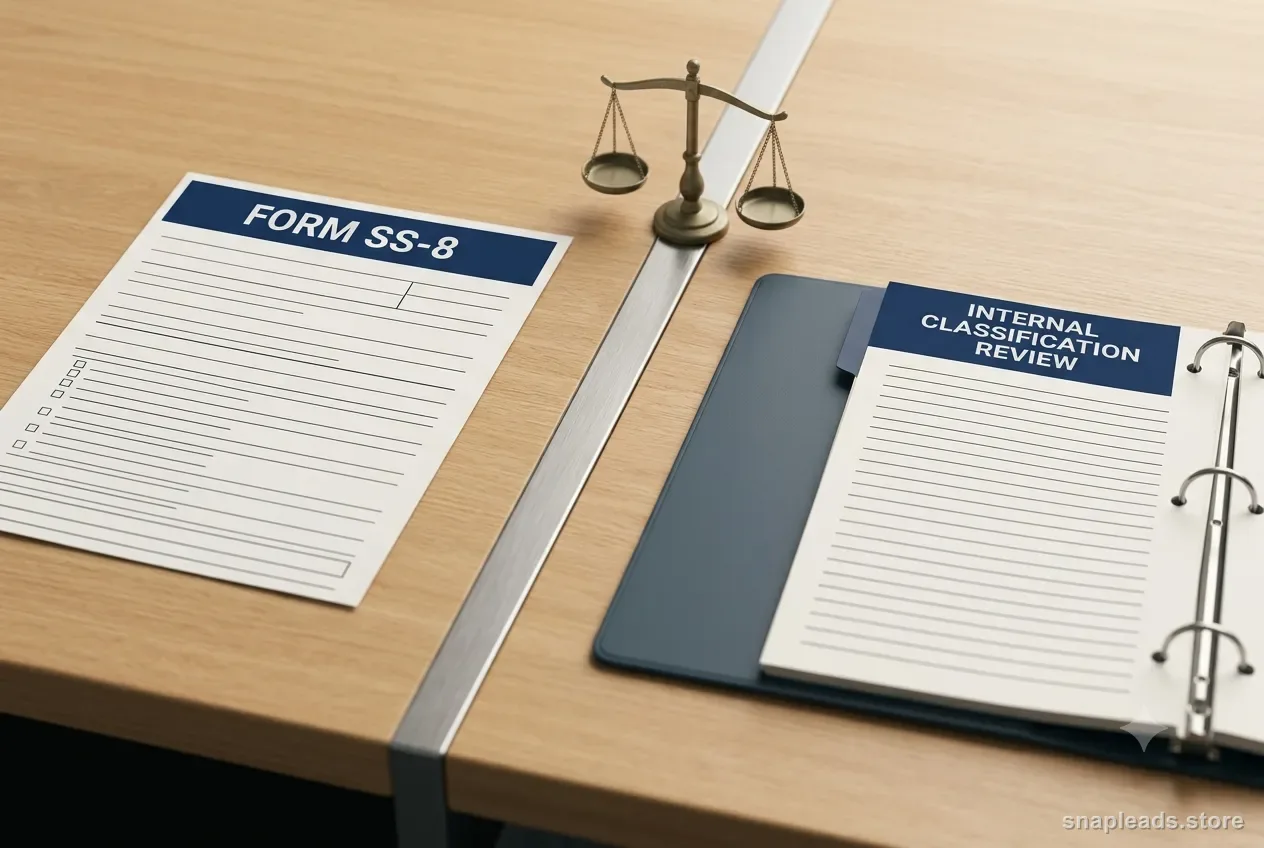 Form SS-8 vs. an Internal Worker-Classification Review: Which One Does What?
 How Long Does an SS-8 Worker-Status Determination Take?
 Is a Remote Software Developer a Contractor or Employee?