Begin with the relationship, not the tax form
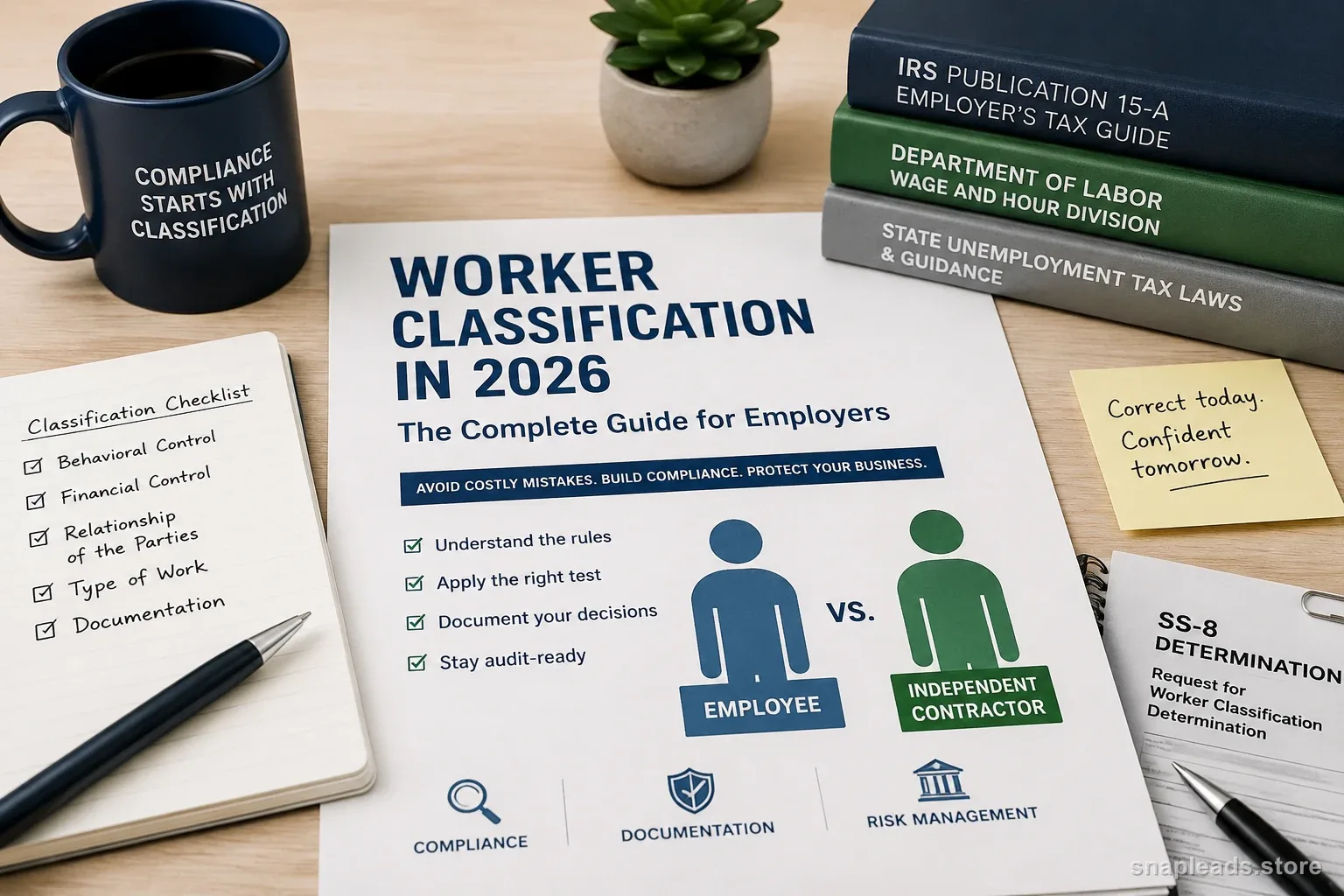
A Form 1099-NEC is a reporting result, not a classification test. The IRS starts with the business relationship between the payer and the person doing the work. Publication 15-A explains that a common-law employee generally exists when the business has the right to control what will be done and how it will be done. That right can matter even when a manager rarely exercises it. For a small business, this means the safest review begins before payroll paperwork: write down how the work is assigned, what freedom the worker has in carrying it out, and what business risks the worker actually bears.
Publication 15-A groups the relevant evidence into three categories: behavioral control, financial control, and the type of relationship. Those categories organize the inquiry; they do not create an official score. IRS guidance also says there is no “magic” or set number of factors that makes a worker an employee or independent contractor. A fact that carries weight in one occupation may matter much less in another. The useful question is what the whole relationship shows about the business’s right to direct and control the work and the worker’s actual independence.
Behavioral control asks who owns the method
Behavioral control is broader than whether someone has a supervisor standing over them. IRS guidance looks at instructions about when and where to work, tools or equipment, the sequence of tasks, assistants, and training. A skilled specialist may need little day-to-day instruction, yet the business can still retain a meaningful right to control the details. Conversely, a client can describe the desired deliverable, deadline, security standards, or legal constraints without automatically turning an outside business into an employee. The distinction depends on the degree and character of control, not the mere existence of expectations.
When reviewing a real role, separate outcome requirements from process requirements. “Deliver the final design by Friday in these file formats” describes a result. “Be online from 9 to 5, use our exact workflow, attend a daily production huddle, request permission before changing the sequence, and work only through the equipment we issue” describes much more of the method. Save the contract, but also inspect calendars, chat instructions, onboarding materials, approval rules, and manager practices because actual operations may tell a different story.
Financial control looks for a business that can win or lose
The financial-control category focuses on the business side of the work. The IRS points to unreimbursed expenses, investment in facilities or tools, availability to the market, method of payment, and the opportunity for profit or loss. None of these is a standalone safe harbor. An outside consultant can be paid hourly in some professions, while an employee might purchase small tools or incur expenses. What matters is whether the worker has meaningful economic independence rather than a cosmetic business label.
A useful file review asks practical questions. Does the worker quote projects, negotiate rates, advertise to other customers, maintain business insurance, buy substantial equipment, decide whether to hire help, and risk losing money if a job is underpriced? Or does the worker receive a preset recurring amount, use the company’s systems and equipment, have expenses covered, and depend on the company for a continuing stream of assignments? The first set can support independent-business status; the second can point toward employee status when combined with the rest of the relationship.
The relationship category catches arrangements that drift over time
Contracts matter as evidence of intent, but the IRS specifically warns that a contract calling someone an independent contractor is not enough. The relationship category also considers employee-type benefits, permanence, and whether the services are a key aspect of the regular business. A six-week specialist hired for a defined migration project presents a different factual pattern from someone who has worked indefinitely inside the same department, performs the same core service the business sells, and is treated operationally like the rest of the team.
This is why classification should not be treated as a one-time onboarding checkbox. An engagement that began as an independent project can gradually become a permanent operating role. A founder may add standing hours, recurring responsibilities, mandatory internal meetings, new approval layers, and exclusivity without revisiting the classification. Quarterly or annual reviews are useful precisely because the legal analysis follows the real relationship, not only the paper signed on day one.
Do not mix the IRS test with a state or FLSA test
Federal employment-tax classification is only one layer. The Department of Labor uses an economic-reality analysis for the Fair Labor Standards Act, and states can apply their own standards. California, for example, generally starts with an ABC test for many purposes, while Texas unemployment law applies its own direction-and-control analysis and published factors. A worker can therefore require a second classification review even after the federal tax file looks organized.
This distinction is especially important in 2026 because the U.S. Department of Labor has an active proposed rulemaking concerning independent-contractor status under the FLSA, FMLA, and MSPA. The proposal is not an IRS rule and does not replace the IRS common-law categories. A compliance file should label the legal purpose of each analysis—federal employment tax, federal wage-and-hour, state unemployment, or another state law—so a checklist built for one system is not silently used as the answer for all of them.
Build a fact memo that a later reviewer can understand
For each contractor role, create a short memo describing the actual workflow: who finds the customers, who prices the work, who supplies major tools, who controls schedule and sequence, whether the worker can serve competitors, how long the engagement is expected to last, how termination works, and whether the role is central to what the company sells. Attach representative documents instead of dumping every email into a folder. The purpose is to preserve the facts that explain the classification decision.
A strong memo also records uncertainty. If several facts point in opposite directions, say so. Avoid rewriting old contracts or creating backdated policies to make the file look cleaner. If the answer remains genuinely unclear, Form SS-8 is the IRS process for requesting a federal worker-status determination. That route can take time, so it is a decision to plan for rather than a last-minute substitute for payroll setup.
A repeatable review sequence for small businesses
First, identify the exact services and the period being reviewed. Second, interview the person who actually manages the work rather than relying only on HR or accounts payable. Third, sort the facts into behavioral control, financial control, and relationship. Fourth, note state or wage-and-hour standards that require a separate analysis. Fifth, decide whether the facts are clear enough for an internal classification decision or whether professional advice or an SS-8 filing is appropriate. Finally, schedule a future review if the engagement is continuing.
That sequence is intentionally slower than asking whether the worker has an LLC or sends invoices. Those facts may be useful, but they can distract from the operating reality. A classification file is most defensible when another person can read it months later and see what facts were considered, which official framework was used, and why the company chose the treatment it did.
What this test can and cannot tell you
The three IRS categories help organize a federal employment-tax classification decision. They do not provide a guarantee against an audit, decide state-law status, or turn a disputed factual record into a certain answer. They also do not authorize a company to choose contractor status simply because both sides prefer it. The IRS states that the substance of the relationship governs when an employer-employee relationship exists.
For a business that discovers substantial employee-like control, the next step is not to manufacture contractor-looking paperwork. It is to assess whether the current treatment should change, whether prior periods need review, and whether a federal relief or correction process is relevant. That is a different task from the initial three-part test, and keeping those tasks separate makes the compliance record much easier to reason about.
REFERENCE TABLE
What each IRS category actually asks
The three categories organize the evidence; they are not a scorecard. Use this to sort facts before reaching a conclusion.
| Category | Core question | Example evidence | Common misread |
|---|---|---|---|
| Behavioral control | Does the business keep the right to direct how the work is done? | Instructions, training, required tools, set hours, approval gates | Assuming 'no daily supervision' ends the inquiry |
| Financial control | Can the worker make or lose money as a business? | Unreimbursed costs, own equipment, market advertising, fixed vs. project pay | Treating an LLC or invoices as decisive |
| Type of relationship | Is the arrangement built to last and central to the business? | Benefits, indefinite term, services the company sells, written intent | Reading a 'contractor' clause as the answer |
WORKED EXAMPLE
Example: a boutique marketing shop adds a “freelancer” to client delivery
The agency hires a copywriter under a contractor agreement. At first, the writer chooses assignments, serves other clients, works on personal equipment, and quotes a project price. Six months later the agency requires fixed weekday availability, assigns every client, provides a company laptop, requires daily standups, prohibits competing work, and pays the same amount every two weeks. The contract did not change, but the operating facts did.
An internal review should capture both phases instead of assuming the original agreement answers the entire year. Behavioral control and permanence became stronger; market independence weakened. That does not let a checklist declare the legal result by itself, but it identifies why the business should re-run the classification analysis rather than renewing the same paperwork automatically.
COMMON QUESTIONS
Frequently asked
- Does the IRS use a points system for the three categories?
- No. IRS Publication 15-A groups evidence into behavioral control, financial control, and the type of relationship, but it says there is no set number of factors that decides status. Weigh the whole relationship; a factor that matters in one occupation can be minor in another.
- Is a signed 1099 or contractor agreement enough to make someone a contractor?
- No. A Form 1099-NEC is a reporting result, and the IRS says a contract calling someone an independent contractor is not controlling. The substance of the working relationship governs, so the file has to show the facts that actually exist.
- Does passing the IRS test also settle state and wage-and-hour status?
- No. Federal employment-tax classification is one layer. The U.S. Department of Labor applies an economic-reality test under the FLSA and had an active independent-contractor rulemaking in 2026, and states use their own standards. Label each analysis by its legal purpose. See the state unemployment audit guide.
- What if the facts point in both directions?
- Document the conflict rather than forcing a score. If federal status stays genuinely uncertain and the answer matters, Form SS-8 is the IRS process for a determination, though it can take at least six months. When to file Form SS-8.