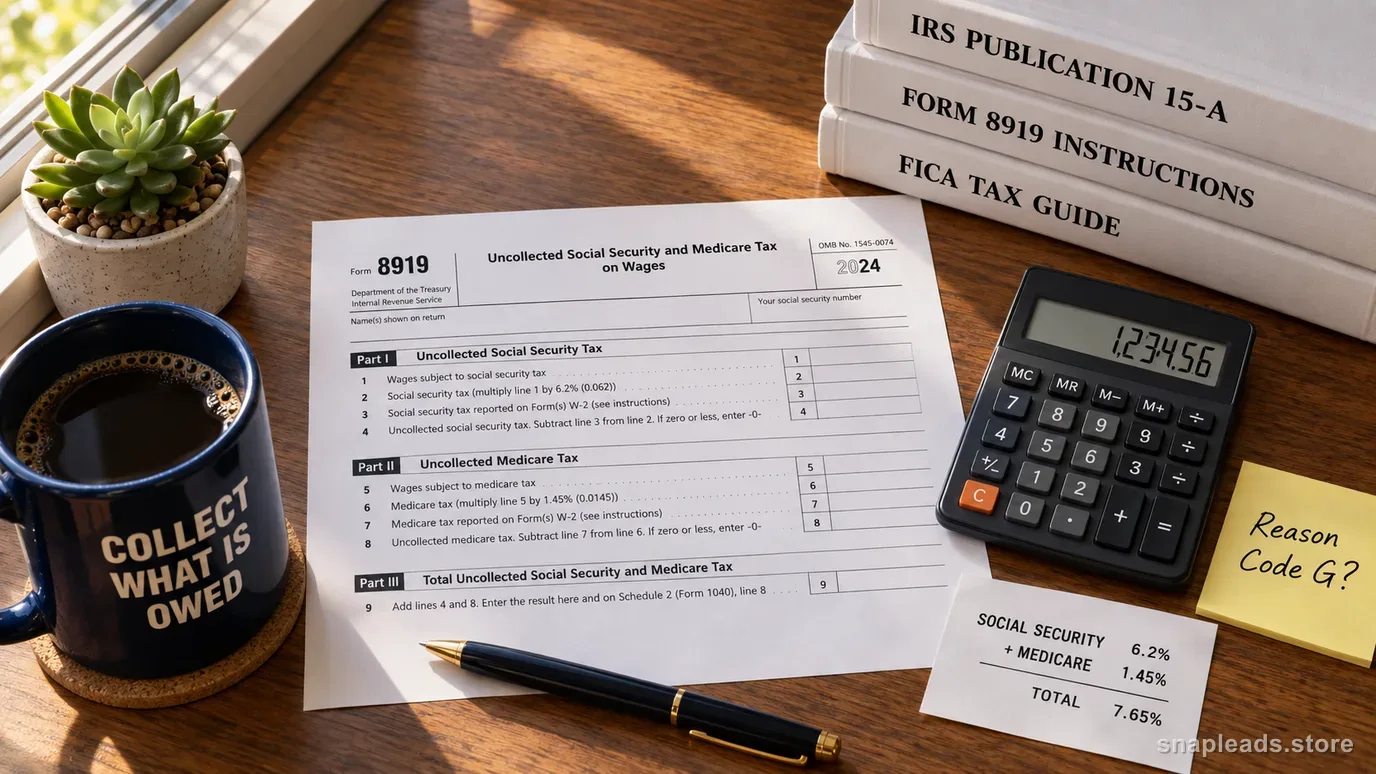
What Form 8919 does
Form 8919, Uncollected Social Security and Medicare Tax on Wages, is a federal tax form for a worker who performed services for a firm, believes the compensation was not properly treated as independent-contractor pay, had no employee Social Security and Medicare tax withheld from that pay, and fits a listed reason code. The form calculates the worker's share of those taxes and carries the result into the worker's federal income-tax return under the current form instructions.
The form does not by itself turn every 1099 payment into wages. Worker status still depends on the applicable federal tax rules and the reason code used. A person who is genuinely self-employed normally reports business income and self-employment tax through the appropriate self-employment schedules rather than using Form 8919 simply to reduce tax. This is tax education, not individualized tax advice.
The current reason codes are A, C, G, and H
One of the most common errors in secondary explanations is to say Form 8919 has seven or eight reason codes running from A through H. The current 2025 form lists four codes: A, C, G, and H. Code A covers a worker who filed Form SS-8 and received an IRS determination that the worker is an employee. Code C covers a worker who received other written IRS correspondence stating the worker is an employee.
Code G applies when the worker believes employee treatment is correct but does not have one of those prior determinations; the form instructs a code-G filer to file Form SS-8 on or before the date the tax return is filed. Code H applies when the worker received Form W-2 and Form 1099-MISC and/or 1099-NEC from the same firm for the same services and the worker's total compensation from the firm was reported across those forms. Always check the form for the return year because codes and instructions can change.
How Form 8919 differs from Schedule C
Schedule C reports income or loss from a trade or business operated as a sole proprietor. A worker filing Form 8919 is asserting that specified compensation should be treated as wages for Social Security and Medicare tax purposes under the reason-code framework, not as net earnings from self-employment. That distinction affects both tax computation and how business expenses are treated, so a worker should not mechanically report the same compensation in both places without understanding the instructions.
The key classification question is not whether the worker has an LLC, receives a Form 1099, or signed a contractor agreement. IRS guidance focuses on the actual relationship, including the right to control the work, financial independence, and the parties' relationship. Form 8919 is the tax reporting consequence of the worker's position; it is not the factual test itself.
How Form 8919 differs from Form 4137
Form 4137 is used for Social Security and Medicare tax on unreported tip income. Form 8919 addresses uncollected Social Security and Medicare tax on wages where a worker was treated as a nonemployee but believes employee treatment applies and a listed reason code fits. Both forms can involve employee-side Social Security and Medicare tax, which is why search results and software screens sometimes confuse them.
Use the form that matches the type of income and the IRS instructions. A restaurant worker with unreported cash tips has a different reporting issue from a project coordinator who received Form 1099-NEC for services performed under an alleged employment relationship. The underlying evidence, tax forms, and reason for missing withholding are different.
What to reconcile before filing
Create a firm-by-firm worksheet showing the payer name and EIN, Forms W-2 and 1099 received, total compensation, amount already treated as wages, reason code, SS-8 status, and supporting correspondence. Reconcile that worksheet to bank deposits and year-end forms before transferring amounts to Form 8919. If multiple firms are involved, analyze each relationship separately; one payer's employee relationship does not determine another payer's status.
If code H may apply, confirm that the W-2 and 1099 forms are from the same firm and relate to the same services, because a legitimate second role can raise a different analysis. If code G applies, calendar the SS-8 filing requirement. Keep copies of the signed SS-8, delivery evidence, Form 8919, and the tax return together so the record shows the filing sequence.
What happens after Form 8919 is filed
The tax return reports the worker's calculation; an SS-8 request, when filed, follows its own determination process. The worker should not assume that filing Form 8919 forces the employer immediately to issue a W-2 or resolves state unemployment or wage claims. Different procedures may continue on different timelines. Keep IRS correspondence and update the file if the Service later issues a status determination.
If the worker later receives a determination that changes the tax position, the appropriate correction depends on the return year and what was originally filed. Avoid filing duplicate self-employment tax and employee FICA positions for the same compensation without reconciling the forms. When the amounts are material or multiple years are involved, the filing sequence deserves careful professional review.
For taxpayers who must calculate Additional Medicare Tax, current IRS Form 8959 instructions direct filers to include wages from line 6 of Form 8919 in the Medicare-wage computation. That is another reason to reconcile Form 8919 carefully rather than treating it as an isolated attachment: its wage amount can feed another tax calculation on the return.
Reason-code map
Current Form 8919 reason codes at a glance
For the 2025 Form 8919, the listed reason codes are A, C, G, and H. Always check the form for the return year you are filing.
| Code | When it fits | SS-8 status / next check |
|---|---|---|
| A | Worker filed Form SS-8 and IRS determined the worker is an employee | Keep the determination letter and reconcile the compensation |
| C | Worker received other written IRS correspondence stating employee status | Keep the IRS correspondence supporting the code |
| G | Worker believes employee treatment applies but no other listed code fits | Current form directs the worker to file SS-8 on or before filing the return |
| H | Same firm issued W-2 and 1099-MISC/NEC for the same services | Compare the services carefully; dual forms alone do not prove the services were the same |
WORKED EXAMPLE
Worked example: W-2 and 1099-NEC from the same firm
A worker receives a $32,000 W-2 and a $14,000 Form 1099-NEC from the same company. The company says the 1099 amount covered “special projects,” but the worker says those projects were the same account-management services performed during normal employment. Before choosing reason code H, the worker compares the services, pay periods, and role descriptions rather than relying only on the fact that both forms came from the same EIN.
The worker prepares a reconciliation showing which payments belong to the allegedly same services and retains the employment agreement, project assignments, W-2, 1099-NEC, and payroll statements. If the 1099 work was genuinely a separate business engagement, code H may not fit; the form cannot substitute for the factual analysis.
COMMON QUESTIONS
Frequently asked
- What are the Form 8919 reason codes?
- The current 2025 Form 8919 lists A, C, G, and H. Check the form for your specific tax year before filing because instructions can change.
- Do I need Form SS-8 if I use reason code G?
- Yes. The current form directs a code-G filer to file Form SS-8 on or before the date the tax return is filed. When to file Form SS-8
- Is Form 8919 the same as Schedule C?
- No. Schedule C reports a sole proprietor's trade or business; Form 8919 reports employee-side Social Security and Medicare tax on compensation the filer believes was wages under a listed reason code.
- Is Form 8919 for unreported tips?
- No. Form 4137 is the form for Social Security and Medicare tax on unreported tip income.
- What if I received both a W-2 and a 1099 from the same company?
- Compare the services reported on each form. If the forms cover the same services, current Form 8919 reason code H may be relevant; genuinely separate roles require a separate classification analysis. Review W-2 and 1099 dual-status rules
 When Should a Small Business File Form SS-8?
 Form SS-8 vs. Form 8919: What Is the Difference?
 Misclassified as 1099? How to Report It to the IRS
 Statutory Employee Examples: The Four IRS Categories
 What Happens If You Misclassify an Employee as 1099?
 Construction Subcontractor vs. Employee: 1099 or W-2?