Start with entity tax classification before asking W-2 or 1099
The familiar worker-classification question—employee or independent contractor—assumes the service provider is not already a partner in the payer partnership. IRS guidance says partners in a partnership, including members of an LLC or other entity treated as a partnership for federal tax purposes, are considered self-employed rather than employees when performing services for the partnership.
So the first workpaper should identify the entity’s federal tax classification and the individual’s ownership status. Is the LLC disregarded, taxed as a partnership, or taxed as a corporation? Is the individual a bona fide partner or member? A payroll team that skips those threshold facts can apply a correct W-2 procedure to the wrong legal relationship.
A bona fide partner is not converted into an employee by putting the person on payroll
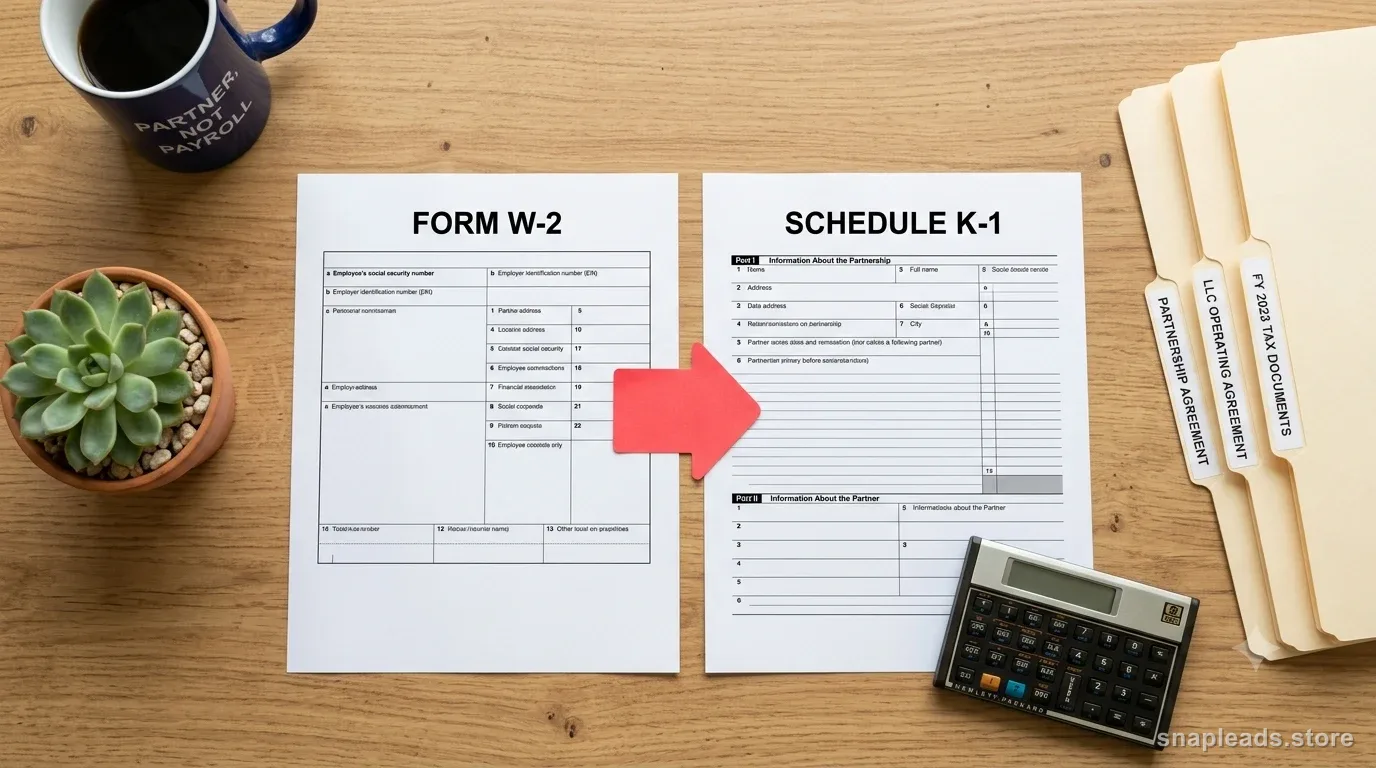
IRS materials state that partners are not employees and should not receive Form W-2 in place of the partnership reporting used for distributions or guaranteed payments. The employment-tax principle reflected in Revenue Ruling 69-184 is that a bona fide partner who devotes time and energy to the partnership’s trade or business is self-employed rather than an employee of the partnership.
This is different from a worker who owns no partnership interest but is called a “partner” as a title. Do not use the rule as a way to take ordinary employees off payroll. Verify real partner status under the governing documents, tax returns, capital or profit interests, and the entity’s actual structure.
LLC status by itself does not answer the question
An LLC is a state-law entity form, not a single federal tax classification. A multi-member LLC can be taxed as a partnership unless it elects another classification; an LLC can also elect corporate tax treatment. That is why “the worker is an LLC member” is incomplete. The federal employment-tax result depends on how the entity is classified and the person’s status in that entity.
Keep the federal classification election or tax-return evidence with the ownership file. If the entity elected corporate treatment, the corporate-officer and employee rules may become relevant instead of partnership self-employment rules. If it is partnership-taxed, partner compensation should be reviewed under partnership provisions rather than routed automatically to payroll.
A disregarded LLC owned by a partnership does not create a payroll workaround for partners
IRS Publication 3402 explains that a partner in a partnership that owns a single-member LLC treated as a disregarded entity is not an employee of that LLC. The partner remains subject to the rules that apply to a partner of the partnership. By contrast, the disregarded LLC can have ordinary employees and is treated separately for employment-tax reporting on wages paid to those employees.
This distinction matters in operating groups that use subsidiary LLCs. Payroll systems may see the disregarded LLC as the payor and assume anyone working there can be W-2 staff of that LLC. The ownership/tax-entity map should identify when the service provider is actually a partner of the owner partnership.
Compensation can take different partnership forms; do not invent a W-2 because the work is regular
IRS materials discuss partner compensation through partnership concepts such as distributive shares and guaranteed payments, and under some circumstances payments for services rendered other than in the capacity as a partner. The correct characterization depends on partnership tax rules and facts beyond ordinary worker classification.
For compliance operations, the key control is routing. When the service provider is a bona fide partner, send compensation design to the partnership-tax workflow rather than an employee/contractor checklist. The business may need tax advice on guaranteed payments, self-employment tax, withholding, benefits, and reporting; a worker-status scorecard is not the right tool.
Do not confuse a partner title with bona fide partner status
Some professional firms use “partner” as a seniority or marketing title. Others grant real equity, profit interests, governance rights, or capital interests. The employment-tax rule applies to bona fide partners, not to a title standing alone. A classification file should document the legal and economic interest rather than relying on an email signature.
Useful records include the partnership agreement, admission documents, capital accounts, Schedule K-1 history where applicable, voting or governance rights, and tax-return treatment. If the person has no real partnership interest, return to the ordinary worker-classification or employee rules instead of using partner self-employment treatment as a shortcut.
Ownership changes need a payroll trigger because status can change on a specific date
An employee can later be admitted as a partner, or a partner can redeem the interest and remain as an employee or contractor. Those are status changes that should create separate reporting periods. Payroll and partnership accounting should share the effective date so compensation is not reported under one model for the entire year by habit.
Build an ownership-change notice into legal/entity administration: admission date, redemption date, tax classification, payroll stop or start instruction, and who approved the treatment. Preserve the old payroll records rather than rewriting history.
The trigger should identify the tax-effective date, not merely the date someone updates an HR title. An admission as a partner, redemption of an interest, entity-tax election, or restructuring can change which federal compensation regime applies. Payroll and the tax-return preparer need the same dated ownership and entity-classification record so that one system does not keep issuing wages after the underlying status has changed.
PARTNER STATUS ROUTER
Before W-2 vs 1099, identify the entity and ownership relationship
This is a routing tool, not a partnership-tax calculator.
| Question | If yes | If no | Evidence |
|---|---|---|---|
| Is payer taxed as partnership? | Continue partner-status review | Route to applicable entity rules | Return/election records |
| Is service provider a bona fide partner/member? | Do not default to W-2 employee | Use ordinary worker/employee analysis | Agreement, K-1, ownership records |
| Is there a disregarded LLC below partnership? | Partner still follows partnership rule | N/A | Entity chart, Pub. 3402 analysis |
| Did ownership status change midyear? | Create separate reporting periods | Maintain current treatment | Admission/redemption date |
WORKED EXAMPLE
Example: a partnership-taxed LLC promotes an employee to a real member on July 1
A consulting LLC taxed as a partnership pays a senior consultant through W-2 payroll from January through June. On July 1, the consultant is admitted as a bona fide member with a profit interest and begins receiving a Schedule K-1 under the operating agreement. Payroll is not told, so wages continue through December.
The year-end review does not ask whether the person still works full time or follows company procedures; those facts do not override bona fide partner status for the partnership relationship. The company identifies the July 1 ownership change, preserves the two periods, and routes the second-half compensation to its partnership-tax advisers for correct treatment and any necessary corrections. The control failure was not a bad 20-factor test. It was the absence of an ownership-status trigger between legal, tax, and payroll.