What a CP2100 or CP2100A notice tells a payer
A CP2100 or CP2100A tells a payer that one or more name and taxpayer identification number (TIN) combinations reported on information returns do not match IRS records. The notice is tied to filed returns and payee accounts; it does not decide whether the worker was an employee or independent contractor. Keep the classification analysis separate from the name/TIN correction. A contractor can be properly classified and still have a mistyped TIN, while a perfect 1099 record does not prove contractor status.
The IRS says the two notices carry the same kind of information and instructions. CP2100 is generally issued when 50 or more information returns contain errors; CP2100A when fewer than 50 do. The IRS issues these notices twice a year, in October and the following April. If the business uses a payroll company, accountant, or filing service, first identify which payer account and transmitter are named. Do not assume the service provider has already handled every payee listed.
Secure the notice and identify the correct payer account
Route the notice to one owner in finance or tax, record the date received, and restrict access because the listing contains sensitive taxpayer data. Confirm the payer name, employer identification number, tax year, form type, account number, and any transmitter control code against the business’s filing records. If an outside transmitter filed the returns, ask it for the submission confirmation and a copy of the exact payee data sent. Preserve the notice itself; the IRS generally expects the payer to manage the correction rather than send a routine response asserting that the data was fixed.
Build a case row for every listed account: notice line, payee and account identifier, form and tax year, filed name/TIN, W-9 name/TIN, current vendor master, payments made, prior notices in the last three calendar years, and assigned reviewer. Keep the notice’s data in a restricted file rather than a shared spreadsheet. Record only the minimum necessary identifier in general workflow dashboards, and store the full notice in the tax folder with access controls.
Reconcile the IRS listing before contacting the payee
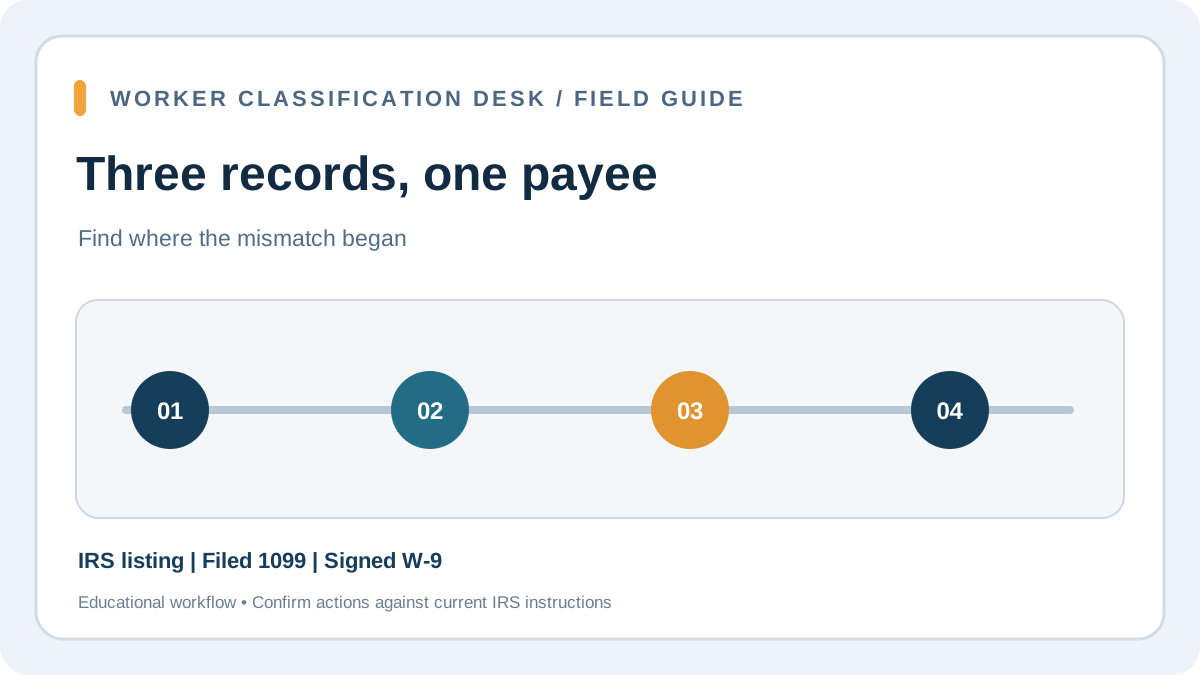
Compare the name/TIN combination shown on the IRS listing with three items: the information return as actually filed, the payer’s vendor master at filing time, and the payee’s signed Form W-9 or approved substitute. This triage determines whether the error arose in the original collection, vendor setup, data export, or transmission. Check for a missing digit, transposed digits, legal-name versus trade-name confusion, an outdated entity name, or a TIN copied into the wrong vendor record. Also inspect whether two vendor IDs split the same payee’s payments.
If the notice combination does not match the payer’s own filed and retained data, the IRS says the problem may reflect a recent update, a filing error, or an IRS processing issue. Correct the payer’s own records and future reporting as needed; the IRS says not to send a B Notice in that situation and not to contact the IRS merely to report that the record was corrected. If the notice and your records do match, move to the B Notice procedure. The match step prevents a business from sending an alarming tax letter to someone whose data the payer itself entered incorrectly.
Choose the first or second B Notice using the three-year history
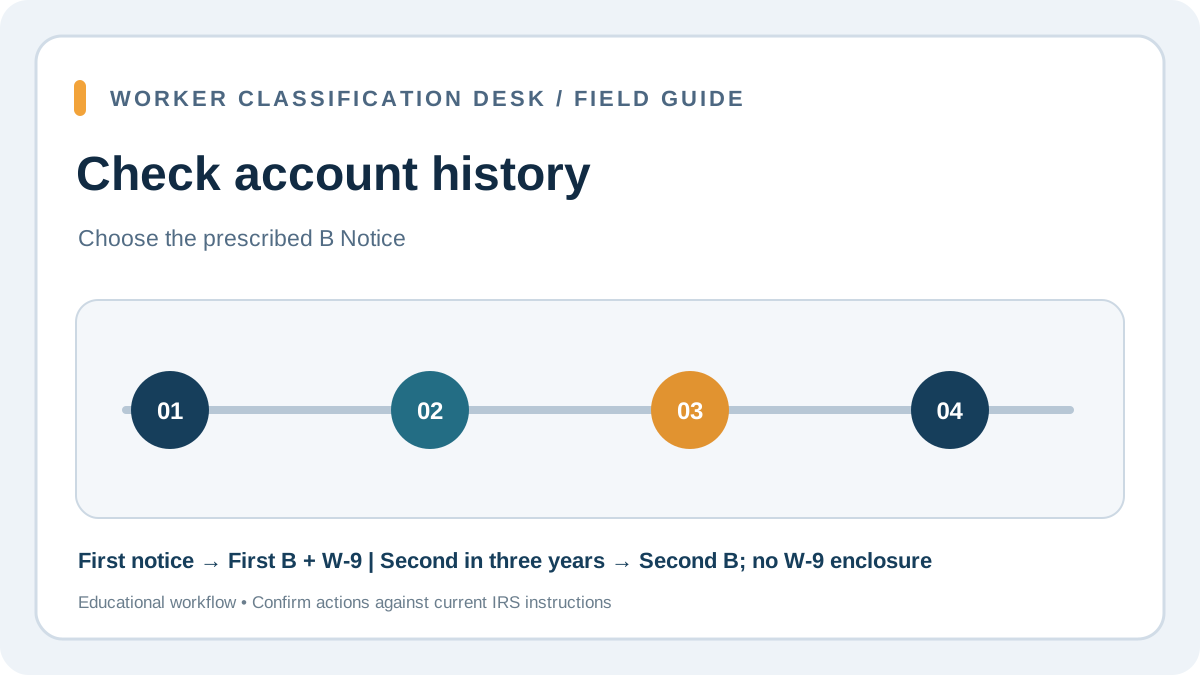
The notice does not tell you whether this is the first or second notification for the payee account. The payer is responsible for tracking the history. Search prior CP2100/CP2100A notices and B Notice records for that account over the applicable three-calendar-year period before choosing which letter to send. Do not count notices by worker name alone: a payee can have multiple accounts, and the IRS instructions tie the process to the account and notice history.
For a first notice, the IRS’s Publication 1281 calls for the First B Notice and a Form W-9 or acceptable substitute. For a second notice within the relevant three-year period, use the Second B Notice and do not include Form W-9; the payee is directed to obtain validation from the IRS or Social Security Administration, as applicable. The second-notice path requires the payer to receive the stated validation before stopping withholding. If the same payee appears in more than one line, reconcile account-level history carefully instead of mailing duplicate requests automatically. Also apply the Publication 1281 exception before mailing a second letter: a payer may disregard a second CP2100/CP2100A received in the same calendar year as the first, even if the notices concern different tax years; the payer also has no obligation to mail a second B Notice when notices received in different years both relate to the same payee account for the same calendar year. Track the underlying account and tax year so this exception is applied to the right record, not treated as a blanket waiver.
Send the notice on time and calendar backup withholding
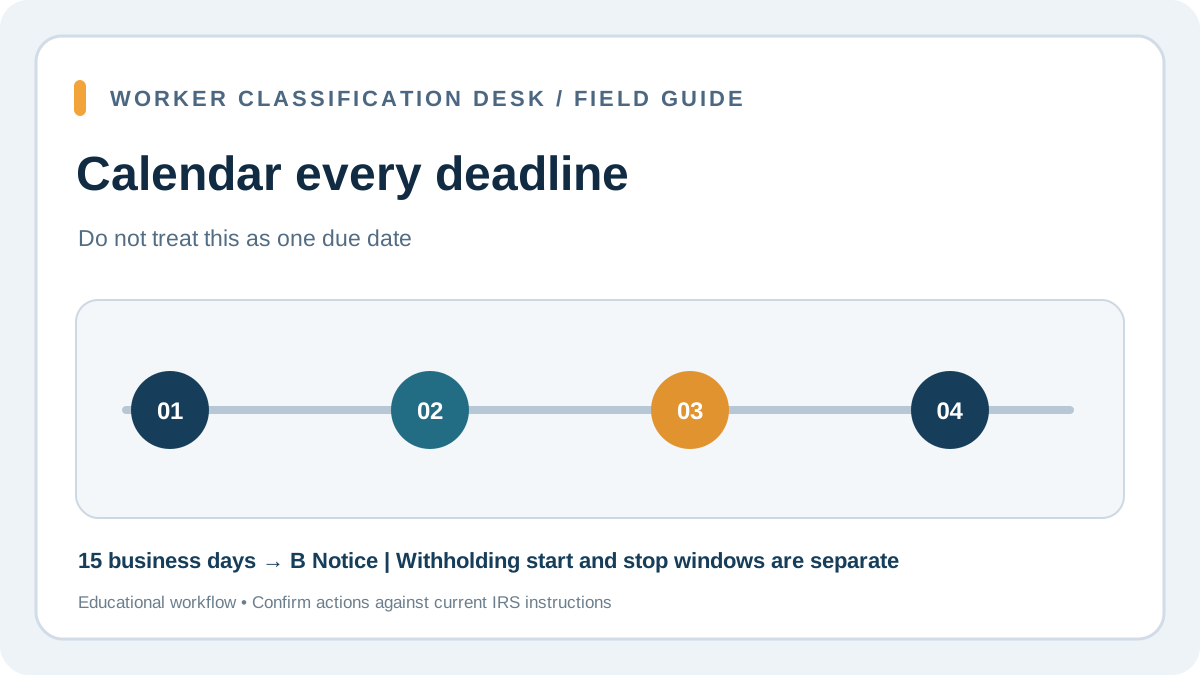
Publication 1281 says the B Notice must generally be sent within 15 business days after the later of the date on the CP2100/CP2100A or the date the payer received it. Use the actual notice and current IRS instructions to calculate the deadline; log both dates and the business-day calculation. Send the correct IRS-prescribed notice to the payee using a method that lets the payer document mailing and delivery. Keep the exact letter version, the included W-9 when required, the mailing date, address used, and any returned mail in the case file.
If a payee whose notice data matches the payer’s records does not resolve the issue, IRS guidance says backup withholding on future reportable payments must begin no later than 30 business days after receipt of the notice. The general backup-withholding rate is 24%. Stop withholding within 30 calendar days after receiving the required certification for a first notice or required IRS/SSA validation for a second notice. A missing TIN or obviously incorrect TIN can trigger a separate immediate withholding rule; do not confuse that case with the CP2100 incorrect-match timetable. Ask a tax professional to resolve edge cases and deposit scheduling.
Put the start date, affected payee, rate, payment base, deposit owner, and stop condition into the payable system. Backup withholding is not a late-year estimate: it is taken from affected payments, reported under the applicable rules, and deposited on the payer’s schedule. The IRS explains that nonpayroll federal income-tax withholding is reported on Form 945. Keep the tax operations owner responsible for confirming the deposit calendar and return treatment; an accounts-payable note alone does not perform the withholding.
Correct the vendor and the information-return workflow
When a payee responds, compare the new name/TIN certification with the notice and the vendor record, then update the controlled master record with effective date, reviewer, and supporting document. Avoid silently overwriting the prior value: preserve an audit trail that shows what was filed, what changed, and which future payments use the corrected data. If the original 1099 itself was wrong, determine with the information-return filer whether a corrected return is required. Do not issue a corrected form just because a notice arrived if the filed data was already correct and the IRS listing appears stale.
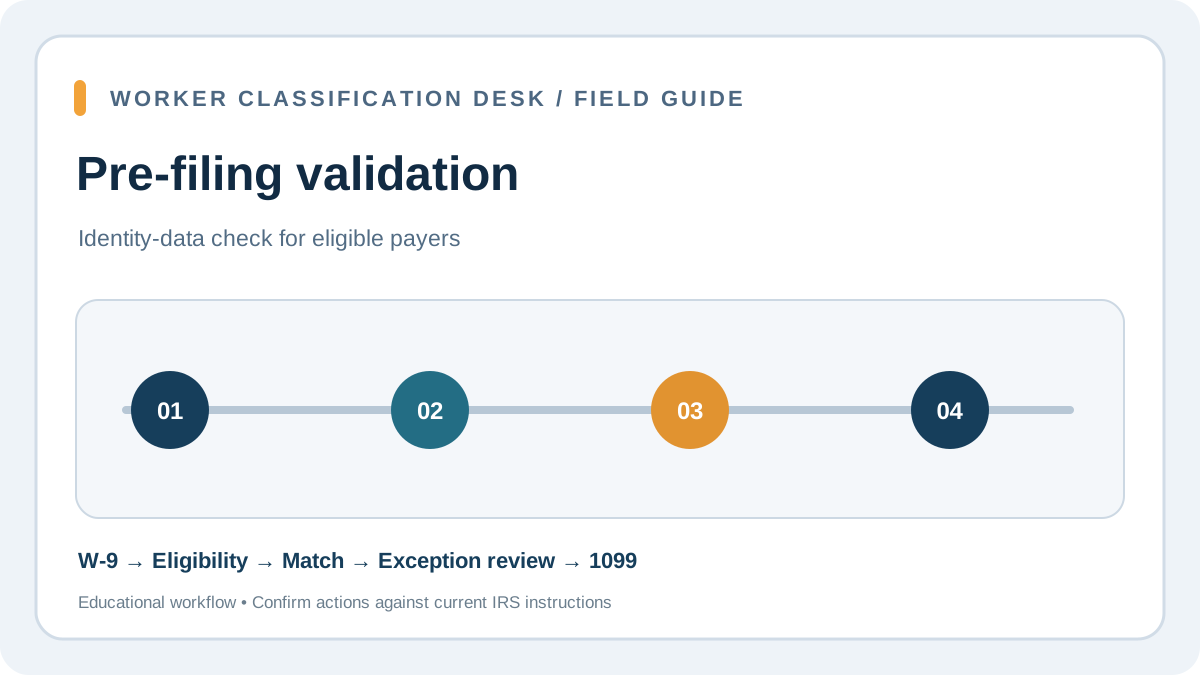
Add a prevention step before the next filing: normalize vendor names, merge duplicate payee IDs where appropriate, validate tax-year totals, and test the exact output file sent to the transmitter. Where eligible, use IRS TIN Matching before filing. Review whether an automated system is using a DBA instead of the legal name associated with the TIN. These controls reduce repeat mismatches but do not replace the required B Notice procedure after a notice has been issued.
Keep a complete closure record
Close each account only when the payer can show the notice line, reconciliation result, B Notice version and mailing evidence if needed, response or validation received, withholding start/stop dates, vendor-master changes, corrected-return decision, and final reviewer. Preserve prior notice history long enough to apply the two-in-three-year rule when a former contractor returns. If the payee no longer works with the business or was paid once, Publication 1281 still describes a notice process; retain the case record so a future payment does not restart the review from memory.
A useful closeout is specific: 'IRS line matched the filed return; first B Notice mailed on date X; signed W-9 received on date Y; name/TIN compared and vendor master updated; future withholding stopped within the applicable period; no corrected return needed because the original return matched the source record.' Avoid conclusory notes such as 'fixed' or 'vendor confirmed.' For a disputed identity, second notice, returned mail, payment-agent arrangement, or unclear withholding situation, pause routine processing and consult the payer’s tax adviser.
Notice response controls
CP2100/CP2100A payer response checklist
Use this as an operational tracker alongside the exact IRS notice and current Publication 1281. It does not replace tax advice.
| Checkpoint | Evidence to retain | Next control |
|---|---|---|
| Notice receipt | Date on notice and date received | Calculate 15-business-day B Notice deadline |
| Account history | Prior notices/B Notices by payee account | Select first or second B Notice |
| Data comparison | Filed return, vendor master, W-9, notice line | Send B Notice only if payer record agrees |
| Withholding | Affected payments and effective dates | Apply 24% and deposit/report when required |
| Resolution | Certification/validation and updated vendor record | Stop within applicable 30-day period |
WORKED EXAMPLE
Worked example: the mismatch is in the payer’s export
A small design firm receives a CP2100A listing one contractor. Its signed W-9 and vendor master both show the same name/TIN, but the export log reveals that an older vendor ID was used on the 1099 file and one digit was dropped during migration. The finance lead compares the IRS line with the filed return and retained source record. Because the notice combination does not match the payer’s source records, the business corrects the vendor mapping and works with its filer on the return correction; it does not send the contractor a B Notice for data the contractor did not provide.
A second contractor on the same notice has a listing that matches the name/TIN the firm filed. The payer checks its three-year notice log, determines which B Notice applies, calendars the 15-business-day mailing deadline, and records any withholding start date. The two lines receive different actions because the evidence differs, even though they arrived in the same envelope. Neither action changes the separate worker-classification decision.
COMMON QUESTIONS
Frequently asked
- Does a CP2100A mean the contractor was misclassified?
- No. It identifies a reported name/TIN mismatch. Worker status is a separate analysis under the applicable law.
- How soon must a payer send a B Notice?
- Publication 1281 generally says within 15 business days after the later of the notice date or receipt date. Check the actual notice and current instructions.
- Should I send a B Notice if my filed data does not match the IRS listing?
- The IRS says to correct or update your own records when the notice data does not match them; do not send a B Notice in that situation.
- How much is backup withholding?
- The general rate is 24%, but the trigger and start date depend on the facts. Follow IRS instructions and the payer’s tax-adviser guidance.
- Does the IRS tell me if it is a first or second notice?
- No. The payer must maintain account-level history to select the correct B Notice.
 What Can Trigger a State Unemployment Tax Worker-Classification Audit?
 1099 or W-2? Start With the IRS Three-Category Classification Framework
 EDD Audit: Do You Need an Attorney or CPA?
 IRS TIN Matching for 1099 Payers: Eligibility, Steps, and Limits
 How to Set Up 1099 Contractor Payments in Accounts Payable
 What to Do After a State Unemployment Audit Reclassifies Contractors