
What is Revenue Ruling 87-41's twenty-factor test?
Revenue Ruling 87-41 collected twenty factors the IRS used as guides in deciding whether enough common-law control exists for an employer-employee relationship. The ruling did not create a mathematical score. IRS materials explaining the ruling emphasize that the importance of each factor varies with the occupation and factual context. The core question is the right to control the manner and means by which the worker performs services.
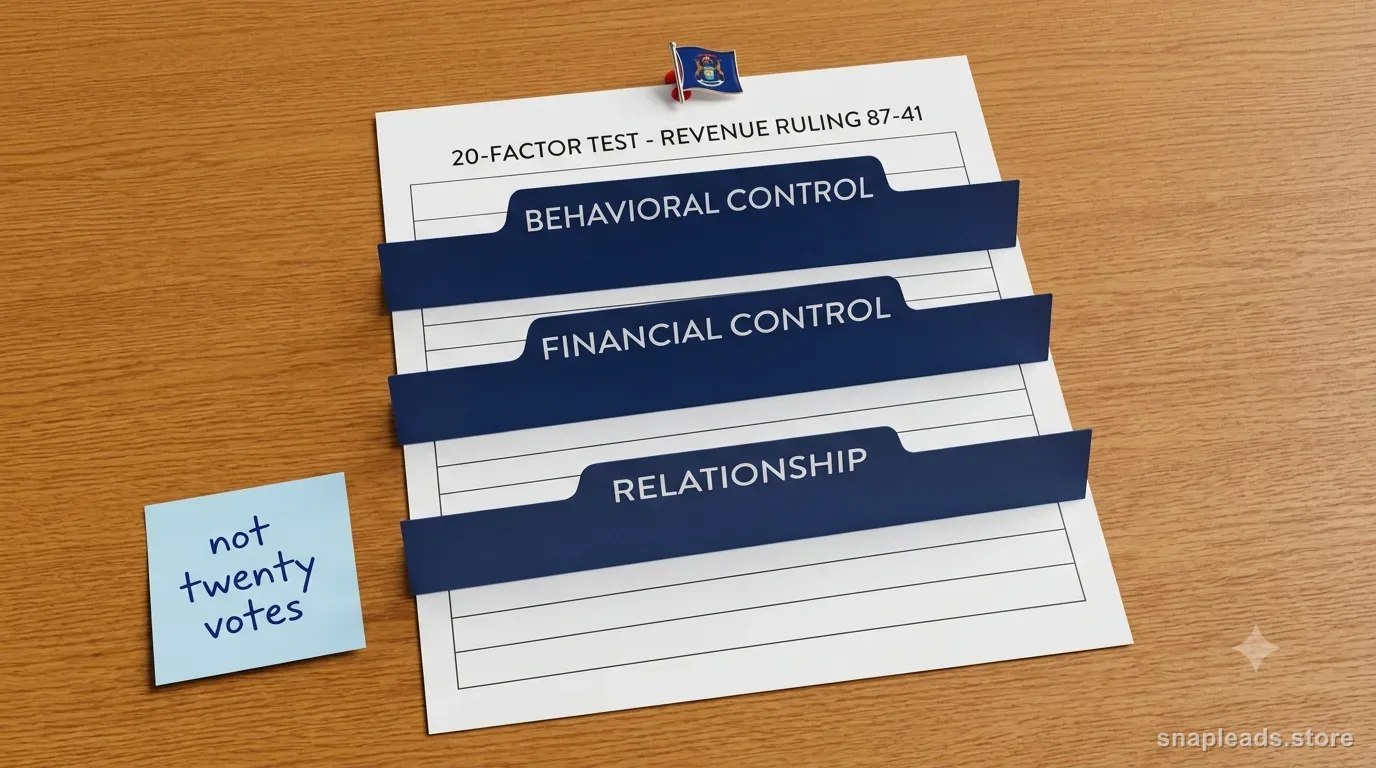
Modern IRS small-business materials more commonly organize classification evidence into behavioral control, financial control, and type of relationship. That newer organization does not make the historical factors useless. Several states still reference the twenty factors in their own laws or administrative guidance, and the factors remain a practical way to recognize evidence that belongs in a common-law analysis. This is employer education, not legal or tax advice.
Factors 1–7 focus heavily on instructions, integration, and continuity
The first seven factors are: instructions; training; integration; services rendered personally; hiring, supervising, and paying assistants; continuing relationship; and set hours of work. Together they highlight whether the business has the right to direct how services are carried out and whether the worker is integrated into an ongoing service relationship. A required method or recurring company schedule can matter differently from a project deadline or safety specification.
Do not assume every factor always points in the same direction. A specialized contractor can work on an important part of the customer's business, and a legitimate project can last months. The analysis asks what the evidence means in that occupation. For example, required security training may be less informative for an outside software provider than company-created training on how to perform the provider's professional method.
- 1. Instructions — a right to direct when, where, and how work is performed points toward employee control.
- 2. Training — company-directed training can show the business wants services performed by its methods.
- 3. Integration — services woven into core operations can make control over performance more significant.
- 4. Services rendered personally — requiring the named worker personally can limit independent business discretion.
- 5. Hiring, supervising, and paying assistants — control of helpers helps show who is operating the service business.
- 6. Continuing relationship — recurring or indefinite service can support an employment relationship, depending on context.
- 7. Set hours of work — company-fixed hours can show control over the manner in which services are performed.
Factors 8–14 examine time, place, reporting, payment, expenses, and tools
Factors eight through fourteen are: full-time required; performing work on the employer's premises; order or sequence set; oral or written reports; payment by hour, week, or month; payment of business or traveling expenses; and furnishing tools and materials. These factors capture operational controls and financial structure that were common evidence in the cases underlying the ruling.
Technology has changed how some factors appear. Remote work makes premises less informative in many occupations, while digital systems can let a company control sequence and reporting more closely than an office ever did. Payment by time can exist in a real business-to-business arrangement, and a contractor may use client systems for security reasons. The factors are prompts for factual inquiry, not automatic labels.
- 8. Full time required — requiring full-time availability can restrict the worker's ability to operate independently.
- 9. Work on the payer's premises — location can matter when the work could otherwise be performed independently, but remote technology can reduce its weight.
- 10. Order or sequence set — controlling the sequence of tasks can reveal control over method rather than only the final result.
- 11. Oral or written reports — recurring reports may indicate supervision when they monitor how work is being performed.
- 12. Payment by hour, week, or month — time-based pay can resemble wages, while project pricing can show business risk; neither is conclusive.
- 13. Payment of business or travel expenses — routine reimbursement can reduce the worker's financial risk, depending on the occupation.
- 14. Furnishing tools and materials — supplying important tools can indicate control, but client systems or regulated equipment may be neutral in some work.
Factors 15–20 focus on investment, business market, profit/loss, and termination rights
The final six factors are: significant investment; realization of profit or loss; working for more than one firm at a time; making services available to the general public; right to discharge; and right to terminate. These factors often reveal whether the worker is operating an independent business with capital, market exposure, and contractual risk or simply providing personal labor inside another business.
A worker does not need multiple simultaneous clients to be a contractor, and one customer does not automatically make the worker an employee. Likewise, an at-will termination clause is one relationship fact. Ask whether the provider can profit through pricing, staffing, efficiency, or investment decisions, whether services are marketed to a real customer base, and what contractual liability exists if the provider walks away from a project.
- 15. Significant investment — meaningful investment in facilities or equipment can support a separate business.
- 16. Realization of profit or loss — pricing, staffing, efficiency, and cost decisions that change profit can show entrepreneurial risk.
- 17. Working for more than one firm — multiple customers can support independence, but one customer alone does not decide status.
- 18. Services available to the public — regular marketing or a public customer market can show the worker is in business independently.
- 19. Right to discharge — a right to terminate the worker without ordinary contract consequences can indicate employee-style control.
- 20. Right to terminate — a worker's ability to quit without contractual liability can resemble an at-will employment relationship.
Why the twenty factors should not be counted
The IRS's own description of Revenue Ruling 87-41 says the degree of importance of each factor varies by occupation and factual context. A list showing 11 'contractor' boxes and 9 'employee' boxes therefore does not produce a reliable federal answer. Some facts may be neutral or irrelevant, while a smaller number of control facts can carry much more weight for the actual service relationship.
Use a narrative evidence matrix instead. For each factor, record the confirmed fact, source document or interview, whether the fact indicates a right to control or independent business activity, and how important it is for that occupation. Then synthesize the relationship under current common-law guidance rather than adding a score.
Why states still make Revenue Ruling 87-41 relevant
Some state programs explicitly continue to use or reference the twenty factors. The Virginia Employment Commission currently publishes the IRS twenty factors as part of its employee-classification guidance and notes that the factors are guides rather than a requirement that every factor be present. Michigan Treasury guidance likewise describes Revenue Ruling 87-41 as an aid for common-law employee determinations. Other states can use different ABC tests, statutory tests, or industry-specific rules.
That means a multistate employer should not say 'the IRS abandoned the 20-factor test, so it no longer matters.' The better statement is that modern IRS materials organize common-law evidence differently while state law may still incorporate or reference the historic factors. Always identify the law being applied before choosing the framework.
When a state adopts or references the factors, use the state's own wording and exemptions rather than pasting a federal worksheet into the audit response. Virginia, for example, publishes the twenty factors together with state exemptions. The historical factor list can therefore remain operationally important even when the federal IRS article a business reads today is organized into three broader categories.
Twenty-factor map
Revenue Ruling 87-41 factors without point scoring
These groups are an editorial organization for review, not a replacement legal test or official weighting scheme.
| Factor group | Revenue Ruling factors | Evidence to pull |
|---|---|---|
| Direction / integration | 1–7: instructions through set hours | Instructions, training, schedules, staffing rights, duration |
| Operational / payment | 8–14: full-time through tools/materials | Work location, sequence, reports, invoices, expenses, equipment |
| Business independence | 15–18: investment through public market | Assets, pricing, profit/loss, other customers, marketing |
| Termination rights | 19–20: discharge and termination | Contract remedies, termination clauses, actual practice |
| Modern IRS synthesis | Behavioral, financial, relationship evidence | Use current IRS common-law framework to synthesize all facts |
| State overlay | State may adopt 20 factors or a different test | Official state statute/guidance for worker location |
WORKED EXAMPLE
Worked example: why 12-to-8 factor counting can mislead
A consulting company classifies a systems specialist as a contractor and completes a home-built worksheet showing 12 factors in the contractor column and eight in the employee column. Most of the contractor points are weak facts such as remote work, no benefits, and use of a personal laptop. The company manager, however, assigns the specialist a fixed full-time schedule, dictates daily ticket sequence, requires personal service, controls all customer interactions, and can move the worker among projects indefinitely.
Instead of relying on the 12-to-8 score, the reviewer documents each factor's factual source and importance, then synthesizes behavioral control, financial control, and relationship evidence under current federal guidance. The company separately checks the worker's state because that jurisdiction may use Revenue Ruling 87-41 differently or apply another statutory test.
COMMON QUESTIONS
Frequently asked
- What are the 20 factors in Revenue Ruling 87-41?
- They are instructions, training, integration, personal service, assistants, continuing relationship, set hours, full-time requirement, premises, sequence, reports, payment method, expenses, tools/materials, investment, profit/loss, multiple firms, public market, discharge, and termination.
- How many factors must point to contractor status?
- There is no magic number. IRS materials say the importance of each factor varies with occupation and factual context.
- Does the IRS still use behavioral, financial, and relationship categories?
- Yes. Current IRS materials commonly organize common-law evidence into behavioral control, financial control, and type of relationship. Current IRS three-category framework
- Do states still use the 20-factor framework?
- Some do. Virginia currently publishes the twenty factors for its classification guidance, while other states use different tests. State worker-classification guides
- Is Revenue Ruling 87-41 a point-based test?
- No. Treat the factors as factual guides to the common-law right-to-control inquiry, not a scored quiz.
 Statutory Employee vs. Independent Contractor: The Federal Category Small Businesses Often Miss
 Virginia VEC Contractor Classification: Turn the 20 Factors Into an Evidence File, Not a Scorecard
 Michigan UIA Contractor Classification: Reconcile the 20-Factor Review Before an Audit or Claim
 Florida Reemployment Tax Classification: How to Prepare for the RTS-6061 Ten-Factor Review
 Missouri UI Worker Classification: Use the 20 Factors as Evidence—Then Check Statutory Employee and Exempt Categories
 What Is a Common-Law Employee?