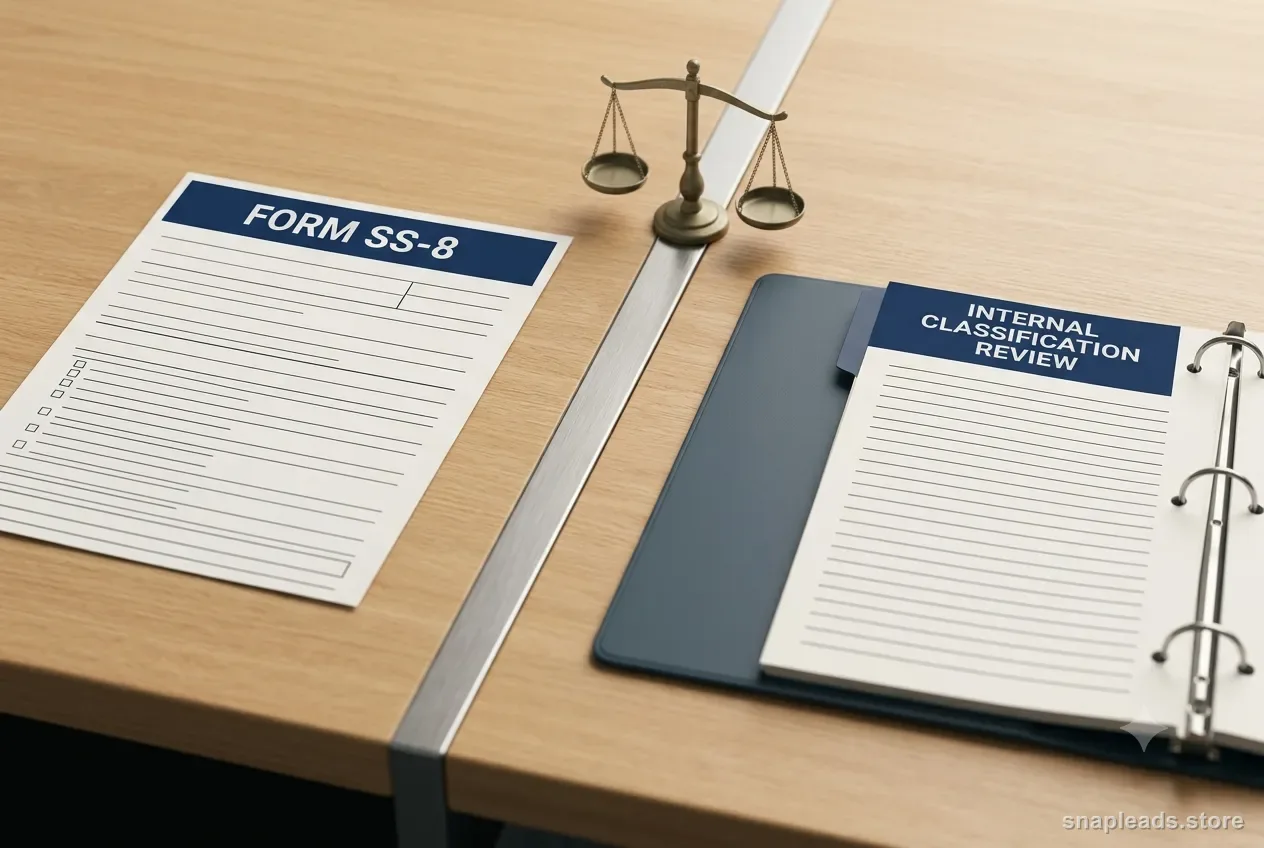
Internal review is the normal first layer
Every contractor engagement should not begin with an IRS filing. An internal classification review organizes facts under the applicable standards, identifies obvious employee-like or contractor-like features, and records the business’s reasoning. It is faster, repeatable, and can be built into onboarding and renewal.
The review can also route the business to separate state and wage-and-hour analyses. Its strength is governance: it helps the company discover problems before a dispute or audit.
SS-8 changes who makes the federal tax determination
With Form SS-8, the business or worker asks the IRS to decide status for federal employment taxes and income-tax withholding. The agency can request facts from the parties and issue a determination based on the submitted relationship. That is a different level of process and disclosure from an internal memo.
Because it can take at least six months, SS-8 is usually not the fastest way to solve an operational staffing question.
Use internal review to decide whether the question is even close
A well-run internal review may reveal that the company has been relying on a bad shortcut: part-time hours, a 1099, an LLC, or a contractor clause. Once the real facts are collected, the result may no longer feel ambiguous. In that situation, the immediate work may be to correct the relationship rather than wait for a formal determination.
If important facts remain genuinely mixed, the internal review gives the SS-8 preparer a much cleaner starting record.
Internal review can examine several legal systems at once
A business can build a matrix that separately evaluates federal employment tax, FLSA, and relevant state standards. SS-8 cannot do that job because its legal scope is federal tax status. This is particularly important for workers in states with ABC tests or unemployment-specific standards.
The matrix should not blend the tests into one score. It should show separate rows, sources, and conclusions so one standard does not contaminate another.
SS-8 is valuable when third-party certainty matters
A formal IRS determination may be more valuable when a relationship will continue for years, the compensation is material, the parties disagree, or the same role is used widely across the business. The cost is time and a detailed factual process. Management should decide consciously whether that tradeoff makes sense.
An internal review can recommend SS-8 as an escalation outcome instead of pretending every case can be resolved internally.
The two tools also have different failure modes
An internal review can fail because the business used stale facts, a biased checklist, or a score that does not exist in the governing test. SS-8 can fail earlier in the process if the form is not signed correctly, lacks enough information, concerns a business-to-business question, covers closed periods, or falls into another IRS non-acceptance category. These are different risks and should be controlled differently.
For routine governance, the internal file should be easy to update when the role changes. For SS-8, the submission should be stable enough that the IRS can understand exactly which services, period, and worker class are being presented. The choice is therefore not “informal versus official” in the abstract; it is which process fits the question the business actually has.
Neither tool creates a safe harbor by itself
An internal memo is not immunity from tax liability, and filing SS-8 is not a promise that penalties disappear. Federal relief provisions such as Section 530, Section 3509 rates, or VCSP have separate requirements and should be analyzed on their own facts. Do not write “SS-8 filed, therefore protected” into a compliance plan.
The same caution applies to state law. An IRS determination does not erase a stricter state test.
Use the same evidence discipline for both
Contracts, schedules, instruction records, payment terms, expenses, equipment, market activity, duration, and benefit practices are useful whether the company is making an internal decision or preparing SS-8. Preserve the source evidence and note the date range. This makes escalation much easier if the internal answer later becomes disputed.
Do not let the internal memo become a collection of conclusions with no citations to company records. A reviewer should be able to see how each material fact was established.
Build a ladder: screen, review, escalate, implement, monitor
A practical program starts with a short pre-hire screen. Higher-risk or mixed roles receive a full internal review. Truly uncertain federal tax cases can be escalated to professional advice or SS-8. Whatever the decision, implementation changes the actual relationship, and monitoring catches later drift.
That ladder is more sustainable than treating worker classification as an annual form-selection exercise. It makes the classification decision part of operating design.
Document the handoff when an internal review escalates to SS-8
If the internal review ends with “federal status remains genuinely uncertain,” preserve the memo that explains why. The SS-8 preparer should be able to see which facts were verified, which facts were mixed, what period is being presented, and which separate state questions remain outside the filing. That handoff avoids two common failures: rebuilding the relationship from memory and quietly changing the internal analysis to match the outcome management hopes the IRS will reach.
If the business later decides not to file, record that decision too. The internal review should show whether the company changed the role, moved the worker to payroll, obtained other professional advice, or accepted a documented level of uncertainty. A missing SS-8 should never be interpreted years later as proof that no classification question existed; the governance record should explain what actually happened.
TOOL-SELECTION MATRIX
Choose the next step based on the problem you actually have
An internal review and Form SS-8 solve different problems. Use this matrix before escalating a routine fact review into a formal federal tax determination request.
| Situation | Usually start with | Why |
|---|---|---|
| Facts are still incomplete or changing | Internal review | You need a coherent operating record before asking anyone to decide status |
| Several legal systems may apply | Internal review + qualified state/federal advice | SS-8 answers a federal employment-tax question, not every classification law |
| Stable federal-tax facts remain genuinely uncertain | Consider Form SS-8 | A formal IRS determination may resolve the federal tax-status question |
| A deadline or active dispute is already running | Professional review immediately | A slow determination process should not displace time-sensitive obligations |
WORKED EXAMPLE
Example: ten similar contractors did not all need ten immediate filings
A small agency discovered that ten “account coordinators” had almost identical schedules and supervision. Management proposed filing ten SS-8 forms at once. An internal review first showed that the role itself had been designed like ongoing staff work, and the company decided to examine reclassification and prior-period issues with its advisers.
SS-8 remained available for unresolved federal questions, but the internal review prevented the form from becoming a substitute for fixing a clearly problematic operating model.
COMMON QUESTIONS
Frequently asked
- Is an internal review a substitute for filing SS-8?
- They are related tools, not substitutes. Internal review is the normal first layer for governance and resolves most cases once real facts are collected. SS-8 changes who makes the federal call and is worth it when the answer stays uncertain and third-party certainty matters.
- Does filing SS-8 protect us from penalties?
- No. Filing SS-8 is not a safe harbor. Federal relief provisions such as Section 530, the Section 3509 rates, and the VCSP have their own separate requirements, and a favorable determination does not erase a stricter state test.
- Can SS-8 evaluate our state ABC-test exposure?
- No. SS-8’s legal scope is federal tax status. Use an internal matrix with separate rows for federal employment tax, the FLSA economic-reality test, and each relevant state standard so one test does not contaminate another. State unemployment audit basics.
- What should we keep if the internal review escalates to SS-8?
- Preserve the memo explaining which facts were verified, which were mixed, the period presented, and the state questions left outside the filing. That handoff prevents rebuilding the relationship from memory or quietly editing the analysis to match a hoped-for outcome.