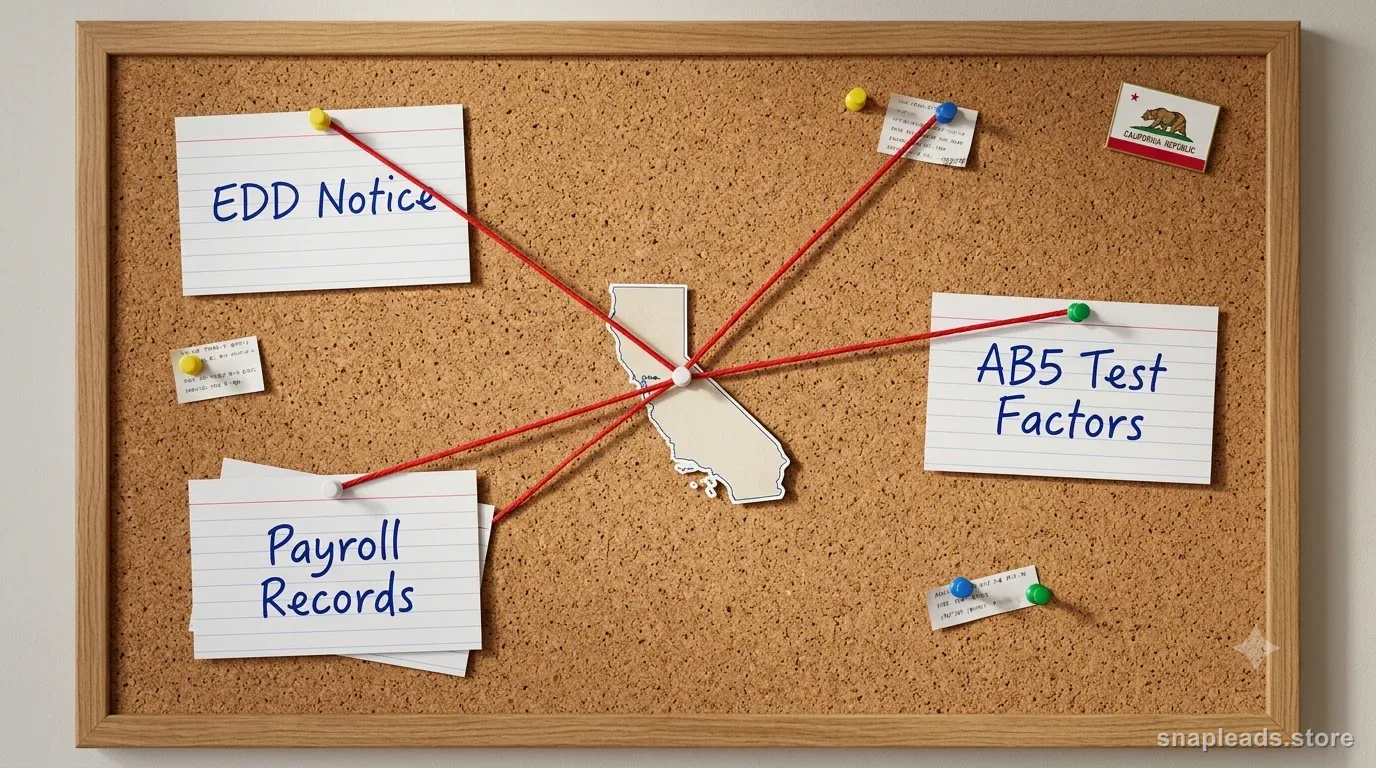
California starts from its own classification framework
California EDD’s employment-status guidance describes the ABC test for many purposes and also recognizes situations in which a different analysis can apply. That means the first audit task is legal scoping: identify the service, statute or program at issue, and whether a listed exception changes the test. Do not begin by counting IRS behavioral, financial, and relationship factors. Those federal tax categories may still be useful in a separate file, but they are not a substitute for the California rule the EDD is administering.
The ABC framework is intentionally structured. A business asserting independent-contractor status generally needs to analyze all three prongs when the test applies. That is different from a loose balancing exercise. Because exceptions and industry-specific rules can be technical, the site should not tell a reader that checking three informal boxes guarantees status. The employer should use official EDD and DIR material and seek California-specific professional advice when the applicability of an exception is uncertain.
Prong A puts actual control under a microscope
The control question should be documented with real operating evidence. Look at scheduling, instructions, supervision, required meetings, tools, approval chains, training, and the worker’s ability to choose the manner of performance. A contract saying the provider is free from control is useful only if the day-to-day relationship supports it. Preserve both documents and representative communications so the file does not describe a paper relationship that never existed.
Be precise about external constraints. A construction site may have safety rules and access windows; a healthcare environment may have regulatory requirements. Those facts should be identified separately from discretionary managerial control. The issue is not whether any rule existed, but what the hiring entity actually controlled within the governing legal framework. A short chronology can be especially helpful when manager practices changed over time.
Prong B requires a serious look at the usual course of business
The ‘usual course’ issue can be uncomfortable for a company that relies on freelancers to deliver the very service it sells. A branding agency hiring outside designers, a home-care company using individual aides, or a delivery business using drivers should not skip this prong because the workers have LLCs. Describe what the company offers customers, how it earns revenue, and where the worker’s services fit. Marketing materials, customer contracts, and organizational charts may be relevant to that factual picture.
Do not confuse support services with the core offering. An accounting firm hiring a plumber for office repairs presents a very different relationship from the same firm hiring accountants to serve its clients. The answer can become more nuanced in multi-service companies or project-based businesses. Write down the business line and service at issue rather than relying on an overly broad statement such as ‘we are a technology company.’
Prong C asks whether an independent business truly exists
Evidence of an independently established trade can include other customers, marketing, a business location, insurance, licenses where relevant, investment, staff, and the ability to continue operating after the relationship ends. No single item should be manufactured for the audit. A website created after the notice does not prove the worker was independently established two years earlier. Date the evidence and connect it to the period under review.
The absence of one traditional business feature may not end every analysis, especially where exceptions or other standards apply, but it is a signal to investigate rather than assume. Ask what the person would have done if this customer disappeared. Did the worker have a market-facing business capable of finding replacement clients, or was the supposed business essentially the job itself? Preserve objective records that help answer that question.
Exceptions require their own checklist
California law contains exceptions and specialized rules that can move a relationship out of the default ABC analysis or impose additional criteria. A compliance file should state the claimed exception, cite the official source, and list each condition separately. Avoid the common mistake of finding one familiar label—such as ‘professional services’—and treating the label as automatic qualification. The actual statutory conditions and facts need review.
When an exception leads to another test such as Borello, start a new worksheet. Do not mix ABC prongs with common-law or economic-reality factors in one unlabeled list. Clear separation makes the audit response easier to review and helps future staff understand why a different framework was used for one role than another.
Prepare EDD records by worker group and period
For an EDD audit, build a roster of all affected service providers with dates, amounts paid, role, manager, and claimed classification basis. Then attach the evidence relevant to the California test. Grouping can make sense when workers truly share the same operating model, but note exceptions. A single contractor agreement used across fifty people does not make their factual relationships identical.
Reconcile the roster to payroll reports, Forms 1099, and accounts-payable data so the agency can see that the population is complete. If the company discovers an omitted worker or payment, resolve the record issue openly. Inconsistent totals can distract from the classification analysis and create a second compliance problem that has nothing to do with the legal test.
Do not treat an EDD result as a universal national answer
A California outcome addresses the California program and facts before the agency. The IRS may apply a common-law standard for federal employment tax, and federal wage-and-hour status can involve the Department of Labor’s economic-reality analysis. Other states use other tests. Preserve the EDD determination in the compliance file, but label its scope rather than putting ‘employee everywhere’ or ‘contractor everywhere’ in a master spreadsheet without further analysis.
If California requires reclassification, use the finding to trigger a broader review: payroll setup, wage-and-hour practices, benefits eligibility, prior-period tax questions, and any federal correction or relief pathways that may be relevant. The operational correction should be coordinated, but the legal reasons for each component should stay identifiable.
WORKED EXAMPLE
Example: a creative agency discovers the core-service issue
A Los Angeles agency pays six designers as contractors. All have written agreements and home computers, but the agency sells design services, assigns client work through an internal project manager, sets recurring availability windows, and includes the designers in production meetings.
The company’s prior file consists only of W-9s and contractor contracts. During an EDD review, it rebuilds the analysis around California’s framework, documents the service line, actual control, and each designer’s outside business activity, and flags the relationship for California-specific advice rather than assuming the federal memo settles the question.