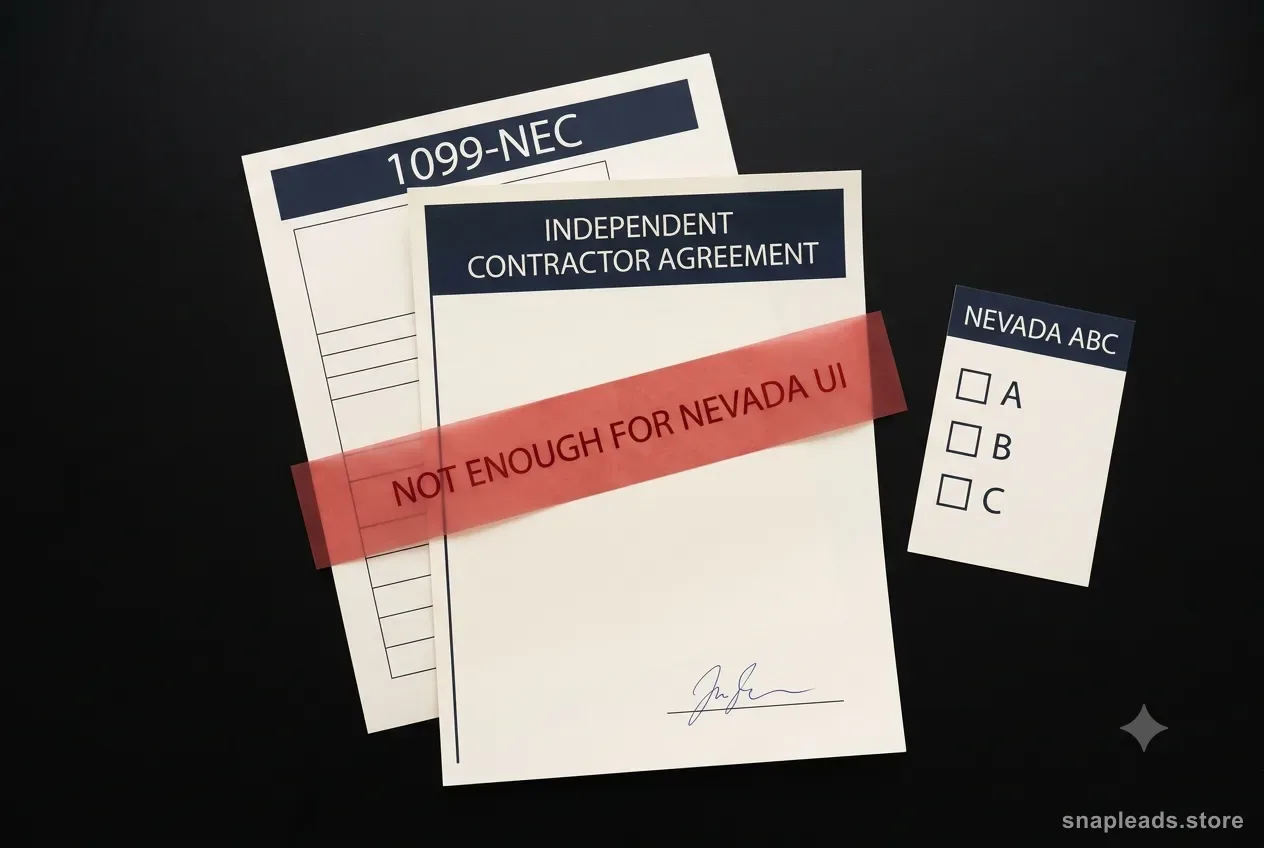
Nevada has its own unemployment classification question
Nevada’s UI materials state that unemployment law does not define “independent contractor” with a simple label but applies what the agency describes as the ABC test. Unless a specific exclusion applies, payment for services is subject to unemployment tax as employee compensation unless all three conditions are satisfied.
That means a company operating in several states should not import a federal SS-8 conclusion or another state’s contractor memo and change the header to Nevada. The factual records can be shared, but the legal mapping needs to be Nevada-specific.
A asks for freedom from control or direction in contract and fact
Nevada’s first condition looks at whether the person has been and will continue to be free from control or direction over performance, both under the contract of service and in fact. Review retained contractual rights and real operating practices separately. A manager who rarely supervises may still have reserved control; a contract that promises freedom can be undermined by actual instructions.
Preserve schedules, training, work instructions, approval rights, route or task assignments, required procedures, and the worker’s authority to choose methods. The strongest A-prong file explains the line between specifications for the finished result and control over the process used to achieve it.
B requires outside usual course or outside all places of business
Nevada’s B condition uses an alternative formulation: the service must be outside the usual course of the business or performed outside all of the enterprise’s places of business. Identify the route the company relies on. Do not write a single sentence saying the work is “outside the business” without describing the company’s actual activity and where the service occurred.
For site-based industries, place-of-business facts can be especially important. For remote work, do not assume a home office automatically satisfies B. Record the actual service, customer-delivery function, physical locations, and the business reason the company believes one branch of B applies.
C asks whether an independently established business really exists
The third condition requires the person to be customarily engaged in an independently established trade, occupation, profession, or business of the same nature as the service. Evidence should show business continuity beyond this payer: other customers, marketing, pricing, recurring expenses, insurance, licenses where relevant, and a record of offering the same service in the market.
Avoid treating the ability to work for others as equivalent to actually operating an independent business. If the individual formed an entity only for this engagement and has no outside market, document the weakness. The classification file should help the company make a decision, not manufacture a favorable appearance.
For B, write down the exact route and the exact place-of-business facts
Nevada’s B condition is written in the alternative: the service can satisfy the prong by being outside the usual course of the enterprise’s business or by being performed outside all of the enterprise’s places of business. Do not let a reviewer write only “B satisfied.” The memo should identify which route is being used and preserve the facts for that route. If both routes appear supportable, analyze both separately rather than blending them into one vague conclusion.
For the usual-course route, describe what the enterprise actually sells or delivers to customers and whether the worker performs that same production function. For the place-of-business route, identify every relevant physical location connected to the service and why it is or is not a place of the enterprise’s business. A worker’s home address, a customer site, and a company-managed location can present different facts; the file should not assume that “remote” is a legal conclusion.
This precision becomes important in a multi-state program because federal common-law materials usually do not ask this B-prong question at all. The company can reuse underlying documents such as contracts, work locations, and service descriptions, but it must add the Nevada mapping. That is the difference between evidence reuse and conclusion reuse—and it is why a favorable federal memo cannot simply be attached as the Nevada answer.
The Nevada handbook expressly rejects two common shortcuts
Nevada’s employer handbook asks whether a written agreement declaring workers to be independent contractors exempts them from unemployment tax and explains that it does not necessarily do so; the statutory conditions must be met in fact. The handbook also asks whether meeting IRS independent-contractor requirements exempts the workers from Nevada unemployment taxes and answers that it does not necessarily.
Turn those warnings into review controls. A checkbox for “contract signed” should never auto-approve status. A federal classification memo should be linked as supporting evidence but should not close the Nevada review. The state file must still show A, B, and C.
Correcting a classification starts with identifying the affected period and population
Nevada warns that misclassification can create UI tax consequences and penalties when wages are not correctly reported. If an internal review identifies a weak contractor population, first define who shares the same operating model and when that model began. Do not limit the correction analysis to the one worker who raised the issue if ten others work under the same contract and supervision.
Freeze the facts before changing them: save current contracts, payment history, schedules, instructions, and business-market evidence. Then get the appropriate payroll or tax advice on correction mechanics. This separates factual classification work from the separate question of how prior reports should be corrected.
NEVADA ABC CROSSWALK
Federal facts can be reused; federal conclusions cannot
Map the same evidence to Nevada’s three conditions.
| Nevada prong | Core question | Useful records | Shortcut to reject |
|---|---|---|---|
| A | Who controls performance? | Contract rights, instructions, schedules | “IRS said contractor” |
| B | Outside usual course OR all places? | Business description, location records | “Works remotely” |
| C | Independent business of same nature? | Clients, marketing, expenses, pricing | “Has an LLC” |
| Whole test | Do all three apply for the period? | Dated ABC memo | Signed agreement alone |
WORKED EXAMPLE
Example: a Nevada company has a favorable federal memo but a weak B prong
A Nevada company has a federal worker-classification memo supporting contractor treatment for a specialist who controls methods, has several clients, and bears business expenses. Procurement assumes the same memo resolves state UI.
During Nevada review, the company maps the facts to A, B, and C. A and C are well supported, but the specialist performs the same service the company sells to customers and works regularly at company-managed client sites. The team recognizes that B needs a separate Nevada analysis instead of hiding behind the federal conclusion. The value of the crosswalk is not that it guarantees a different result; it reveals which state-law question the federal memo never answered.
COMMON QUESTIONS
Frequently asked
- Does a written contractor agreement exempt a worker from Nevada unemployment tax?
- Not necessarily. Nevada’s employer handbook says a written agreement declaring workers to be independent contractors does not by itself exempt them; the ABC conditions must be met in fact.
- We meet the IRS independent-contractor requirements — does that cover Nevada?
- Not necessarily. The Nevada handbook expressly says meeting IRS requirements does not automatically exempt workers from Nevada unemployment taxes. Build a Nevada-specific ABC memo that proves A, B, and C.
- Can we reuse another state’s contractor memo for Nevada?
- Reuse the underlying documents, not the conclusion. Nevada’s B prong (usual course or all places of business) is often not asked in federal common-law materials, so the state mapping has to be done separately.
- What happens if a classification is wrong in Nevada?
- Nevada warns that misclassification can create UI tax consequences and penalties when wages are not correctly reported. Identify everyone under the same operating model and when it began, freeze the facts, then get correction advice. What triggers a state UI audit.