Connecticut begins with a presumption of employment
For Connecticut unemployment tax purposes, service is generally treated as employment unless the service recipient can establish all three parts of the state’s ABC test. That puts the burden on the business to prove an exception rather than on the worker to prove employee status. The classification file should therefore be built before a dispute, not reconstructed only after a former 1099 worker files a claim.
The three parts ask different questions: A addresses freedom from direction and control under the contract and in fact; B asks where and in what business context the service is performed; and C asks whether the worker is customarily engaged in an independently established trade, occupation, profession, or business of the same nature. A strong answer to one prong cannot cure a failure on another.
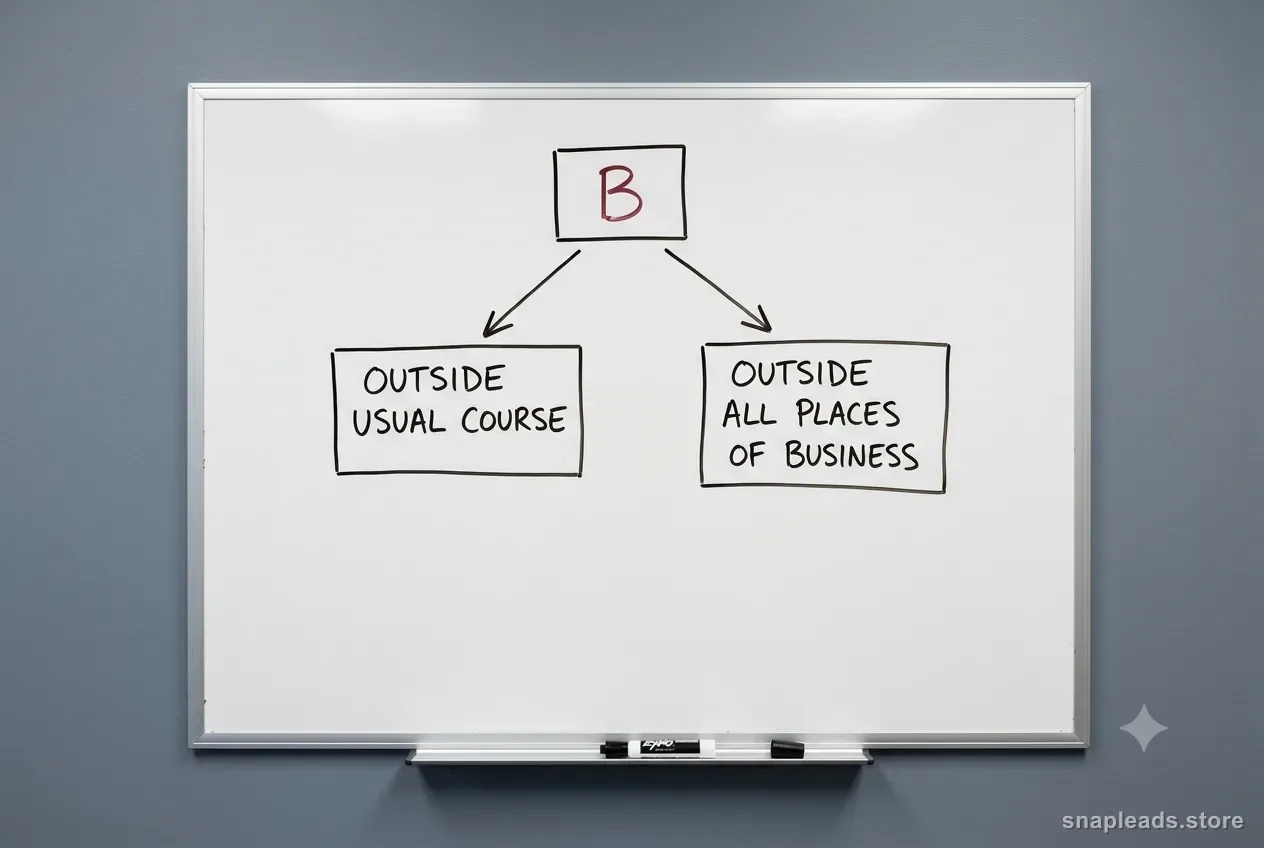
B is not one condition—it contains two alternative routes
The most useful drafting detail in Connecticut’s formulation is the word “either.” The B prong can be satisfied when the service is outside the usual course of the employer’s business, or when it is performed outside all of the employer’s places of business. Those are different factual theories. A company should identify which one it relies on rather than using vague language that mixes both.
For an accounting firm hiring a plumber to repair a remote storage facility, “outside the usual course” may be straightforward. For a business hiring someone to perform work similar to its own core service, the place-of-business route may become more important—but “place of business” should not be assumed to mean only the headquarters address. Preserve the actual location facts and avoid conclusions that outrun CTDOL guidance or applicable case law.
A requires freedom from control in the contract and in reality
Connecticut expressly tests direction and control both under the contract of hire and in fact. That means two failure modes exist. A contract can reserve too much control even when a manager rarely exercises it. Conversely, a clean contract can be undermined by daily instructions, required methods, fixed shifts, approval gates, or training that shows the company controls how the work is performed.
Build an A-prong record from operating artifacts. Identify who sets sequence, who decides methods, whether substitutes are allowed, whether the worker can refuse assignments, how quality is specified, and whether the business trains the worker in a proprietary process. Distinguish a customer defining the desired result from a customer retaining the right to direct the means of reaching it.
C is about a business that exists independently, not one created for the engagement
CTDOL’s misclassification materials emphasize that a worker who forms a business in response to an offer of work as an independent contractor may not satisfy the “customarily engaged” and “independently established” concepts. That makes timing evidence valuable. When did the business begin? Did it have customers or marketing before this payer? What happens to the business if this engagement ends?
Useful C-prong evidence includes prior and concurrent clients, proposals, business insurance, licensing where relevant, independent pricing, public marketing, recurring operating expenses, and records showing the worker bears business risk. An LLC certificate is only one document. The file should tell the story of a functioning enterprise rather than a legal shell created because onboarding required one.
Do not let remote work turn B into an assumption
Remote arrangements can tempt employers to write “outside our place of business” and stop. That is too quick. First identify whether the company is relying on the usual-course route or the place-of-business route. Then document why the chosen route fits the actual work. If the service is core to the company’s business, the usual-course route may be weak even though the worker logs in from another state or home office.
For remote engagements, preserve where services are actually performed, whether the company requires presence at client sites, whether the worker uses company-controlled virtual systems as the functional worksite, and whether any physical locations are integral to the service. The point is not to invent a universal rule for virtual work; it is to make the factual premise explicit so the business knows what needs review.
A stronger remote-work memo therefore starts with a location inventory: employer facilities, customer sites, required meeting locations, and the worker’s chosen workspace. It then states which B alternative the company relies on and why. That is more useful than treating a home address as a magic fact, because Connecticut’s B prong is an either-or legal test whose two routes require different evidence.
A Connecticut audit response should be organized A, B-route, C—not chronologically
When CTDOL asks about a worker, a chronological pile of contracts and invoices forces the reviewer to do the legal mapping. A more useful response index is structured by the test. Tab A contains contract/control evidence; Tab B identifies the selected route and location or usual-course facts; Tab C contains independent-business records. A short cover memo explains contradictions and the period reviewed.
This structure also exposes weaknesses before submission. If Tab C contains only a W-9 and LLC filing, that is a signal to investigate rather than a reason to add adjectives. If B depends on “outside all places of business” but half the work occurred on the company’s site, the file reveals the problem early. Good audit preparation is partly a classification test conducted on your own evidence.
CONNECTICUT B-PRONG TOOL
Choose one B-prong route before collecting evidence
Mark the route the business actually relies on. Do not check both simply because both sound favorable.
| Question | Outside usual course route | Outside places route | Record to pull |
|---|---|---|---|
| What service was purchased? | Compare service to revenue-producing business activity | Identify where every material service occurred | SOW + business description |
| Where was work performed? | Context only | Must support the place-based theory | Location log, site records |
| Was work core to customer delivery? | Potential weakness | May still require separate place analysis | Org chart, customer workflow |
| Did worker enter company sites? | Not necessarily decisive | Potential contradiction | Badges, calendars, site logs |
| Which route is stated in memo? | Name it expressly | Name it expressly | Dated classification memo |
WORKED EXAMPLE
Example: the same remote designer can present a strong A and C file while B remains unresolved
A Connecticut retailer hires an independent design studio with three other clients. The studio chooses methods, prices by project, uses its own software, and works from its own office. A and C have substantial supporting records.
The retailer initially writes that B is satisfied because the designer is remote. During review, the team realizes the relevant question is more precise: is design outside the retailer’s usual course, or is the company relying on work outside all places of business? The classification memo is revised to identify the actual route and evidence instead of treating “remote” as a legal conclusion. That correction improves the file even before anyone decides the ultimate status because it converts a slogan into a testable factual position.
COMMON QUESTIONS
Frequently asked
- Does Connecticut presume workers are employees?
- Yes. For unemployment tax purposes, service is treated as employment unless the business establishes all three parts of the ABC test. The burden is on the company, so the classification file should be built before a claim, not reconstructed after one.
- What are the 'two paths' in the B prong?
- Connecticut’s B prong uses the word 'either.' It is satisfied when the service is outside the usual course of the employer’s business, or when it is performed outside all of the employer’s places of business. These are different factual theories; pick and document the one you rely on.
- Does remote work automatically satisfy prong B?
- No. A home address is not a legal conclusion. If the service is core to the company’s business, the usual-course route may be weak even for a remote worker. Start with a location inventory, then state which B route applies and why.
- Does meeting the IRS test satisfy Connecticut’s ABC test?
- Not on its own. Federal common-law materials usually do not ask the B-prong question at all. You can reuse the underlying documents, but the Connecticut analysis must independently establish A, B, and C. The federal three-category framework.