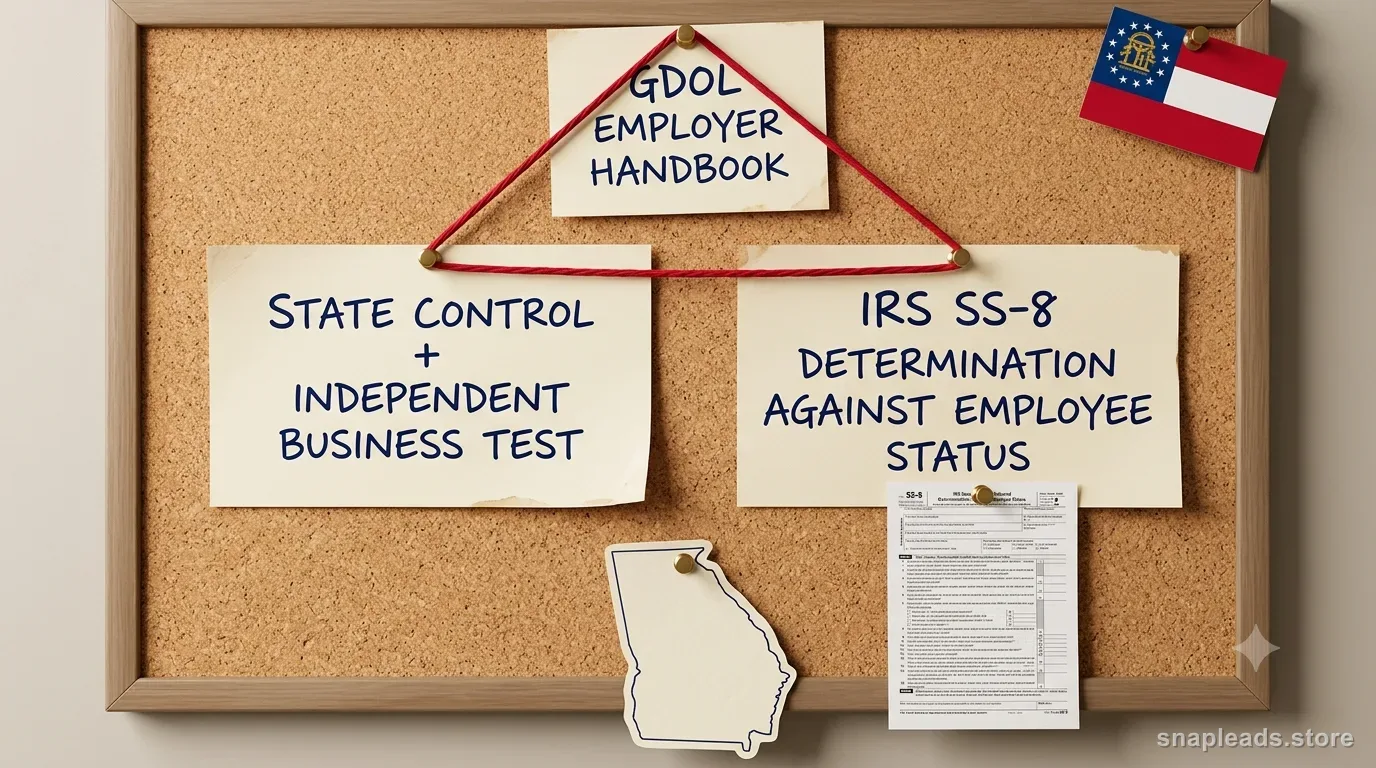
Georgia’s handbook gives employers an either/or structure for UI classification
The Georgia Department of Labor Employer Handbook states that services performed by an individual for wages are considered employment for Georgia unemployment-insurance purposes unless an exemption is established under Georgia law. The handbook describes two alternative ways to establish the independent-contractor exemption. Under the first, the individual must be free from control or direction over the performance of the services, under the contract and in fact, and customarily engaged in an independently established trade, occupation, profession, or business.
The handbook then describes an alternative: the individual and services are the subject of an IRS Form SS-8 determination that decided against employee status. GDOL says only one of the alternative tests must be satisfied and that the SS-8 determination described there is accepted by GDOL. This is not a reason to merge federal and Georgia tests. It is a reason to preserve the exact path the employer relies on.
The state-law path has two required elements and should be documented on Georgia facts
If the employer relies on the ordinary Georgia statutory path, build two findings. First, show freedom from direction or control over performance both contractually and in practice. Second, show that the individual is customarily engaged in an independently established trade, occupation, profession, or business. A contractor agreement alone does not establish either element if actual operations point the other way.
For control, review schedule, methods, training, assignments, approvals, tools, staffing, and manager communications. For the independent business, review market activity, customers, investment, pricing, business identity, insurance where relevant, and whether the enterprise would continue if the payer relationship ended. Do not add a third unofficial prong or convert the two requirements into a factor tally. The question is whether both statutory elements are supportable for the relevant services.
The SS-8 alternative requires an actual determination, not merely a filed Form SS-8
The handbook’s alternative refers to an SS-8 determination by the IRS that decided against employee status. Filing Form SS-8 and waiting for the IRS is not the same thing as possessing the determination. IRS guidance separately explains that the SS-8 program examines federal employment-tax worker status and can take at least six months in many cases. An employer should therefore not mark the Georgia exemption satisfied simply because a request has been submitted.
Create three status fields: “not filed,” “pending,” and “determination issued.” If issued, save the complete IRS letter and identify the individual or class of workers covered. Confirm that the services under Georgia review are the same services addressed by the determination. If the work materially changed after the federal decision, escalate whether the old letter still maps to current facts rather than treating it as a perpetual contractor certificate.
An IRS website article or accountant opinion is not the handbook’s SS-8 alternative
Businesses often have federal classification material that sounds authoritative: an internal three-category analysis, an accountant’s memo, Publication 15-A excerpts, or an IRS webpage about independent contractors. Those can inform the classification review, but they are not the specific SS-8 determination described by the GDOL handbook. Preserve the distinction in both the memo and communications with managers.
Likewise, a federal SS-8 result should not be rewritten as “the IRS approved our contractors everywhere.” The determination is for federal employment-tax status of the worker or class presented to the IRS. Georgia’s unemployment handbook chooses to accept the described determination for its exemption path. Other Georgia laws, federal wage law, workers’ compensation, another state, or a later changed relationship can present different questions. Scope language prevents a useful document from being overextended.
Match the SS-8 letter to the worker class before relying on class treatment
The GDOL handbook notes that an SS-8 determination may concern an individual worker or a class of workers. That makes class definition critical. Compare duties, contractual terms, supervision, compensation method, location, tools, and business model of current workers with the workers described in the determination. A letter involving outside sales representatives should not automatically be applied to internal account coordinators simply because both are paid through accounts payable.
Create a class-comparison memo when relying on a determination beyond the named individual. List the defining facts the IRS considered and the current population’s corresponding facts. Exclude workers with material differences and analyze them under the state test or seek advice. A narrower, well-supported population is more defensible than a broad label such as “all 1099 salespeople.”
Use the alternative strategically only when it fits the business timeline
Because an SS-8 determination can take substantial time and the IRS may request information from both parties, filing solely to create a future Georgia UI document may be inefficient or inappropriate. IRS guidance identifies circumstances in which Form SS-8 is useful and also situations in which the program may not issue a determination. A business with an immediate Georgia classification question still needs to evaluate current state obligations rather than waiting indefinitely for federal correspondence.
If an SS-8 is already pending for a genuinely disputed worker class, note the Georgia significance and preserve the future determination. Meanwhile, maintain a Georgia two-part analysis so management understands present risk. If the IRS later issues a determination against employee status that clearly covers the services, update the Georgia file to identify the alternative relied on. The sequence should follow actual agency status, not wishful timing.
Audit responses should state which alternative is being used before attaching evidence
When responding to GDOL, lead with the path. If relying on freedom from control plus independently established business, organize evidence under those two headings. If relying on the SS-8 alternative, attach the determination and a short coverage memo explaining why the worker or class and services match. Avoid sending both piles without explanation and expecting the reviewer to infer the legal theory.
Keep an audit copy of every document produced. If the agency questions whether the SS-8 letter covers the current class, be prepared to show the role comparison rather than merely repeating the federal conclusion. If the business cannot establish the letter’s scope, fall back to the state analysis rather than stretching the determination. The unusual alternative is valuable precisely because it is specific; its value disappears when it is treated vaguely.
GEORGIA ROUTING TOOL
Two-path UI classification decision card
Choose the evidence path that actually exists. A pending SS-8 is tracked, but it is not the same as an issued determination against employee status.
| Path | Required core evidence | Common mistake | File status |
|---|---|---|---|
| Georgia two-part test | Freedom from control + independently established business | Scoring “mostly independent” while one element is unsupported | Supported / gap / reclassify |
| SS-8 alternative | Issued IRS determination against employee status covering worker/services | Treating a filing receipt or tax adviser memo as the determination | Issued / pending / not filed |
| Class coverage | Role comparison to class addressed by IRS | Applying one letter to materially different workers | Match / exclusions / uncertain |
| Scope control | Memo states Georgia UI purpose | Calling result universal approval | Scoped / revise wording |
| Change review | Current facts compared with determination period | Using an old letter after duties/control change | Current / re-review |
WORKED EXAMPLE
Example: an SS-8 determination helps one sales class but not a second role with the same 1099 code
A Georgia distributor has an IRS SS-8 determination concluding that a class of independent territory representatives is not employee status for federal employment-tax purposes. Accounts payable also codes showroom coordinators as 1099 vendors and assumes the same letter protects both groups.
The GDOL review file compares the current roles with the class described in the IRS determination. Territory representatives match the relevant services and facts; showroom coordinators work fixed on-site hours under supervisors and are not part of the determined class. The business relies on the SS-8 alternative only where coverage is supportable and separately analyzes the coordinators under Georgia’s two-part test.