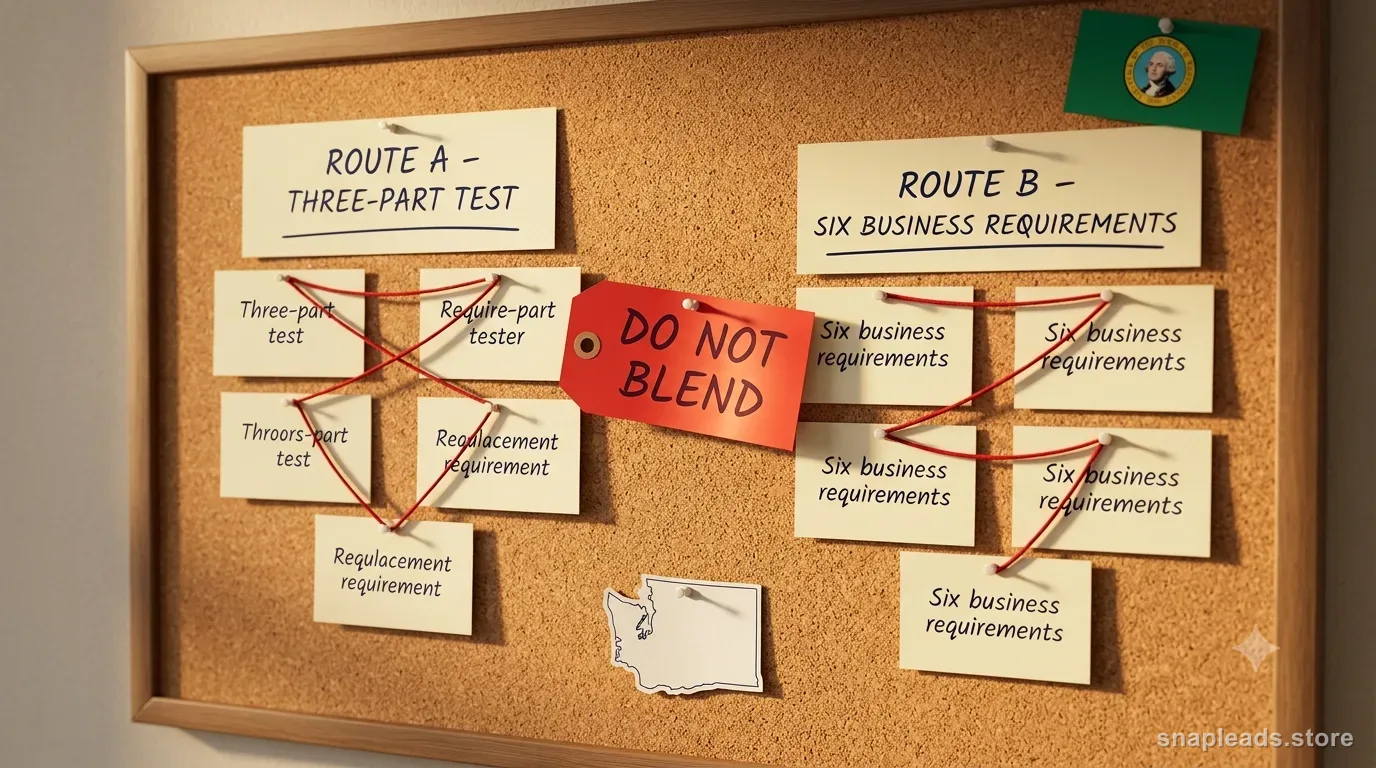
Washington unemployment classification needs its own statute file
Washington Employment Security Department explains that employers pay unemployment taxes on employees, not qualifying independent contractors, and warns that misclassification can produce back taxes, penalties, and interest. For unemployment purposes, RCW 50.04.140 contains statutory exceptions that require a more exact analysis than a generic federal contractor checklist. The relevant question is whether the service meets one complete statutory route.
Keep this file separate from Washington workers’ compensation or licensing analyses. Different Washington programs use different statutes and may have special rules for industries such as construction or electrical work. An employer can create confusion by copying an L&I checklist into an ESD unemployment memo because both use words such as control, business registration, and independent trade. Put “ESD / unemployment insurance” at the top of the workpaper and cite the RCW section being applied.
The first statutory route is a compact three-part test with demanding language
One route in RCW 50.04.140 looks familiar: the individual must be free from control or direction over the performance of the service, both under the contract and in fact; the service must be outside the usual course of business for which it is performed or outside all places of business of the enterprise; and the individual must be customarily engaged in an independently established trade, occupation, profession, or business of the same nature. Each element needs evidence.
This route may fit an established outside specialist whose work is clearly peripheral to the payer’s ordinary business. It is not made easier by a long contract. For control, test actual work practices. For the second element, describe the payer’s usual business and the places where that business operates. For the third, document the independent enterprise. If one element is weak, do not borrow a registration or bookkeeping fact from the six-part alternative and call the three-part route satisfied. The statutory alternatives are not a menu of interchangeable factors.
The second route adds six concrete business-structure requirements
RCW 50.04.140 also provides a separate six-part alternative. In simplified compliance terms, it requires freedom from control; work outside the usual course or outside the places of business, with an additional principal-place-of-business-cost option described by statute; an independently established trade or a principal place of business that qualifies for a federal business-expense deduction; responsibility to file the applicable IRS expense schedule; active and valid state registrations and accounts, including a unified business identifier where required; and maintenance of separate books and records reflecting income and expenses.
Those administrative elements are not paperwork decoration. If the business relies on the six-part route, check them directly. A contractor may operate independently in practice and still lack an active Washington account required by the statute. Another may have a UBI but mix all business receipts with personal spending and not maintain separate books. The employer should obtain evidence appropriate to the engagement without collecting unnecessary personal information: registration verification, business identity, invoices, and a representation or appropriate proof about separate records and tax filing responsibilities.
Choose the route before collecting evidence so the file does not become a hybrid test
A good intake form begins with a routing decision. Route One asks whether the business can support the three statutory elements. Route Two asks whether all six alternative requirements are supportable. If either route has a factual gap, record it. Do not write one nine-factor worksheet and mark the overall relationship “mostly independent.” Washington’s statutory structure makes that kind of blending hard to audit and easy to overstate.
For a contractor class with varied facts, route each worker or genuine business entity separately where necessary. Some vendors may have active registrations and separate books; others may be occasional individuals with no independent enterprise. A single vendor code in accounts payable does not make the group homogeneous. If the company wants a standardized contractor channel, design onboarding around one statutory route and define which engagements must be escalated instead of forcing every vendor through the same label.
“Outside our office” is not enough to establish the place-of-business element
Both routes require careful attention to where and how the service relates to the enterprise. Remote performance can be relevant, but the analysis is not simply whether the individual enters headquarters. Document customer locations, company facilities, job sites, territory, digital or operational presence where relevant, and whether the contractor is performing the enterprise’s ordinary service at those locations. The statute’s wording should guide the memo rather than a casual work-from-home rule.
If relying on the principal-place-of-business-cost language in the longer alternative, document the specific statutory condition instead of reducing it to “has a home office.” Who is responsible for the costs of the principal place from which the service is performed? What location is actually the worker’s business base? Is there evidence of a real business facility or deductible business use? These questions are distinct from the ordinary convenience of working remotely.
ESD consequences make vendor-master maintenance part of classification compliance
ESD warns that an employer that mistakenly treats employees as independent contractors can owe back unemployment taxes, penalties, and interest. That makes classification more than an onboarding decision. A vendor that qualified under a registration-heavy route two years ago may let state accounts lapse, stop operating independently, or shift into a controlled role. Accounts payable often sees these changes before legal or HR does.
Add periodic controls to the vendor master. For contractor classes relying on the six-part route, verify registrations on a reasonable schedule and flag name or entity changes. For both routes, trigger a review when managers add fixed schedules, recurring internal duties, exclusivity, or employee-like supervision. Keep the original classification evidence and the renewal evidence together so a future ESD review can see not only why the company classified the worker initially but also why it continued that treatment.
Construction and other regulated work should trigger a second legal-standard check
Washington statutes contain special provisions for certain industries, including construction and electrical work, and other agencies may apply separate worker rules. This guide is deliberately about unemployment tax under RCW 50.04.140. If the engagement involves regulated construction, electrical work, workers’ compensation, prevailing wage, or licensing, open a separate issue list and identify the applicable statute rather than assuming an ESD result controls the other program.
The compliance benefit is clarity. One worker can require several legal classifications for different purposes, and a company should know which conclusion belongs to which law. Store the ESD memo under unemployment, cross-reference any L&I or licensing review, and avoid statements like “Washington approved this contractor.” Agencies decide issues within their authority; an internal file should be equally precise about its scope.
ROUTING TOOL
RCW 50.04.140 route selector
Pick a complete statutory route first. Do not combine a favorable item from Route 1 with administrative items from Route 2 and call the total a pass.
| Checkpoint | Route 1 — 3-part | Route 2 — 6-part |
|---|---|---|
| Control | Free from control in contract and fact | Free from control in contract and fact |
| Course/place | Outside usual course OR outside all places of business | Statutory course/place condition, including principal-place-cost alternative where applicable |
| Independent business | Customarily engaged in independently established trade | Independent trade OR qualifying principal business place condition |
| Tax/registration layer | Not a substitute for the three elements | IRS expense responsibility + active required state accounts/UBI |
| Records | Evidence supporting all three elements | Separate books/records plus evidence supporting every other requirement |
WORKED EXAMPLE
Example: a consultant cannot pass by combining five facts from two different routes
A Washington manufacturer hires an operations consultant. She controls her methods and works from her own office, but her state business registration has lapsed and she has stopped taking other clients. The company’s worksheet gives points for autonomy, home office, old UBI, invoices, and a written agreement and labels the result “5 of 6—contractor.”
The corrected review stops scoring. It tests the three-part route and the six-part route separately. The independent-enterprise facts require closer examination under Route One, while the inactive registration creates a distinct problem if the company relies on Route Two. Management receives two incomplete statutory analyses instead of one reassuring hybrid score and can decide whether to change the engagement or reclassify.