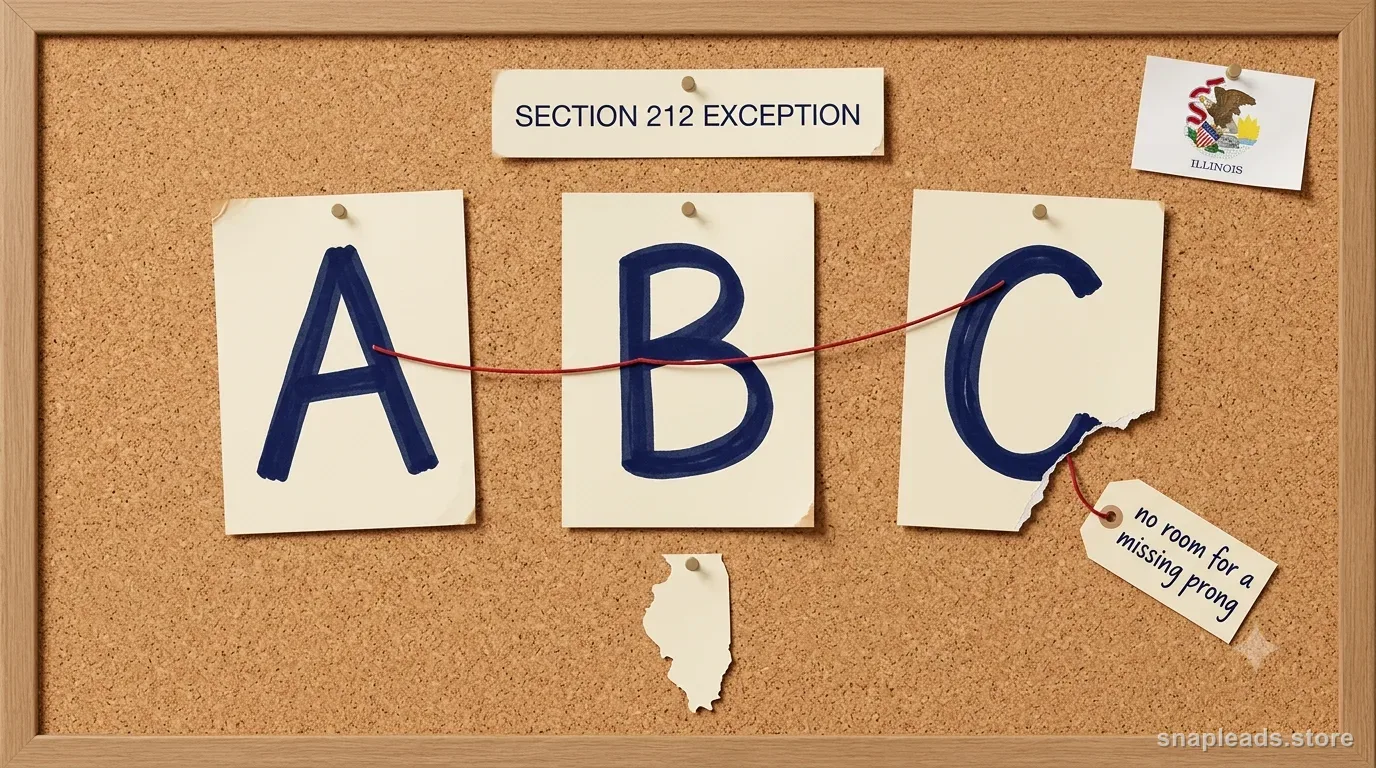
IDES describes Section 212 as a narrow exception to employment
Illinois Department of Employment Security guidance describes Section 212 of the Unemployment Insurance Act as an exception for services where the individual is free from the employer’s control and direction, is engaged in an independent trade, occupation, business, or profession, and performs services outside the course of the employer’s business or outside its place of business. The statutory structure requires the conditions to be established rather than treating contractor status as the default created by a Form 1099.
The practical consequence is an all-prongs workpaper. Separate A, B, and C and identify the evidence for each. If one prong is uncertain, call it uncertain. Do not total favorable facts from the other two. IDES itself characterizes the exception as narrower than the broad everyday idea of an “independent contractor,” which is a useful warning for businesses whose federal or commercial vendor policy uses a looser definition.
Prong A should compare written freedom with the company’s actual right of direction
For control and direction, preserve the contract but test the real operating relationship. Who sets hours, methods, sequence, location, training, staffing, reporting, customer communications, and correction procedures? Which rules merely define the expected result or protect safety, data, or customer property? Which rules allow managers to tell the worker how to perform the service? The right to direct can matter even when a manager exercises it only occasionally.
A useful memo does not declare every policy neutral. If a contractor must attend employee training and follow a detailed internal workflow, say so. If the worker chooses methods and the business only accepts or rejects completed milestones against objective specifications, document that distinction. The point is to determine whether the prong is supportable, not to relabel operational control as “quality assurance.”
Prong B should identify the exact outside-course or outside-place route
Section 212’s second element can be satisfied through the statutory alternatives concerning the course of the employer’s business or the place where services are performed. The employer should state which route it relies on. For the course-of-business route, define what customers pay the company to do and compare the contractor’s service with that activity. For the place route, document where the enterprise’s business is conducted and where the worker performs the service rather than assuming that working from home automatically resolves the issue.
A staffing company placing people into its customers’ operations, a bakery hiring an outside electrician, and a design agency hiring a freelance designer present very different B-prong facts. Use customer contracts, service pages, revenue categories, job sites, and actual work locations. A memo that says only “contractor works off-site” or “service is non-core” without evidence does not show why the statutory alternative applies.
Prong C asks whether an independent trade or business exists beyond the payer
For the independently established trade, occupation, business, or profession element, look outward. Does the individual maintain a business identity, offer services to the market, bear business expenses or risk, serve or seek other clients, invest in tools or facilities, set pricing, maintain required licenses, and continue operating when this engagement pauses? Not every fact must appear in every occupation, but the evidence should describe an enterprise rather than a payroll substitute.
Do not overvalue incorporation. An LLC formed at the payer’s request can coexist with employee-like dependence, while a sole proprietor may operate a substantial independent business without a complex entity structure. Preserve third-party or historical evidence where possible: advertisements, proposals, customer history, insurance, licenses, business registrations, or invoices issued to multiple customers. The strongest Prong C file is created by genuine market activity, not by documents generated for the audit.
Illinois has additional special provisions, so identify the exact statutory section before using a checklist
The Illinois UI Act and IDES rules include special provisions for certain services and industries, including detailed rules beyond the general Section 212 framework. For example, transportation arrangements can implicate more specific statutory and regulatory conditions. An employer should therefore confirm that the general Section 212 test is the right provision before applying it to a specialized worker class.
Create a statutory-routing field in the intake. If the worker is in construction, trucking, direct sales, agriculture, domestic service, or another regulated category, check whether a specific Illinois provision changes the analysis. Keep that specialized review separate from the general A/B/C memo. This avoids both under-analysis and the opposite mistake of importing a narrow industry rule into ordinary professional services.
Use worker-level reconciliation when one vendor category contains different operating models
Businesses often assign all nonpayroll service providers to one accounting code even though their classification facts differ. During an IDES review, split the population by role and operating model. A consulting company may have incorporated project firms bidding fixed scopes, individual specialists embedded in internal teams, and one-time vendors performing peripheral repairs. A single “contractor” code is not evidence that Section 212 applies to all of them.
For each class, identify the representative contract, manager, work location, payment method, customer-facing function, and independent-business evidence. If material differences exist within a class, move to worker-level analysis. This reconciliation also helps quantify potential exposure without assuming that one adverse worker automatically decides every vendor relationship or that one strong vendor proves the rest.
A three-prong exception is easiest to defend when the file leads with its weakest prong
Before finalizing the memo, ask which prong an IDES reviewer would challenge first. Put that issue in the executive summary. If the worker performs the same service the company sells, address B before describing an LLC and outside clients. If managers direct the workflow closely, address A before discussing a separate business. If the worker has no market presence beyond this payer, address C rather than assuming technical skill establishes an enterprise.
Then state the conclusion and unresolved facts with dates. If the business changes the relationship, record the prospective change and the classification review that follows. Section 212 compliance is stronger when management can show a real decision process, including difficult facts, than when every contractor memo reaches the same result through identical favorable language.
SECTION 212 TOOL
Illinois missing-prong gate
A row marked “unsupported” stops the general Section 212 exception analysis; favorable evidence in another row does not cure it.
| Prong | Core question | Evidence set | Status |
|---|---|---|---|
| A — control/direction | Is the worker free under contract and in actual performance? | Agreement + manager/schedule/method records | Supported / gap / unsupported |
| B — course/place | Which statutory alternative applies and why? | Customer offer + locations/job-site evidence | Supported / gap / unsupported |
| C — independent enterprise | Does a market-facing business exist independently? | Clients/marketing/risk/tools/licenses/business records | Supported / gap / unsupported |
| Special-rule screen | Does another UI Act section govern this occupation? | Industry and statutory routing note | General 212 / special review |
| Population scope | Are workers in the class factually alike? | Worker-role reconciliation | Class / split population |
WORKED EXAMPLE
Example: a separate LLC does not cure an inside-the-business service
An Illinois media company hires a producer through the producer’s LLC. The producer has business insurance and occasionally serves another client, giving management substantial Prong C evidence. The producer also chooses technical methods. But the company sells full-service video production and assigns the producer to deliver the same production service sold to customers.
The Section 212 review does not average the favorable A and C facts against B. It identifies the course-of-business issue as the weak prong and obtains advice on that statutory element. The LLC remains relevant evidence of an enterprise, but it is not used as a substitute for proving every required condition.