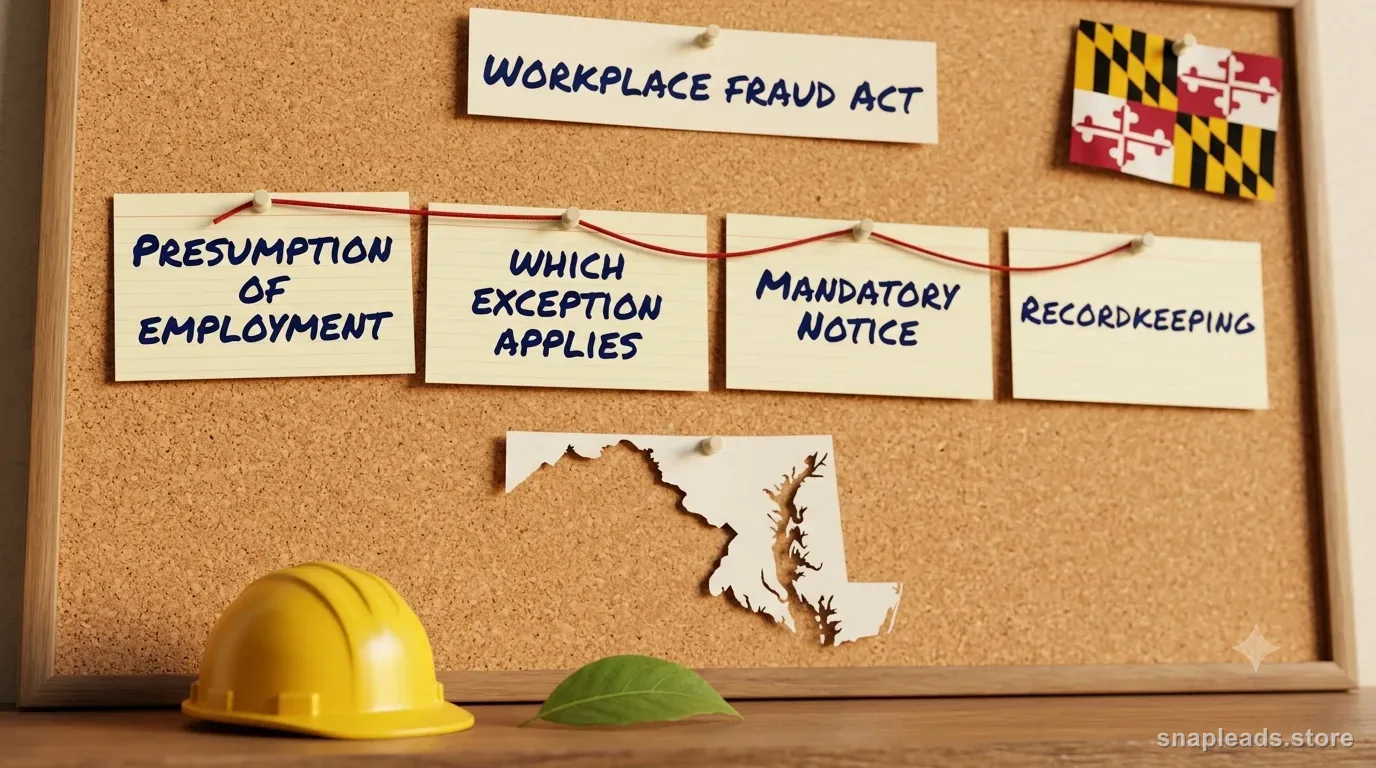
Maryland construction and landscaping start with a presumption of employee status
Maryland’s Workplace Fraud Act focuses specifically on construction and landscaping. In those industries, a worker performing services is presumed to be an employee of the person or business receiving the services unless the relationship fits an exception recognized by the Act. That is more than a generic warning against misclassification; it changes what the company should collect before work begins.
The state explains four pathways that can overcome the presumption in different circumstances: an exempt-person route, the ABC independent-contractor route, certain subcontracting between business entities, and another business-entity subcontracting route with written-contract, affidavit, good-standing, and licensing requirements. The first page of the file should identify which path the business is relying on.
If you rely on the ABC route, prove all three facts rather than restating them
Maryland’s ABC formulation asks whether the worker is free from direction and control over the manner and means of the work, is engaged in an independent business or occupation of the same nature, and performs work outside the usual course of the recipient’s business or outside any place of business of the recipient. A signed agreement that repeats those words is not evidence that they are true.
Use project records. For control, preserve who schedules, supervises, supplies methods, and approves changes. For independent business, preserve other customers, marketing, business infrastructure, and risk. For the course/place element, describe the recipient’s actual business and the worksite. A general contractor should be especially cautious about assuming construction performed at its project site is “outside the business” merely because a subcontractor signed a contract.
The exempt-person route has its own definition and should be documented separately
Maryland describes an “exempt person” under the Workplace Fraud Act as an individual operating an independent business as a sole proprietor with no employees other than a parent, child, or spouse. That is not a synonym for every small contractor. If the company relies on this route, the file should show the facts that make the individual fit the definition during the period of work.
Avoid using a generic vendor questionnaire with a single “sole proprietor?” checkbox. Ask whether the person has employees, who they are, how the business operates, and whether the information remains current. A contractor who later hires unrelated employees may no longer fit the same factual description even though the vendor record never changes.
Mandatory notices are part of compliance, not evidence of contractor status
For covered construction and landscaping businesses, Maryland requires a prescribed Notice to Independent Contractors and Exempt Persons when contracting with an individual in those categories, and a similar notice must be posted at worksites and the place of business. The state provides English and Spanish versions. The notice explains classification; it does not itself make the classification correct.
Track notice delivery like any other onboarding control. Keep the signed worker notice, the version used, the date delivered, and proof that the required posting was in place. Do not turn the notice into a waiver or add language suggesting the worker agrees never to challenge status. The state’s substantive test and exceptions remain controlling.
Maryland’s recordkeeping list should shape the site file
The Department’s business FAQ says covered businesses must retain specified records for at least three years, including identifying and classification information, rates or payment methods, amounts paid each pay period, and additional contractor or exempt-person records. The FAQ also describes keeping at the worksite or place of business a business description or contract, signed notice acknowledgments, and copies of licenses or registrations provided by the contractor or exempt person.
Design the folder around those categories. A worker roster should link each person to classification path, payment method, project, notice acknowledgment, and license or registration record. That structure is much easier to produce during an investigation than searching email for documents after an inspector arrives at a jobsite.
Index those records by worker and project period rather than keeping one undated vendor folder. Construction relationships change quickly: helpers are added, a subcontractor begins taking daily direction, or a separate business stops serving other customers. Periodized records allow the company to show what was true during the months under review instead of reconstructing an idealized relationship from the latest contract.
Business-to-business subcontracting needs entity evidence, not just a new invoice name
Maryland recognizes circumstances in which one business entity subcontracts work to another. Depending on the route, the state focuses on a real business relationship and may require a written contract with statutory elements, an affidavit, good standing, and occupational licenses. Simply asking an individual to create an LLC does not transform the underlying facts.
Before relying on a business-entity route, verify entity status, good standing where required, licensing, who employs and directs the labor, the contract, and whether the subcontractor is genuinely available to others. If the prime contractor still hires, schedules, directs, and pays the individual workers as if they were its own crew, the invoice header is not the main fact.
Investigations reward contemporaneous files and expose retrospective paperwork
Maryland gives the Worker Classification Protection Unit investigative authority that includes entering covered worksites, requesting documents, issuing subpoenas, and pursuing enforcement remedies. That makes timing important. A complete file created at onboarding has a different evidentiary story from forms signed after an investigation begins.
Add three controls to project closeout: verify all contractor notices and licenses remain in the file, reconcile payments to the contractor roster, and flag anyone whose operating facts changed. If a solo exempt person added a crew, if a subcontractor stopped maintaining a separate business, or if the prime began directing day-to-day methods, send the relationship back through classification review before the next project.
MARYLAND SITE-FILE TOOL
Workplace Fraud Act contractor file index
Use one row per individual or subcontracting entity and identify the exact exception relied on.
| File element | ABC contractor | Exempt person | Business-entity route | Refresh trigger |
|---|---|---|---|---|
| Classification path | All 3 ABC prongs | Sole-proprietor definition | Applicable entity exception | Scope/entity change |
| Notice | State worker notice | State worker notice | Check applicability | New project/version |
| Business evidence | Clients, control, course/place | Ownership + permitted family employees | Good standing, affidavit, licenses | Ownership/staffing change |
| Payment record | Method + amount | Method + amount | Entity invoices/payments | New payment model |
| Worksite file | Contract/business description + acknowledgments | Same core records | Contract/entity documents | New site or project |
WORKED EXAMPLE
Example: a landscaping company discovers its “solo subcontractor” now brings a three-person crew
A Maryland landscaping company has used the same sole proprietor for seasonal projects and relies on the exempt-person route. The onboarding file is two years old. On a new job, the project manager notices that the contractor now sends three unrelated workers and directs them on site.
Instead of treating the old checkbox as permanent, the company flags the changed staffing fact, reviews whether the exempt-person definition still fits, and determines whether another Workplace Fraud Act route can be supported. It also refreshes the notice, payment, license, and business records for the new project.
The valuable control is the trigger: a change in how the contractor actually operates forces a new legal path instead of silently inheriting an old classification.