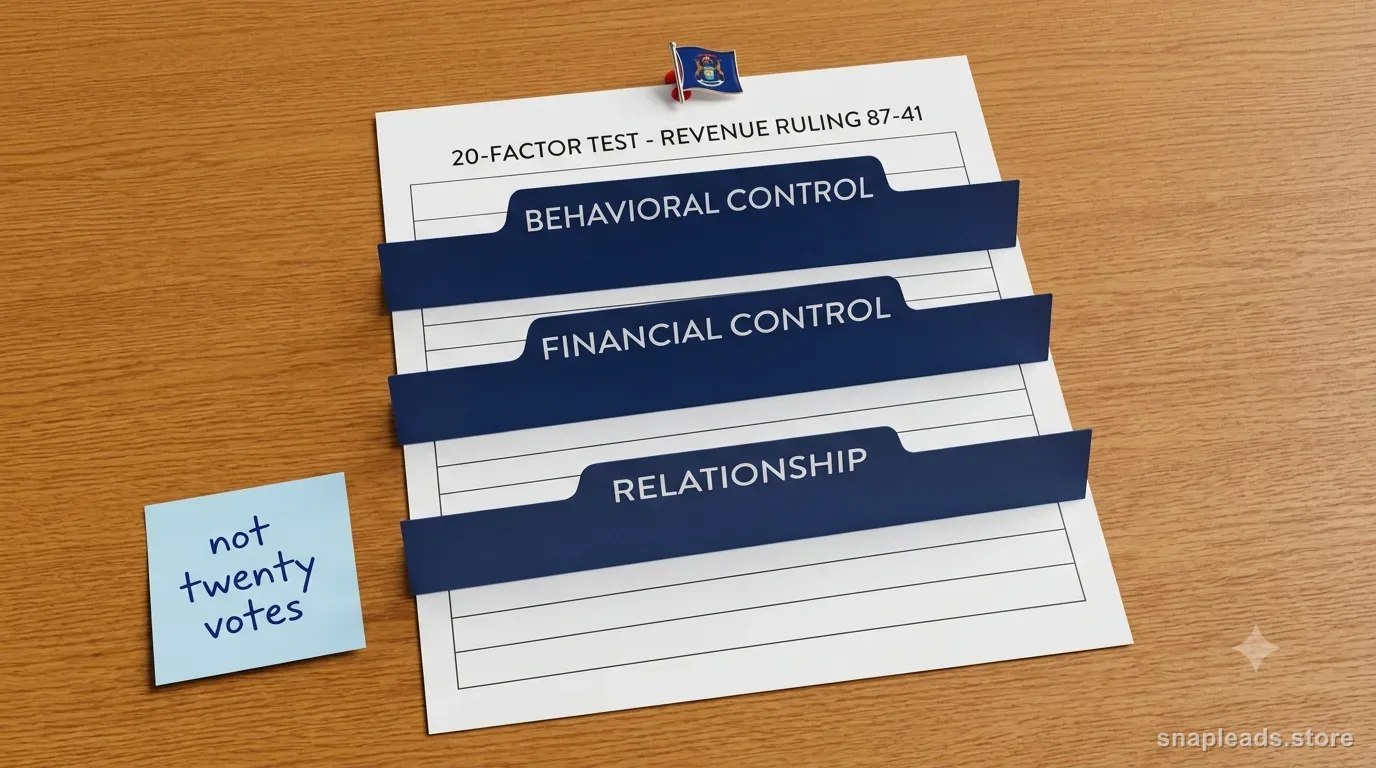
Michigan UIA expressly says its unemployment analysis uses the IRS twenty-factor test
Michigan UIA Fact Sheet 155 states that Michigan unemployment-insurance law requires the IRS twenty-factor test discussed in Revenue Ruling 87-41 to determine whether services were performed as an employee or independent contractor. If the person is an employee, wages are subject to state unemployment taxation and the person may be eligible for unemployment benefits; if the person is an independent contractor, the employer does not pay state unemployment tax on those earnings and the services are not covered employment. That gives the classification decision direct tax and benefit consequences.
The same fact sheet groups the factors into behavioral control, financial control, and relationship categories while cautioning that no one category or factor controls and that there is no magic number of factors. A Michigan review should therefore preserve both levels: a factor-by-factor evidence schedule for traceability and a grouped narrative explaining what the relationship as a whole shows. Avoid a colored dashboard that declares “13 green, 7 red = contractor.”
Behavioral control is easier to evaluate from work artifacts than from job titles
Michigan’s published factor list includes instructions, training, personal performance, hiring and paying assistants, continuing relationship, set hours, full-time expectations, work location, sequence, and reports. These are concrete operating facts. Reconstruct how work flowed: who assigned it, who decided methods, whether the person could change sequence, whether the business trained the worker, whether assistants were possible, and what reporting was required.
Job titles such as consultant, technician, adviser, or contractor do not answer those questions. Neither does the absence of a supervisor standing nearby. A business can retain a strong right of control through required procedures, fixed schedules, mandatory training, approval gates, and personal-service restrictions. Conversely, a contractor may send progress reports because the customer needs project visibility without surrendering control of the means. Explain the function of each practice rather than mechanically classifying it.
Financial control should be reconciled to the general ledger and the worker’s project economics
The Michigan fact sheet addresses payment intervals, expense reimbursement, tools and materials, significant investment, and opportunity for profit or loss. The accounting system can answer much of this objectively. Pull payment history, invoices, reimbursements, company-issued assets, purchase records, and project pricing. Identify which costs the worker could control and whether efficient management could improve profit or poor estimating could create loss.
Do not confuse gross revenue with profit opportunity. A person paid a high hourly rate can still have employee-like economics if the payer supplies the workspace, reimburses expenses, sets hours, and bears all operational risk. A contractor paid a fixed project fee may have stronger business-risk evidence if the contractor staffs the work, purchases tools, absorbs overruns, and can improve margins through independent decisions. Quantify those differences instead of writing “can make a profit.”
Relationship factors test whether the worker operates in a market beyond this engagement
Michigan’s relationship factors include integration of the service into the employer’s operation, work for more than one firm, making services available to the general public, and rights to discharge or terminate. These facts can reveal whether a supposed vendor is truly operating an independent business or functioning as part of the company’s workforce. Review public business presence, proposals, client history, exclusivity, termination terms, and how essential the service is to the payer’s regular operation.
Multiple customers are useful evidence but not a magic requirement, and one customer does not automatically create employment. The important task is to document the whole market relationship. If a specialist temporarily has one large client but continues marketing, maintains infrastructure, negotiates projects, and bears business risk, the context differs from a person working indefinitely under one company’s schedule with no outside market. Preserve facts that show the distinction.
A claim-triggered review can expose payroll and accounts-payable populations that never matched
Michigan UIA’s misclassification materials connect employee status with unemployment coverage, which means a former nonpayroll worker’s claim can bring classification facts into focus. Before that happens, reconcile accounts payable to payroll by role. Identify individuals receiving recurring labor payments, the manager who directs their work, contract dates, Forms 1099 where applicable, and whether similar people perform the same duties on payroll.
This is not an assumption that every 1099 worker is misclassified. It is an exception report. Recurring individual payments, employee-like titles, shared schedules, company equipment, and long duration are reasons to review the relationship, not automatic conclusions. A quarterly or semiannual reconciliation catches role drift while managers can still explain the facts and before years of unexamined payments accumulate.
Periodize the analysis when the relationship changes instead of forcing one historic label
A software contractor may begin with a six-week implementation project using independent methods and later be retained for continuous support with set coverage hours, internal training, and manager-assigned tickets. Several twenty-factor facts have changed. The correct Michigan workpaper should identify the change date and analyze the periods separately rather than deciding that the person was always a contractor because the first agreement said so.
Maintain a role-change trigger in the vendor file: fixed recurring hours, new supervision, company tools, benefits-like perks, indefinite renewals, loss of outside business activity, or a move into the company’s regular internal team. When triggered, compare the current facts with the original factor schedule. If the classification changes, document prospective payroll conversion and preserve the historical analysis rather than deleting it.
The final Michigan memo should explain weight and contradictions, not hide them
Fact Sheet 155 says there is no magic or set number of factors and no one factor stands alone. The final memo should therefore identify the most meaningful control and business-economics facts for the occupation. It should also list contradictory evidence. A worker may supply tools but receive extensive training; may have another client but work fixed full-time hours; may invoice through an LLC but have no authority over method. Those tensions are the analysis.
End with a dated conclusion, the reviewed period, evidence list, unresolved items, and re-review triggers. If the company cannot support the result without ignoring several material facts, escalate before an audit. A file that records uncertainty and a corrective decision is more valuable than a clean-looking twenty-row table created after the worker files for benefits.
MICHIGAN RECONCILIATION TOOL
UIA 20-factor contradiction finder
Group the factors, then record the strongest contractor fact and strongest employee fact in each theme. This prevents a one-sided checklist.
| Theme | Strong contractor-side evidence | Strong employee-side evidence | Record to verify |
|---|---|---|---|
| Behavioral control | Worker chooses methods/sequence | Required training, schedule, detailed instructions | Messages, SOPs, calendars |
| Staffing/personal service | Worker hires and pays assistants | Personal performance required by payer | Subcontractor/staffing records |
| Financial control | Fixed-price risk, own tools/investment | Hourly pay, reimbursements, payer tools | Invoices, AP, asset/expense records |
| Market relationship | Multiple clients/public offering | Practical exclusivity/no outside market | Proposals, marketing, client history |
| Continuity/termination | Project end and contractual remedies | Indefinite relationship/at-will-like exit | Contracts, renewals, termination record |
WORKED EXAMPLE
Example: the same developer changes classification risk after a project becomes a permanent support shift
A Michigan company hires a developer for a fixed-price migration. She uses her own tools, sets methods, and serves another client. After launch, the company keeps her for twelve months of support, assigns a daily 9-to-5 coverage block, supplies a laptop, requires weekly training, and routes tickets through an internal manager. Accounts payable continues the original contractor code.
The semiannual reconciliation spots the changed factors. The company periodizes the file, preserving the project facts separately from the later support arrangement, and re-evaluates the current relationship under UIA’s twenty-factor framework. The useful insight is not that one label was “wrong forever”; it is that the operating relationship materially changed while the vendor master did not.