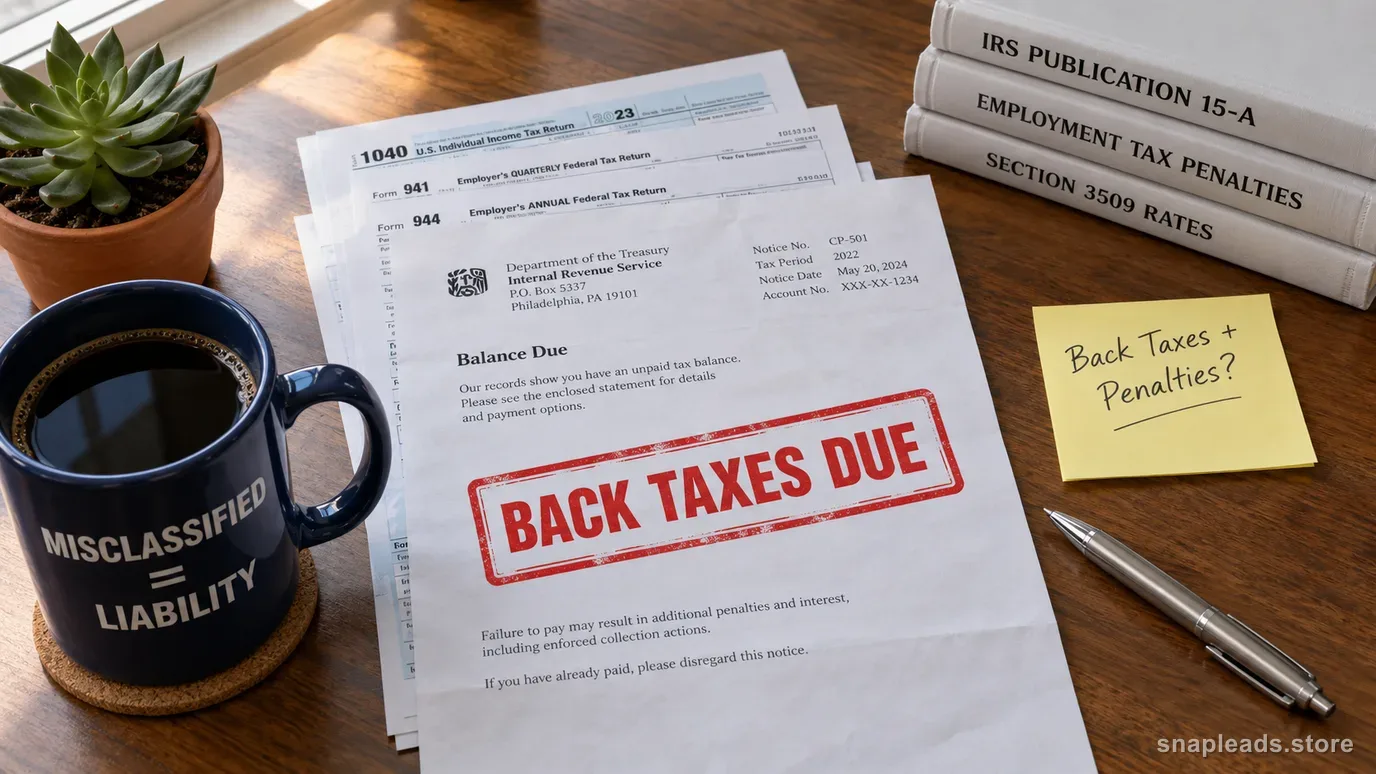
What happens if you misclassify an employee as a 1099 contractor?
If a worker was an employee under the rule that applies to the issue being examined, issuing Form 1099 instead of treating the person as an employee does not end the inquiry. For federal employment-tax purposes, the IRS looks at the actual relationship, including behavioral control, financial control, and the type of relationship. The same facts may also matter under state unemployment law, but a state can use a different statutory test. Wage-and-hour law is another track again: the Fair Labor Standards Act uses an economic-reality analysis rather than the federal tax common-law framework.
That is why the practical consequence is not one universal “misclassification penalty.” A business can face an employment-tax adjustment, information-return corrections, state unemployment contributions, interest, and possibly wage claims arising from minimum-wage or overtime rules. The amount and procedure depend on the facts, the years involved, which returns were filed, whether required information returns were issued, and whether a relief provision applies. This is employer education, not legal or tax advice.
Federal employment-tax exposure is usually the first calculation
For an employee, the employer generally has federal withholding and employment-tax duties that do not apply in the same way to a true independent contractor. When an examination reclassifies a worker, the IRS may calculate taxes on compensation that was previously treated as nonemployee compensation. Publication 15 explains special section 3509 rates that can apply to certain worker reclassifications. Those reduced rates are not simply “the employer owes 7.65%.” The calculation can include reduced employee withholding components as well as the employer Social Security and Medicare portions.
For 2026 guidance, when required information returns were issued, Publication 15 states section 3509 rates of 7.44% for Social Security, 1.74% for Medicare, plus 1.5% for federal income-tax withholding, with a separate Additional Medicare amount where applicable. Higher reduced rates apply if required information returns were not issued. Section 3509 is also unavailable in specified situations, including intentional disregard of withholding requirements. A business should therefore identify the worker population, compensation by year, and information returns actually filed before estimating a number.
Section 530 can relieve federal employment tax without declaring contractor status
Section 530 is a federal employment-tax relief provision, not a classification test and not a declaration that the workers were independent contractors. A business that satisfies reporting consistency, substantive consistency, and reasonable-basis requirements may receive relief from federal employment-tax liability for a class of workers even though the underlying worker status has not been decided. That distinction matters because a state agency, a worker, or another federal law may still analyze the relationship separately.
The first screening question should be whether the business timely filed required information returns consistently with nonemployee treatment and whether substantially similar workers were treated consistently. The business should then document the reasonable basis that existed when the classification decision was made. Evidence created only after an audit starts is not a substitute for what the business actually relied on. If Section 530 may apply, preserve the historical decision file instead of immediately rewriting the story around current facts.
Wage-and-hour exposure is a separate track
A federal tax determination does not automatically answer whether the worker is an employee under the FLSA. The Wage and Hour Division describes misclassification as treating a worker who is an employee under the FLSA as an independent contractor. When the FLSA applies, employee status can affect minimum wage, overtime, and recordkeeping obligations. The Department of Labor's 2026 rulemaking also means employers should distinguish between the 2024 regulation and the Department's current enforcement posture rather than presenting one frozen test as permanent.
Operationally, that means a repair file should include hours information, schedules, time records, compensation terms, and evidence about how work was actually performed, not just Forms 1099 and contracts. A tax-focused spreadsheet may be enough to estimate employment-tax exposure but not enough to evaluate possible wage-and-hour issues. Businesses should avoid assuming that paying above a particular hourly rate makes classification safe; status and wage compliance are different questions.
State unemployment exposure can start from the same worker facts
State unemployment agencies can examine whether payments reported outside payroll should have been treated as wages under state law. California's EDD, for example, says its employment-tax audits verify worker classification and can examine payments for personal services, contracts, invoices, books, and worker information. Its process is not the national rule; other states use their own statutes and tests. The practical lesson is to identify where each worker performed services and not assume the federal result is the only classification decision that matters.
A state assessment may involve unemployment contributions and other state payroll taxes depending on the jurisdiction. The business should reconcile its general ledger, Forms 1099, payroll records, contracts, invoices, and worker roster before responding. Inconsistent populations—such as one list for the IRS and a different list for the state—create avoidable credibility and calculation problems even when there is a legitimate legal distinction between the federal and state rules.
A disciplined correction sequence prevents expensive guesswork
Start with facts, not labels. Build a worker-by-worker table showing services, dates, compensation, location, who set the schedule, who supplied tools or systems, how prices were set, whether the worker served other clients, what benefits were offered, and which tax forms were filed. Then separate the legal questions: federal employment tax, federal wage-and-hour, state unemployment or payroll tax, and any other state-specific employment rule. Do not average the factors into a score; classification frameworks weigh facts rather than award a magic number.
Next, identify available federal relief or settlement routes before filing corrections. Section 530, section 3509, VCSP, amended payroll returns, and prospective reclassification solve different problems. VCSP, for example, is prospective and has eligibility conditions, including restrictions involving current audits. The right sequence depends on whether the business is already under examination and what it wants to accomplish. Document the decision and preserve the version of the facts used at the time.
Exposure map
What to review after a possible 1099 misclassification
Use this as a routing table, not a penalty calculator. Each issue has its own test, records, and possible relief.
| Issue | Agency / rule | Records to pull | What to review next |
|---|---|---|---|
| Federal employment tax | IRS common-law status | Forms 941/W-2/1099, payroll and AP ledger | Section 3509 calculation and Section 530 relief |
| Federal wage-and-hour | U.S. DOL / FLSA | Hours, schedules, pay records, work instructions | Minimum wage, overtime, and recordkeeping exposure |
| State unemployment | State workforce/tax agency | Worker roster, payments, contracts, work location | State test, lookback period, assessment and appeal rights |
| Information reporting | IRS filing rules | 1099/W-2 filing history and corrections | Whether returns were timely, correct, and consistent |
| Prospective correction | IRS / payroll process | Worker-class list and proposed conversion date | VCSP eligibility or another prospective reclassification path |
WORKED EXAMPLE
Worked example: a five-person design studio reclassifies two coordinators
A design studio paid two project coordinators $54,000 each during 2025 and issued Forms 1099-NEC. The coordinators worked inside the studio's project system, attended required weekday planning calls, used company templates, and had no separate client base. The owner first assumes the exposure is simply 7.65% of $108,000, but that shortcut is incomplete because section 3509 has specific reduced-rate mechanics and eligibility limits.
The studio builds one file for federal tax classification and Section 530, another for hours and wage-and-hour facts, and a state-by-state file for the coordinators' work locations. It also confirms whether a current IRS, DOL, or state classification audit affects VCSP eligibility before deciding between prospective payroll conversion and another correction route. The worked example does not decide the workers' legal status; it shows the record sequence needed to make a defensible decision.
COMMON QUESTIONS
Frequently asked
- What is the penalty for classifying an employee as an independent contractor?
- There is no single universal penalty. Federal employment-tax adjustments, information-return penalties, interest, state unemployment assessments, and wage claims can follow different rules, and section 3509 or Section 530 may change the federal tax result.
- Can I just put the worker on W-2 going forward?
- You can change prospective treatment, but doing so does not automatically resolve past periods. Review whether a federal relief or settlement route applies before assuming a forward-only change closes the historical issue. Review VCSP eligibility and timing
- Does a 1099 prove the worker was a contractor?
- No. The form reports how the payment was treated; it does not itself establish worker status. The IRS and other agencies examine the actual working relationship. Why labels and contracts do not decide status
- Should I check Section 530 before calculating back tax?
- Yes, when federal worker reclassification is at issue. Section 530 is a threshold relief question in IRS worker-classification examinations and can eliminate federal employment-tax liability for a qualifying worker class. Section 530 relief in an audit
 Statutory Employee vs. Independent Contractor: The Federal Category Small Businesses Often Miss
 Corporate Officers, Shareholder-Employees, and Directors: Who Is an Employee for Federal Employment Taxes?
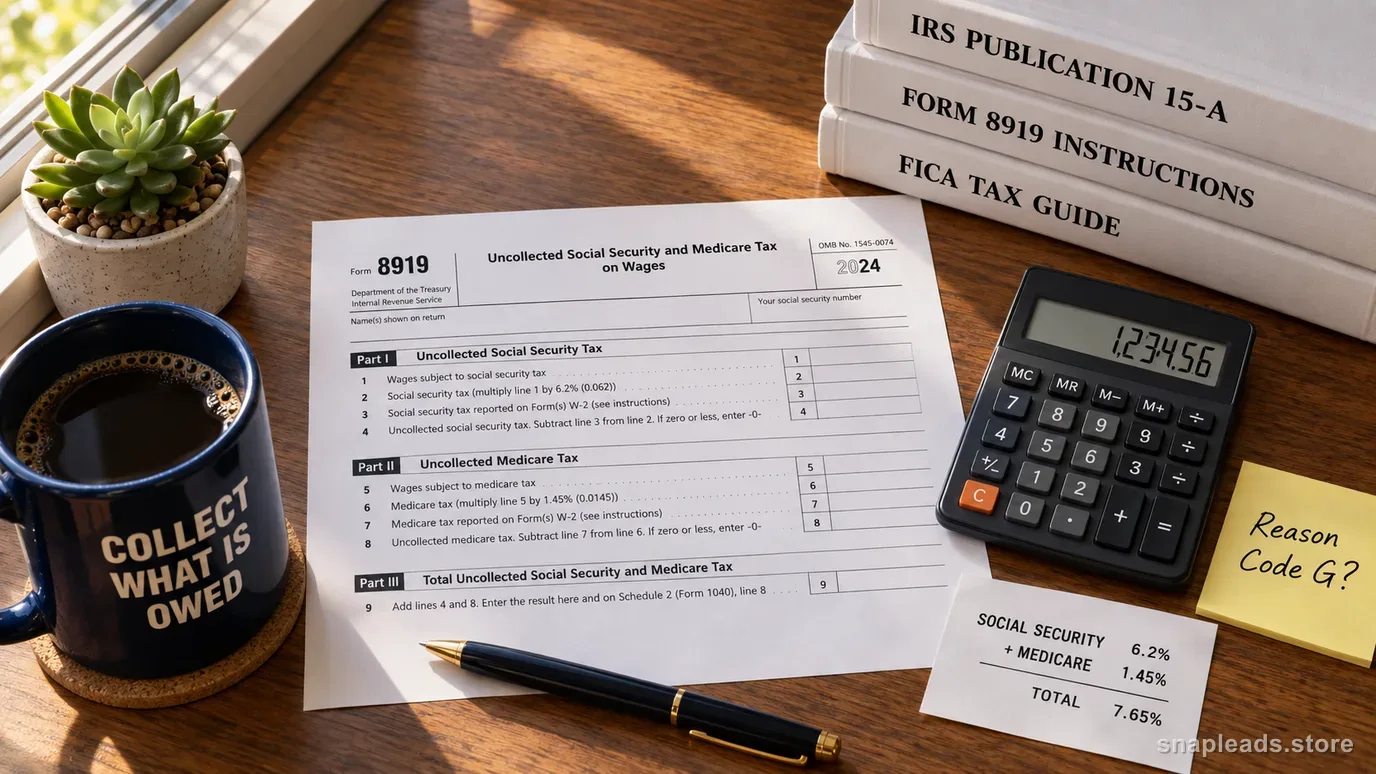 Form 8919: Uncollected Social Security and Medicare Tax
 Nebraska Construction and Delivery Classification: Contractor Registration Is Not the Same as Employee Status
 Part-Time Does Not Mean 1099: How to Classify a Worker With Limited Hours
 What Happens When You Get Audited by Unemployment?