Arizona DES starts with the relationship, not the payment form
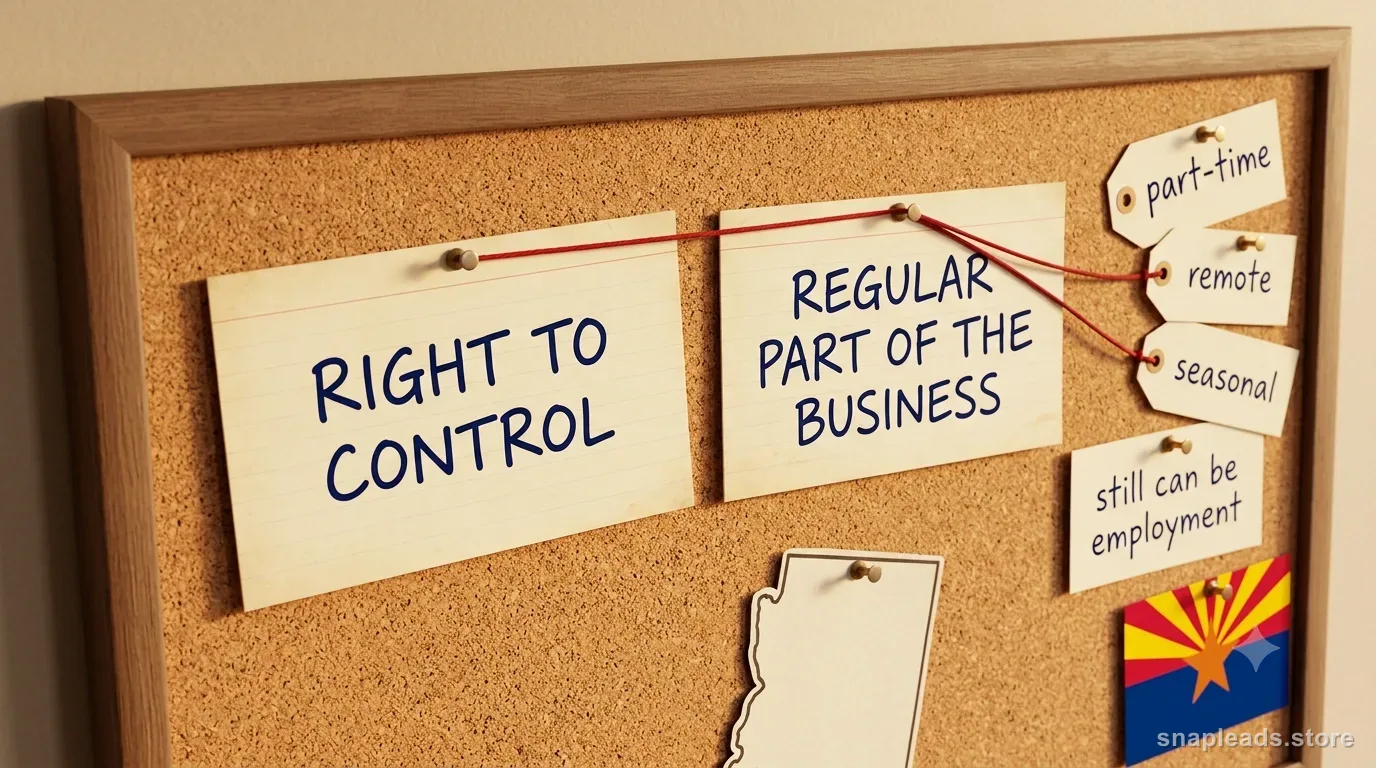
Arizona DES explains that an employment relationship exists when a worker performs services subject to the business’s control or right to control, whether or not the business actually exercises that control. That makes reserved authority as important as daily supervision. A worker can be left alone most days and still be in an employee-like relationship if the company retains the right to direct the details whenever it chooses.
The classification memo should therefore quote the actual decision rights in the agreement and compare them with practice. Who sets methods, sequence, hours, performance procedures, and corrections? Can the worker decline assignments or use helpers? Who decides what happens when the work fails specifications? These facts are more probative than whether AP issues a 1099.
“Regular part of the business” is a risk signal that deserves an operating map
DES says an employment relationship generally exists when the services performed are a regular part of the business, because the business is presumed to have a right to control the manner in which workers perform services that protect its business interests. Do not translate that statement into an automatic rule that every core-service contractor is an employee; instead, treat it as a reason to document the control relationship with more care.
Map the service into the business model. Does the worker deliver what the company sells to customers, maintain a recurring internal function, or perform a discrete outside specialty? Who is accountable for the service quality to the customer? What control does the company retain because the work is integrated into its operation? The answers help explain why control is or is not present.
Part-time, temporary, seasonal, remote, and probationary labels do not remove the issue
Arizona’s UI guidance expressly notes that services may be full-time, part-time, temporary, seasonal, or probationary and may be performed on or off the employer’s premises, including in the worker’s home. Those facts can matter to the relationship, but they do not create contractor status by themselves.
That is especially important for remote labor. A person working from a home office may still follow a company schedule, use company systems, receive detailed instructions, and perform a regular business function. Conversely, an outside specialist can work on site without becoming an employee solely because the job requires physical access. Analyze control and business context instead of using location as a proxy.
Arizona’s “regular part of the business” signal should be tested against the operating model, not the worker’s location
Arizona DES guidance says services that are a regular part of the business are a significant relationship fact and also makes clear that work can be full time, part time, temporary, seasonal, probationary, on premises, off premises, or in the worker’s home. Build an operating map that shows what the company promises customers, which recurring functions make that promise possible, and where the worker’s service sits in that chain. Remote performance does not remove a function from the business model.
The map is most useful when paired with control evidence. A company may hire a specialist for an activity that is important to the business yet genuinely leave the specialist to operate an independent trade; another company may call a worker “project-based” while assigning the same customer-facing production work, procedures, and supervision used for payroll staff. The classification memo should describe both the business-integration signal and the actual right-to-control facts rather than treating either as a single-factor shortcut.
This approach also improves vendor analytics. Instead of flagging every offsite vendor, flag people whose services sit inside a recurring revenue or operating function and then review the relationship facts. That produces a smaller, more relevant population for human review and matches Arizona’s emphasis on the real relationship rather than labels such as temporary, seasonal, or remote.
Use accounts-payable data to find relationships that deserve review
Arizona employers that are liable for unemployment insurance must report employee wages and pay the applicable UI taxes. A practical control is to reconcile recurring payments to individuals outside payroll with the people managers treat as part of ongoing operations. The objective is not to presume every vendor is an employee; it is to find relationships where the right-to-control facts may have drifted.
Useful flags include monthly labor payments, company email accounts, recurring schedules, internal titles, manager task assignment, company equipment, and work identical to payroll roles. For each flag, open the current contract and confirm whether the operating relationship still matches the original classification memo.
Do not let a business entity hide the individual service relationship
An invoice from an LLC can be relevant evidence that the worker operates a business, but Arizona DES says independent contractors are customarily engaged in an independent trade, occupation, profession, or business. The entity name should lead to more factual questions, not end them. Does the enterprise market to others, set prices, bear costs, and control how work is performed?
Keep business-entity documents in the file, but pair them with actual market and control evidence. A single-member entity created because procurement required a vendor name may tell a very different story from a consulting firm with multiple customers, employees, insurance, independent systems, and project risk.
Document change dates when a project becomes an operating role
Many classification failures begin with a legitimate project. A specialist is hired for a defined implementation, then kept for support, placed on a fixed schedule, given internal responsibilities, and managed through the same workflow as employees. The tax coding remains unchanged because no one reopens the vendor record.
Set re-review triggers for indefinite renewals, fixed recurring hours, internal title or email, new supervision, company-provided tools, and transfer into a regular business function. If the facts change, periodize the file rather than insisting the original relationship determines all later months.
ARIZONA RELATIONSHIP MAP
Right-to-control + regular-business review
Use this before approving recurring individual vendors.
| Question | What to document | Contractor-side fact | Employee-side fact |
|---|---|---|---|
| Who controls method? | Instructions, SOPs, approvals | Worker selects means | Company reserves detailed direction |
| Is service regular to business? | Workflow/revenue map | Discrete outside specialty | Recurring core operating function |
| How is time controlled? | Schedules, calendars | Milestone/deadline only | Fixed shifts/availability |
| What business exists outside payer? | Clients, marketing, costs | Independent market | Entity with no outside activity |
| Did role drift? | Original vs current scope | Project remains bounded | Ongoing embedded role |
WORKED EXAMPLE
Example: an Arizona seasonal label masks year-round control
An Arizona event company hires a “seasonal contractor” each year for a four-month busy period. The worker is paid through accounts payable, but the company sets daily shifts, provides the equipment, trains the worker in company procedures, assigns every event, and requires supervisor approval for time away.
The annual vendor review stops treating “seasonal” and “1099” as status facts and maps the actual right to control. Because the same relationship recurs and the service is a regular part of operations, the business escalates classification rather than assuming temporary duration makes the worker independent.
The lesson is simple: duration describes when the work happens; it does not answer who controls how it happens.