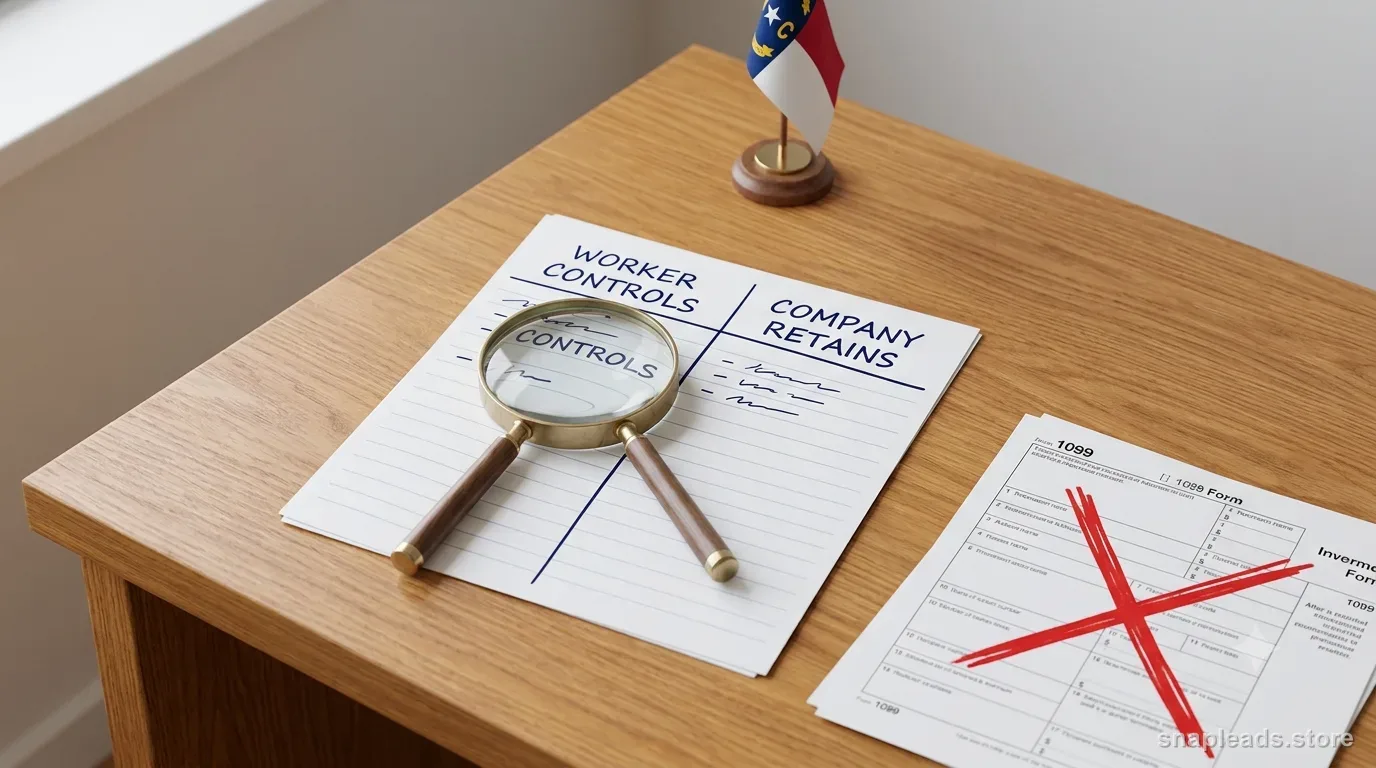
North Carolina gives “independent contractor” a direct statutory definition
North Carolina’s unemployment statute defines an independent contractor as an individual who contracts to do work for a person and is not subject to that person’s control or direction with respect to the manner in which the details of the work are performed or what the individual must do as the work progresses. That wording puts day-to-day operating authority at the center of the file.
Start by listing decisions, not labels. Who decides sequence, methods, staffing, work hours, location where flexible, tools, corrections, and how the job progresses? Then list the company’s legitimate customer constraints: deadline, required result, safety rules, regulated requirements, or acceptance criteria. The boundary between those lists is the classification evidence.
A strong contract allocates decisions, but the working relationship must follow it
An agreement can help by defining deliverables, change-order procedures, responsibility for tools and helpers, payment milestones, and the worker’s discretion over method. It becomes weak when managers ignore it and direct the details anyway. North Carolina’s definition asks whether the individual is subject to control or direction, not whether the contract uses independent-contractor terminology.
Compare the contract with project communications. If the agreement says the worker chooses schedule but a supervisor assigns fixed daily hours, note the contradiction. If the worker may hire assistants but every substitute requires the company’s employment-style approval, document that. Classification review should describe the relationship that existed, not the relationship procurement intended.
Use a “decision-rights map” for roles where control is subtle
For knowledge work, control may not look like a foreman giving instructions. It can appear as mandatory procedures, required internal tools, ticket assignment, approval gates, or a standing duty to be online. A decision-rights map makes those less visible facts concrete. List each recurring decision and identify who has final authority.
For field work, the map may cover route, sequence, staffing, equipment, purchase of materials, and rework. For creative work, it may cover concept, method, software, revision process, and timing. The point is occupation-specific evidence. A generic “sets own hours?” checklist can miss the actual control point in the service being reviewed.
Connect classification to DES reporting obligations before the worker leaves
North Carolina DES explains that employers meeting state liability rules must register and file quarterly tax and wage reports for employees. A classification decision therefore determines whether compensation belongs in the unemployment wage-reporting system. Waiting until a former contractor seeks benefits can turn a current records question into a historical reconstruction problem.
Reconcile payroll and accounts payable by individual at least periodically. Flag recurring labor payments to people who have manager assignments, employee-like schedules, or roles parallel to payroll staff. The flag does not mean the person is an employee; it means the company should confirm that the control-or-direction file still supports nonemployee treatment.
Separate customer specifications from a retained right to direct the work
North Carolina’s control-or-direction inquiry becomes clearer when the file distinguishes the result the customer purchased from the decisions used to produce it. A deadline, required deliverable, security standard, or acceptance criterion can describe the result. By contrast, a standing right to set the worker’s sequence, daily hours, methods, staffing, or corrective process reaches into how the work is performed. Put those two categories on separate pages instead of treating every requirement as “control.”
The same document can contain both kinds of facts. A statement of work may legitimately require a monthly close by the fifth business day but also require the individual bookkeeper to work the client’s prescribed 9-to-3 schedule, follow a supervisor’s task order, and obtain permission before changing reconciliation methods. The first fact describes an outcome; the later facts may show retained direction over details. The classification memo should quote the operative rights and then compare them with actual project messages.
This also prevents an opposite error: removing ordinary quality standards merely to make a contractor file look independent. The objective is not to erase every client requirement. It is to identify who has the legal and practical authority over the manner, details, and progress of the work, which is the distinction North Carolina’s statutory definition and DES materials make important.
Periodize the file when the right to control changes
A North Carolina contractor can begin with a clearly defined deliverable and later become embedded in ongoing operations. A company may add fixed support hours, internal procedures, standing assignments, or manager approval as the relationship matures. Those changes affect the statutory question even if invoices and tax reporting remain unchanged.
Record the date of material changes and review the periods separately. If the first three months show independent control but the next year shows detailed company direction, do not force one conclusion across the entire history. A dated role-drift log helps the business identify when reclassification or additional advice is needed.
An audit memo should explain retained rights, not just exercised instructions
A common response says “we never supervised the contractor.” That can be incomplete if the agreement or operating structure gave the company authority to direct details when it wished. Identify both what the company actually did and what rights it retained. If the worker was free because the company lacked the right to control method—not merely because the manager chose not to interfere—say so and support it.
End the memo with unresolved facts and a re-review trigger. If the worker’s scope is expanding, if a manager wants fixed coverage, or if the company is about to issue internal equipment and mandatory procedures, classification should be checked before the new model starts rather than after DES asks why the person was not reported.
NORTH CAROLINA CONTROL MAP
Who owns each work decision?
Fill this with the manager and the worker-facing contract side by side.
| Decision | Worker has final say | Company has final say | Evidence |
|---|---|---|---|
| Method/sequence | SOW, instructions, messages | ||
| Schedule/availability | Calendar, coverage rules | ||
| Tools/systems | Asset and access records | ||
| Helpers/substitutes | Contract, approval history | ||
| Corrections/rework | Acceptance criteria, tickets | ||
| Progress decisions | Project plan, supervisor notes |
WORKED EXAMPLE
Example: a North Carolina bookkeeper is independent on method but not on daily workflow
A company hires a bookkeeper who invoices monthly and uses her own accounting practice. The contract says she controls method. In practice, the controller assigns tasks each morning, requires work from 9 to 3, dictates the order of reconciliations, requires the company’s step-by-step procedure, and must approve any absence.
The classification review does not stop at the external business or invoice format. The decision-rights map shows that the company retains substantial authority over how the work progresses. The business escalates the relationship for employment-status review before another year of nonpayroll payments accumulates.
The useful insight is that a real outside business can still have a particular client relationship whose control facts deserve separate analysis.