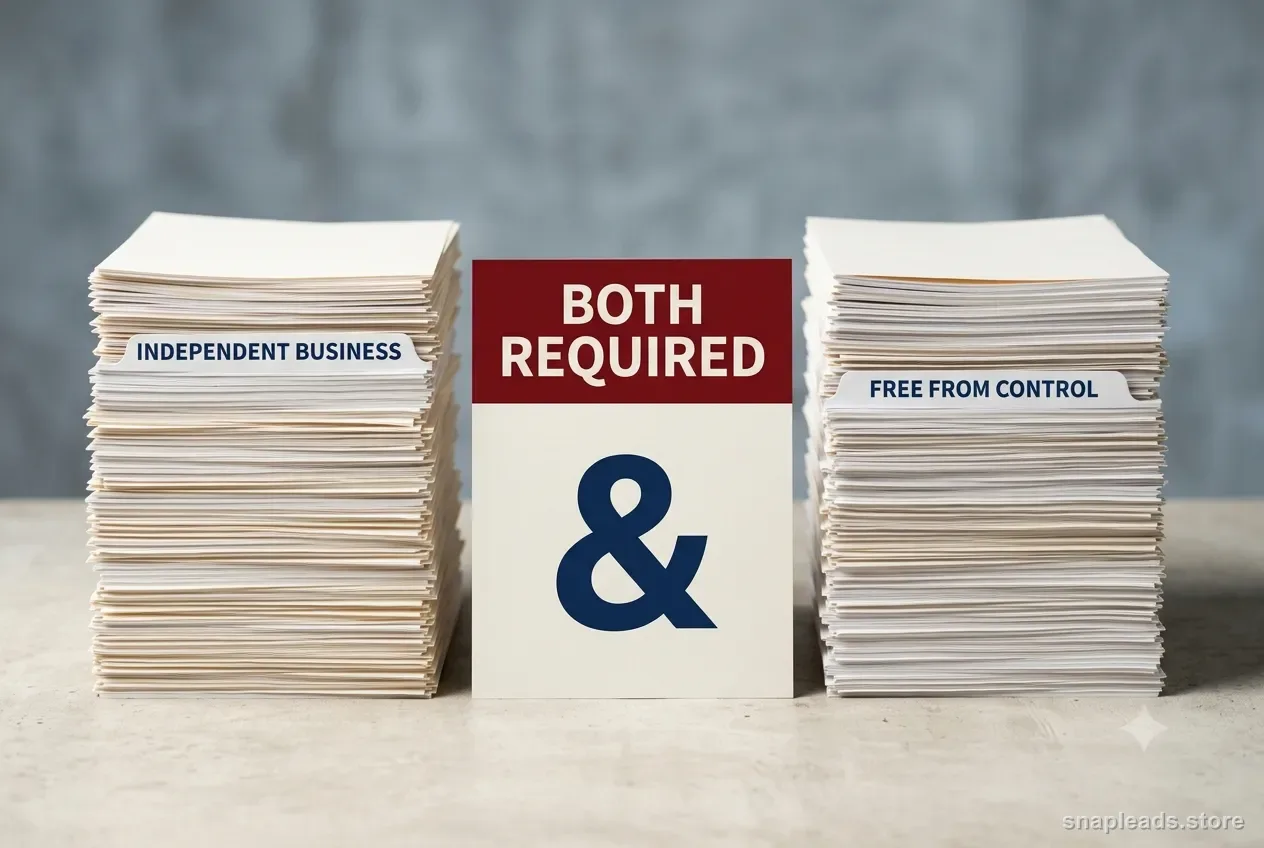
Utah requires two “yes” answers, not one overall impression
Utah’s Employment Security Act guidance says services performed for wages or under a contract of hire are considered employment unless the individual is customarily engaged in an independently established trade, occupation, profession, or business of the same nature as the service and has been and will continue to be free from control or direction over the means of performance, under the contract and in fact.
Build two separate conclusions. The first asks whether an independent business exists. The second asks who controls performance. Do not let strong evidence in one column compensate for a failure in the other. Utah’s own worker-misclassification materials summarize the rule the same way: independently established and free from company control or direction.
Independent business is tested by market reality
Utah lists guide factors such as a separate place of business, substantial investment in tools or equipment, services for other customers, profit or loss, and advertising or other public offering. The importance of each factor varies by occupation, so the file should explain what independence looks like for this specific trade or profession.
A software consultant may not need a commercial office but may have subscriptions, insurance, multiple proposals, pricing discretion, and clients. A mechanic may have significant equipment and a separate shop. Preserve evidence that the business exists beyond one payer and can continue after the engagement ends. A newly formed entity with no market activity should not be treated as equivalent to an established enterprise.
Freedom from control is about the means of performance
Utah’s guidance considers factors such as instructions, training, personal service, assistants, continuing relationships, set hours, method of payment, expenses, tools, and other indicators of control. Use those factors as evidence of who controls means—not as a mechanical point system.
A customer can specify the product, deadline, and regulatory requirements without necessarily controlling every method. The concern is retained authority over how the worker performs: required sequence, mandatory techniques, extensive company training, fixed hours, or supervision that goes beyond acceptance of the final result. Document both the reserved contract rights and actual practice.
Utah’s practical question—what happens when this job ends?—belongs in the memo
Utah’s UI materials offer a useful practical heuristic: if the worker finishes the engagement and is simply unemployed, that can indicate the person was not independently established. It is not a substitute for the legal test, but it forces the reviewer to examine whether a business exists apart from the current payer.
Answer the question with evidence. Does the worker have other customers, bids, advertising, recurring business expenses, licenses, or a pipeline? What did the person do before this engagement? What work is scheduled after it? A vague statement that the contractor “can work for anyone” is weaker than records showing an actual market-facing business.
Build the independent-business record as a timeline, not a snapshot taken after a claim
Utah’s independently established-business requirement is easier to evaluate when the evidence shows what existed before, during, and after the engagement. Record when the worker began offering the same type of service, when business licensing or insurance began if relevant, how customers were found, whether prices were set independently, what continuing expenses existed, and whether the worker kept seeking or serving a market while the payer’s project was active. A folder assembled only after a benefits claim can overemphasize documents created in response to the dispute.
A limited client list is not a reason to invent customers or treat the analysis as a head count. Instead, document market behavior. Did the person advertise, quote other work, maintain a business location or equipment, carry recurring business costs, negotiate project terms, or have a realistic ability to continue the same trade when this contract ended? If the answer is weak, say so. Utah requires the independent-business pillar in addition to freedom from control; one strong pillar does not cure an unsupported second one.
For recurring vendor reviews, preserve a one-page timeline with dated evidence rather than replacing last year’s file. That makes deterioration visible. A worker who once served several customers may gradually stop marketing, become economically tied to one payer, and take on an indefinite operating role. The historical record lets the reviewer identify when the Utah analysis should be reopened instead of pretending the original onboarding facts remained permanent.
Do not treat Utah’s online assessment as an official determination
Utah provides a worker-misclassification assessment tool, but the state states that the assessment is not an official employment or non-employment determination and that investigations are case-specific. Use a self-assessment to identify questions, not as a certificate to store in the vendor file and forget.
For a material or uncertain population, Utah’s guidance tells employers who classify or contemplate classifying workers as self-employed or independent contractors to notify Workforce Services so a proper determination can be made. Before doing so, organize the two-part evidence and the actual contract; do not submit a generic checklist without the operating facts.
A Utah re-review should be triggered by loss of either pillar
The relationship can change in two different ways. The worker may remain autonomous but stop operating an independent business because one client consumes all capacity and outside activity disappears. Or the business may remain healthy but a particular client begins imposing detailed methods, hours, and supervision. Either change matters because Utah requires both conditions.
Track two trigger families: market-independence triggers and control triggers. A quarterly review does not need to redo every factor; it can ask whether any trigger occurred since the last memo. If so, update the relevant evidence and document the new period.
UTAH TWO-PILLAR CHECK
Independent business and control must both stand
Use separate evidence for each pillar.
| Pillar | Strong evidence | Weak/contradictory evidence | Refresh trigger |
|---|---|---|---|
| Independent business | Other clients, marketing, fixed costs, profit/loss | Entity exists only for this client | Client concentration spikes |
| Control | Worker chooses method/sequence | Required methods, hours, training | Manager changes workflow |
| Contract | Rights match independence | Client reserves detailed control | Renewal/amendment |
| Reality | Practice matches contract | Operations contradict contract | New tools/systems/schedule |
WORKED EXAMPLE
Example: an autonomous Utah analyst has no independent business left
A Utah data analyst originally served four clients and controlled method and schedule. Over two years, one company expands the engagement until it represents all of the analyst’s work. The analyst stops marketing, drops business insurance unrelated to the client, and has no pipeline, but still works autonomously.
The company’s old memo focuses on lack of supervision and says “contractor.” The re-review separates Utah’s two pillars and recognizes that independent-business evidence has materially changed even though control evidence remains favorable. The relationship is escalated instead of assuming autonomy alone is enough.
That is exactly why the two conditions should never be blended into one general impression.
COMMON QUESTIONS
Frequently asked
- Are Utah’s two conditions an either/or?
- No. They are conjunctive. Under the Employment Security Act, a worker is an independent contractor only if an independently established business exists and the worker is free from control over the means of performance. One strong pillar does not cure a weak second one.
- A worker is very autonomous but now has only one client — is that still independent in Utah?
- Possibly not. If outside market activity has disappeared and the worker would simply be unemployed when the engagement ends, the independently-established-business condition may fail even though the control condition still looks favorable.
- Is Utah’s online worker-misclassification assessment an official determination?
- No. The state says the self-assessment is not an official employment or non-employment determination and that investigations are case-specific. Use it to spot questions, then organize the two-part evidence before asking Workforce Services for a determination.
- Does meeting the IRS test satisfy Utah?
- Not by itself. Utah applies its own two-part test for unemployment purposes. Reuse the underlying facts, but reach separate conclusions on the independent business and on control. Federal three-category framework.