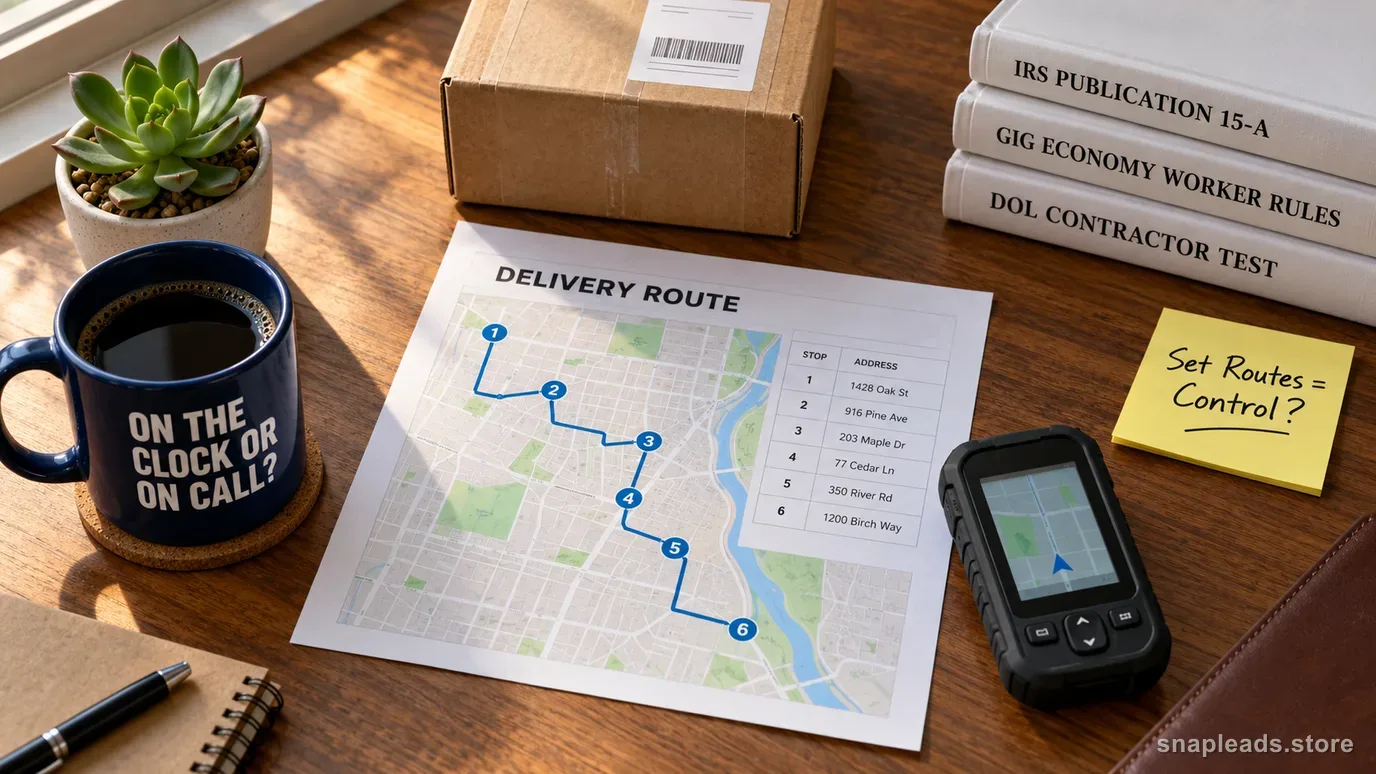
Are delivery drivers 1099 contractors or W-2 employees?
There is no federal tax rule that classifies all delivery drivers the same way. The IRS common-law framework examines behavioral control, financial control, and the type of relationship. A business running a local delivery operation should therefore analyze how routes are assigned, who sets service prices, whether drivers can reject work, who owns or leases vehicles, who bears operating costs, how customer relationships are controlled, and whether the driver is operating an independent courier business.
The occupation label is especially misleading in delivery work because several business models sit under the same word “driver.” A restaurant may hire scheduled in-house drivers. A pharmacy may contract with a courier company. A local courier may serve dozens of businesses under negotiated jobs. An app may match drivers with delivery offers. The facts of each operating model must be reviewed separately. This is employer education, not legal or tax advice.
Route control is often more informative than vehicle ownership
Owning a car does not automatically make a driver an independent contractor. A driver can supply a vehicle while the business still controls the route sequence, mandatory start time, delivery procedures, customer communications, uniform or appearance, performance standards, and the process for accepting or rejecting assignments. Conversely, a company-owned vehicle does not by itself establish employee status if another business truly controls the delivery service under a broader commercial arrangement.
Document who creates the route, whether the driver can rearrange stops, whether jobs are individually accepted, who decides when the driver must be available, and what happens after a missed delivery. Distinguish safety or customer-protection requirements from detailed control over work method. A requirement to protect medication temperature or obtain proof of delivery can be a service requirement; a minute-by-minute operating script may provide different evidence.
Follow the money through each delivery
Financial control in delivery work can be visible in pricing and operating risk. Ask who sets the delivery charge, whether the driver can negotiate rates, who pays fuel, maintenance, insurance, tolls, parking, mobile data, and vehicle depreciation, and whether the driver can profit through business choices rather than simply working more assigned hours. A genuine courier business may quote routes or jobs, combine customers, manage capacity, hire help where permitted, and absorb inefficient routing costs.
Do not turn those facts into a checklist score. A driver can have unreimbursed expenses and still be an employee, and a contractor can work under service standards. The purpose of the analysis is to understand who controls the business side of the delivery activity and whether the driver makes services available to a market independently of the hiring company.
Customer ownership and substitution reveal the operating model
An in-house last-mile operation usually treats customers as the company's customers. Drivers may have no authority to market to them, negotiate fees, or send another qualified driver. An independent courier business may contract to produce a delivery result and control which driver performs the job, subject to licensing, insurance, confidentiality, or customer requirements. Again, substitution is evidence rather than a mandatory test; many regulated services legitimately limit who can perform work.
Review dispatch records, customer contracts, route sheets, driver agreements, and insurance documents together. If the written contract says the driver controls delivery operations but the dispatch system requires acceptance of every route, fixes availability, sets all prices, and disciplines drivers for deviations unrelated to the required result, the operational facts may contradict the contract.
FLSA and state delivery laws require separate review
Federal employment-tax common law is not the same as the Fair Labor Standards Act analysis. The Department of Labor's current 2026 materials describe an economic-reality approach and ongoing rulemaking, so employers should not present the tax factors as the nationwide wage-and-hour answer. If wage or overtime obligations are at issue, build a separate FLSA file using the Department's current guidance.
States can also use their own unemployment or industry-specific statutes. The supplied site already has state guides for Minnesota and Nebraska, where delivery or construction-related statutes deserve their own analysis. Link to the applicable state page rather than telling readers that one federal driver example controls every jurisdiction.
Audit the driver population consistently
Create a roster with every driver, service territory, vehicle arrangement, route source, compensation method, expenses, ability to reject jobs, other customers, and contract version. Then compare drivers who perform similar work. If one group is W-2 and another is 1099, write down the actual operating difference. A difference in start date, tax form, or vehicle ownership alone may not explain the split.
Revisit the classification when the delivery model changes. A business may begin by buying overflow delivery services from independent couriers and later create fixed routes, branded procedures, required shifts, and direct supervision. The historical contractor arrangement does not automatically remain valid after the operational model becomes more integrated.
Keep commercial-auto or personal-auto insurance records, mileage or expense reimbursement policies, dispatch-system settings, driver onboarding materials, and any service-level agreements with customer businesses. Insurance allocation does not decide status, but it can show how the parties understood vehicle risk and who was operating the delivery business. The same is true of branded equipment: a logo on a vehicle is relevant only in context with route control, customer ownership, pricing, and the rest of the relationship.
Driver operating-model matrix
Map the delivery business before choosing 1099 or W-2
The useful comparison is not 'owns car vs. does not own car.' Document who controls the delivery operation.
| Fact | In-house driver pattern | Independent courier-business pattern |
|---|---|---|
| Routes | Company assigns standing routes and sequence | Courier accepts/organizes jobs or routes under commercial terms |
| Pricing | Company sets driver pay and customer price | Courier negotiates or quotes service fees |
| Availability | Required shifts or dispatch windows | Business manages capacity and can decline work |
| Vehicle economics | Costs may be company-paid or tightly reimbursed | Courier bears meaningful operating costs and business risk |
| Customers | Customers belong to hiring company | Courier serves multiple business customers |
| Substitution | Personal service expected | Business may deploy qualified personnel where contract and law permit |
WORKED EXAMPLE
Worked example: same-day pharmacy delivery
A pharmacy schedules six drivers from noon to 8 p.m., assigns routes through its dispatch system, sets every delivery fee, requires drivers to accept all assigned stops, dictates customer-contact scripts, and pays a fixed hourly amount plus mileage. Drivers use their own cars. The pharmacy should not treat vehicle ownership as the deciding contractor fact; the route, schedule, pricing, and operating-control evidence needs a full classification review.
For overflow work, the pharmacy also contracts with Metro Courier LLC for a fixed nightly route price. Metro serves multiple pharmacies, chooses its qualified drivers, manages vehicle and insurance costs, sequences stops within medication-handling requirements, and bears the cost if a route takes longer than expected. The pharmacy keeps the commercial courier contract separate from its individual-driver files.
COMMON QUESTIONS
Frequently asked
- Is a delivery driver a contractor if they use their own car?
- Not automatically. Vehicle ownership is one financial fact. Route, schedule, pricing, customer, supervision, and the whole relationship still matter.
- Can local couriers be independent contractors?
- A genuine independent courier business can exist, but contractor status depends on the operating relationship and applicable federal and state rules, not the courier label.
- Do state delivery-driver rules differ?
- Yes. State unemployment and industry-specific laws can use different tests. Review the state where services are performed. Worker-classification state guides
- Should we review drivers when routes become fixed?
- Yes. A change from project or overflow delivery to required recurring routes can materially change the classification facts. Review status after role changes
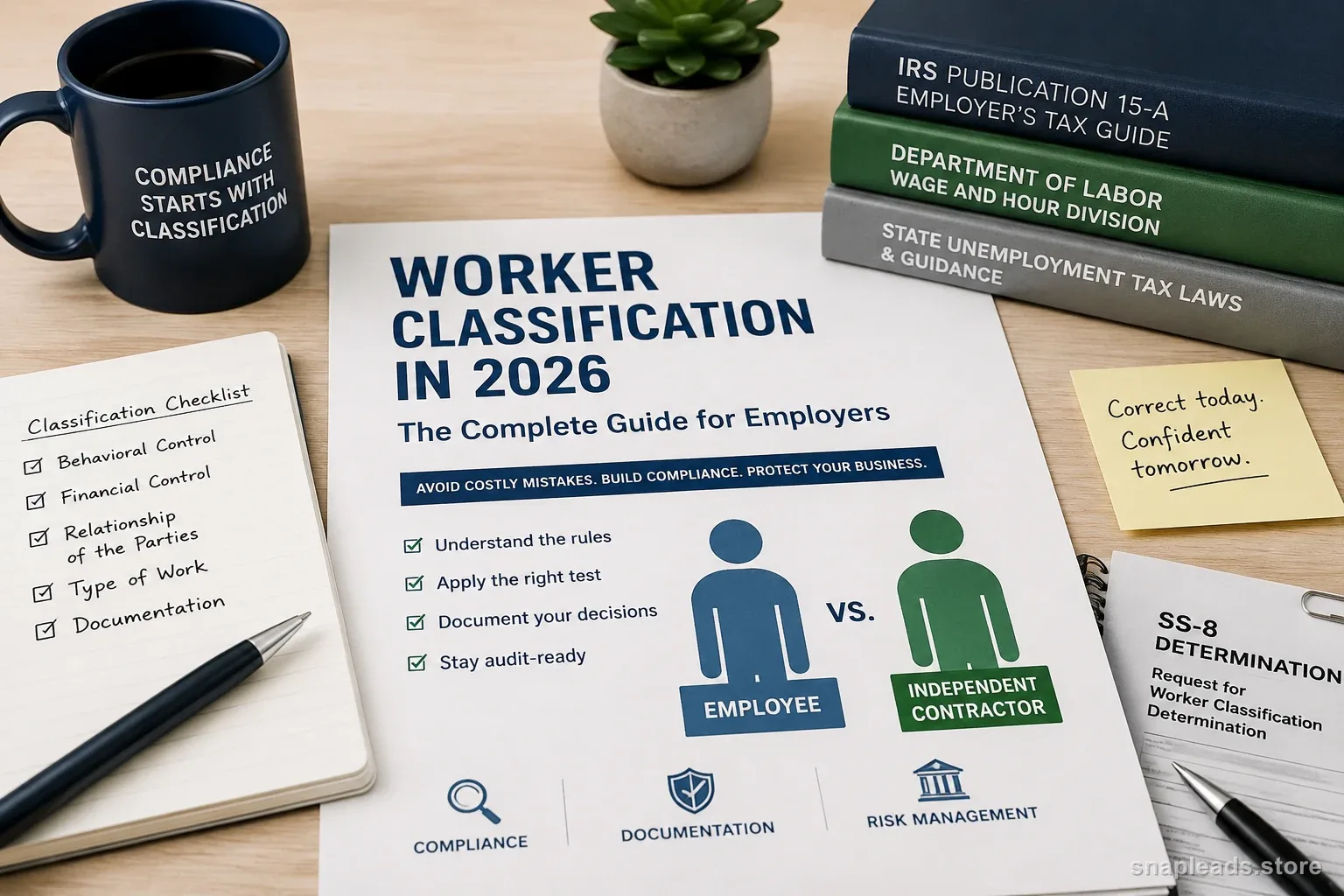 1099 or W-2? Start With the IRS Three-Category Classification Framework
 Corporate Officers, Shareholder-Employees, and Directors: Who Is an Employee for Federal Employment Taxes?
 Is a Bookkeeper 1099 or W-2?
 Can You Be W-2 and 1099 for the Same Company?
 Is a Remote Software Developer a Contractor or Employee?
 Is a Personal Trainer at a Gym an Employee or Contractor?