
Employee classification audit checklist: start with population, not factors
The first self-audit task is to identify everyone paid for services outside payroll. Pull the general ledger, accounts-payable vendor file, Forms 1099, W-9 records, payment platforms, expense accounts, and any recurring service providers coded as professional fees or contract labor. Do not begin with a worker-classification quiz, because a perfect legal framework does not help if half the worker population is missing from the review.
Create one master row per provider with service dates, state, role, compensation, form issued, entity name, contract version, manager, and whether a similar W-2 role exists. Then group substantially similar workers. The goal is to catch both individual mistakes and systemic patterns such as an entire department being routed through accounts payable. This is employer education, not legal or tax advice.
Step 2: identify the legal question before applying a test
Worker classification changes depending on the law. Federal employment tax uses the IRS common-law framework. The FLSA uses a wage-and-hour economic-reality analysis under current Department of Labor guidance. State unemployment, wage, workers' compensation, and industry statutes can use their own definitions. A self-audit should therefore have a column labeled 'law/program being reviewed' rather than one universal contractor score.
For each state, link the worker to the applicable official test. If the business operates nationally, do not use California's test for Texas or the IRS test for every state unemployment account. The legal-routing step prevents the common audit mistake of collecting facts under the wrong framework and then treating a federal conclusion as nationwide clearance.
Step 3: compare paperwork with actual operations
Read the contract, but then test it against schedules, work assignments, invoices, software access, pricing, tools, expense records, customer relationships, training, supervision, benefits, duration, and termination practice. If the contract says the provider sets hours but manager messages show a required 9-to-5 schedule, the operational evidence matters. If the agreement promises project pricing but every invoice is a manager-approved time sheet, flag the inconsistency.
Do not rewrite contracts mid-audit to make the relationship look more independent. If the business model is changing prospectively, document the new effective date and new operating facts. The self-audit file should preserve the historical arrangement as it actually existed.
Step 4: compare similar workers and role drift
Put 1099 and W-2 workers performing similar services side by side. Compare tasks, manager, schedule, pricing, tools, expenses, customer contact, duration, and benefits. A company should be able to explain why two similar-looking roles have different tax treatment using operational facts, not simply different contracts. This comparison is also useful for federal Section 530 consistency questions, though Section 530 is a separate relief analysis.
Then look for role drift. A contractor originally hired for a three-month migration may now be on the regular engineering backlog 18 months later. A booth renter may now follow salon-set prices and shifts. A courier hired for overflow may now run a fixed company route. Classification is not permanent when the relationship changes.
Step 5: separate evidence gaps from adverse facts
Missing evidence is not the same as favorable evidence. If there is no written schedule, that does not prove the worker controlled time. If no reimbursement record exists, that does not prove the worker bore expenses. Mark evidence as confirmed, contradicted, unknown, or not applicable. That prevents the audit team from converting silence into a contractor point.
For every material fact, identify the source: contract clause, invoice, system record, manager interview, worker statement, insurance document, or payment ledger. If sources conflict, note the conflict instead of choosing the answer that produces the desired classification. A defensible audit file shows how the business handled ambiguity.
Add an evidence-status field to every important fact. Use labels such as confirmed by record, confirmed by interview, contradicted, unknown, or not applicable. Then require a source citation inside the internal workpaper. This keeps the review from rewarding missing documentation and lets a second reviewer understand why the first reviewer reached the conclusion.
Step 6: choose an action and preserve the decision record
After the factual and legal review, route each worker population to one of several actions: retain current classification with documented basis, obtain missing evidence, revise the operating model prospectively, move the worker to payroll, seek an agency determination such as Form SS-8 for federal tax, review Section 530 or VCSP where relevant, or obtain state-specific advice. Do not treat reclassification as the only possible output of a self-audit.
Record who reviewed the decision, date, law applied, key facts, official sources, conclusion, open issues, and next review date. Protect sensitive legal communications appropriately and keep ordinary business evidence organized separately. Schedule re-review when contracts renew, duties change, management structure changes, or the company enters a new state.
Prioritize remediation by legal and operational urgency rather than a home-built risk score. A worker whose contract and daily practice plainly diverge may need immediate review even if compensation is small, while a high-dollar outside professional firm with a clear project scope may need only routine documentation cleanup. Track owner, due date, action, and evidence needed for each open item.
Finally, regression-test the audit itself. Reconcile the final contractor population back to the original accounts-payable extract and information returns so no provider was dropped during review. A self-audit that produces excellent memos for twenty workers but silently omits eight vendors is not complete.
Required self-audit table
Worker classification self-audit checklist
Do not total these rows into a score. Each row is an evidence or routing question that must be evaluated under the applicable law.
| Review item | What to collect | Red flag / next action |
|---|---|---|
| Population completeness | AP ledger, Forms 1099, W-9s, payment platforms | Unmapped service providers |
| Applicable law | Federal tax, FLSA, state UI/wage rule | One test reused for every program/state |
| Actual control | Schedules, assignments, approvals, training, system records | Contract contradicts daily practice |
| Financial independence | Pricing, invoices, costs, equipment, other customers | Only an invoice supports independence |
| Relationship | Duration, benefits, termination, integration, similar roles | 1099 and W-2 roles operate the same |
| Role drift | Original scope vs. current duties | Project became indefinite staff function |
| Evidence quality | Source for each material fact | Unknown treated as contractor-friendly |
| Decision record | Reviewer, law, facts, conclusion, next review date | No contemporaneous rationale |
WORKED EXAMPLE
Worked example: 28 contractors across four departments
A software company begins its self-audit by reviewing only five engineers it considers 'high risk.' Finance then reconciles accounts payable and discovers 23 additional service providers in marketing, customer support, design, and finance. The company rebuilds the population first, then groups workers by role and state instead of using one 20-question scorecard.
The audit finds that three project designers are supported by defined scopes and separate businesses, while four 'contract support reps' work assigned shifts in the same system under the same supervisors as W-2 representatives. The company documents the different facts, checks each worker's state UI rule, and creates action items for the support population rather than labeling all 28 contractors high or low risk.
COMMON QUESTIONS
Frequently asked
- Should a worker classification audit use a point score?
- No. IRS and state classification frameworks generally weigh facts rather than award a magic number. Use a structured evidence file, not a pass/fail score.
- What documents belong in a 1099 self-audit?
- Start with the complete payment population, then collect contracts, invoices, schedules, instructions, pricing, tools, expenses, other-client evidence, and relevant state records. Prepare 1099 records for a UI audit
- How often should contractor classifications be reviewed?
- Review at onboarding and whenever duties, duration, control, compensation, management, location, or the operating model materially changes. Review after role changes
- Can an internal audit use the IRS test for every state?
- No. Federal tax, federal wage-and-hour, and state unemployment or wage laws can use different standards. State worker-classification guides
 What Can Trigger a State Unemployment Tax Worker-Classification Audit?
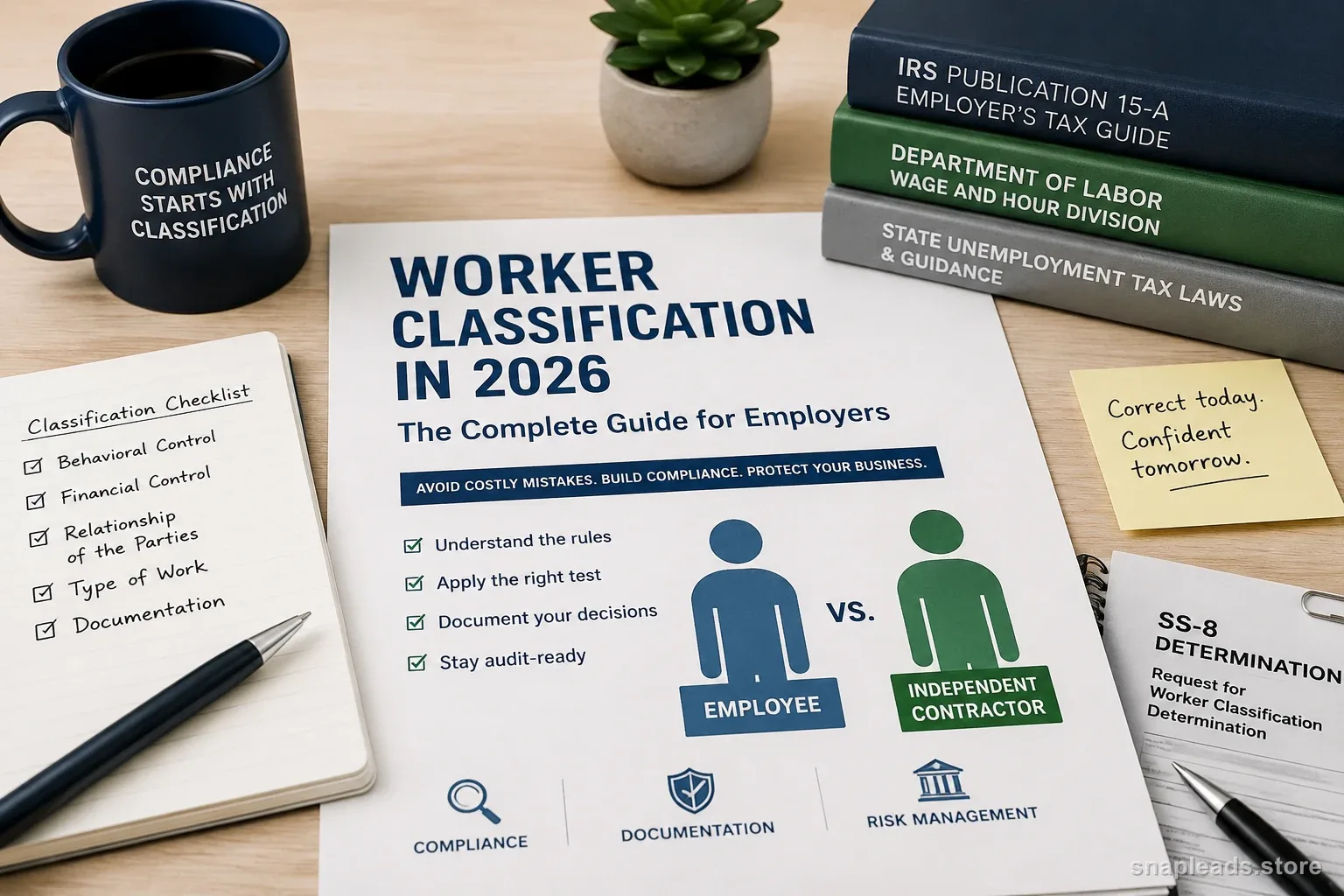 1099 or W-2? Start With the IRS Three-Category Classification Framework
 When to Recheck a 1099 Classification After the Role Changes
 Ohio UI Worker Classification: Choose the Right Test Before You Answer—General, Construction, or Trucking
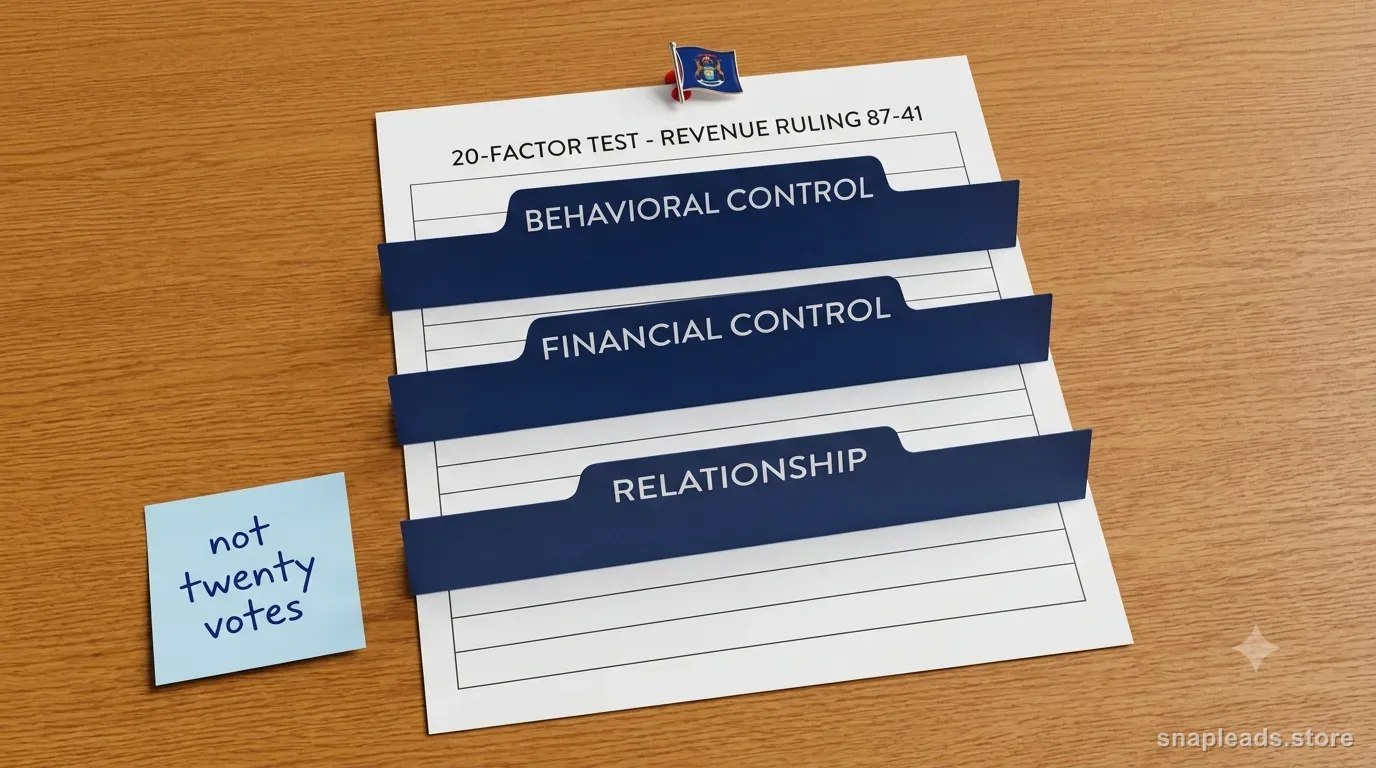 Michigan UIA Contractor Classification: Reconcile the 20-Factor Review Before an Audit or Claim
 Independent Contractor Agreement Clauses That Matter for Tax