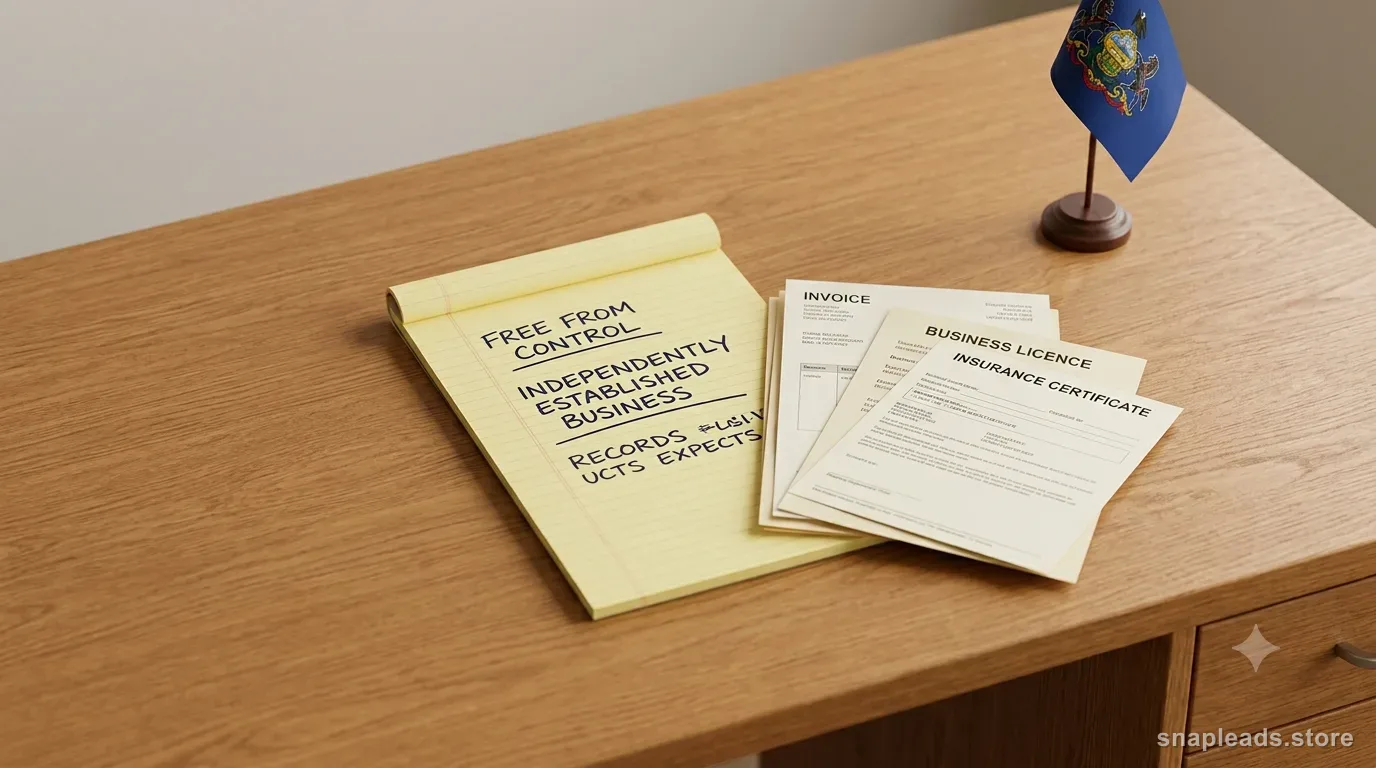
Pennsylvania UC uses a two-part statutory test after presuming paid services are employment
Pennsylvania Department of Labor & Industry explains that a worker who performs services for pay is presumed to be an employee for unemployment-compensation purposes unless the employer can establish both parts of the independent-contractor test. The worker must be free from control or direction over the performance of the services, under the contract and in fact, and must be customarily engaged in an independently established trade, occupation, profession, or business. Both are necessary.
This structure should dictate the audit file. Section One answers control with contract and operational evidence. Section Two answers independent business with market, investment, risk, location, insurance, customer, and business-identity evidence. Do not write one blended paragraph about “entrepreneurial independence.” A worker can operate with little supervision yet still lack an independently established business; another can own a real business but work under payer control on a particular engagement. Pennsylvania asks the employer to support both dimensions.
UCTS investigations can begin from claims or audit activity, so records should exist before the letter arrives
Pennsylvania’s employer reference guide explains that classification questions can arise through unemployment claims and through audit or investigative activity. A former contractor who files for benefits may cause the agency to examine whether the person actually performed covered employment. Random or targeted review can also test employer records. Waiting for a questionnaire to create a classification narrative makes it harder to separate contemporaneous facts from post-hoc explanations.
At onboarding, create a small evidence index rather than collecting every conceivable document. Record the business name and tax identity used for payment, contract, service scope, pricing method, insurance where relevant, public business presence, invoice form, equipment responsibility, and manager contact. Add operational evidence during the engagement if it changes. If a claim later triggers review, the company can answer from dated records rather than asking a manager two years later whether the worker “seemed independent.”
Control evidence should show who owns the method, schedule, tools, assistants, and corrections
The freedom-from-control part deserves an operational map. Identify who decides how and when work is done, who supplies critical tools, who trains the worker, who can assign assistants, how quality problems are corrected, whether the payer can move the worker among duties, and whether the relationship looks like a purchased result or managed labor. Contract terms matter because Pennsylvania looks at freedom under the agreement and in fact, but actual practice can contradict the paper.
Avoid overstating ordinary customer rights. A company can inspect a completed deliverable or require compliance with a site safety rule without necessarily controlling every means and manner of work. At the same time, calling detailed daily supervision “quality assurance” does not change its substance. Save representative work orders, manager instructions, scheduling records, and correction messages so the conclusion rests on the pattern, not on a carefully selected example.
The independent-business side should be proved with external business facts
Pennsylvania guidance points to facts such as ownership of tools or assets, ability to realize profit or loss, proprietary interest in the business, a separate business location, performance of similar services for others or availability to do so, and business liability insurance. Official employer material also describes records that may be relevant in a classification review, including preprinted invoices, signed contracts, bid forms, tax identification, websites or advertising, incorporation material, insurance documents, and leases where applicable.
These are evidence categories, not a requirement to manufacture a complete corporate identity. A solo tradesperson may have strong independent-business facts without a polished website, while an LLC with branded invoices can still be economically and operationally dependent on one payer. Collect what genuinely exists and explain how it relates to the test. If the worker’s enterprise is newly formed, document whether it has a market, investment, risk, and continuing capacity beyond this engagement rather than relying on the formation certificate.
Build a document-response index before sending records to the agency
When UCTS asks for records, do not respond with an unindexed dump of the entire accounts-payable drive. Create a request-to-document matrix. For each request, identify the responsive period, worker population, source system, document owner, and file names produced. Note records that do not exist and why, rather than substituting unrelated material. Preserve exactly what was sent and the transmission date.
This protects both completeness and credibility. If the agency requests contracts for 2024–2025 and the company sends only current 2026 templates, the response can create more questions. If some contractors had written bids and others were assigned hourly work without bids, that difference may be classification-relevant and should not be hidden by a single sample. A worker-level index allows the reviewer to see which facts apply to whom and helps the employer avoid making class-wide assertions that its own records contradict.
Construction work requires a separate Act 72 check rather than a generic UC conclusion
Pennsylvania’s misclassification guidance notes special requirements under the Construction Workplace Misclassification Act for individuals performing construction work, including a written contract and additional statutory conditions. A company involved in construction should not assume that satisfying the general UC two-part analysis answers every classification question that applies to the project.
Flag construction at intake. Keep the UC analysis under the unemployment-compensation framework, then open a separate construction-law checklist using the current official requirements. This prevents a common scope error: using a written construction contract as proof of contractor status under every law, or using a UC conclusion to skip construction-specific obligations. The records may overlap, but the legal questions should remain labeled.
The best audit narrative explains conflicting facts rather than pretending they do not exist
Real relationships rarely produce only favorable evidence. A contractor may own tools and advertise broadly but work a fixed on-site schedule for this payer. Another may set methods and price by project but have no other current customers. The audit memo should identify these conflicts and explain how the employer evaluated them under each of Pennsylvania’s two requirements. Omitting adverse facts makes a file look curated rather than reliable.
End with a worker-population reconciliation. Tie every individual reviewed to payments, Forms 1099 where applicable, contracts, and the classification conclusion. If the company changes treatment prospectively, record the date and reason rather than rewriting the historical file. An accurate transition from contractor to employee can be easier to defend than an impossible claim that a changing relationship was identical for five years.
UCTS RESPONSE TOOL
Pennsylvania audit request-to-evidence index
Use this to control what is requested, what exists, and exactly what was produced. It is intentionally different from the two-part legal memo.
| Agency/request topic | Evidence source | Worker/period coverage | Response note |
|---|---|---|---|
| Control and supervision | Schedules, work orders, manager instructions | List specific workers and dates | Explain actual operating pattern |
| Independent enterprise | Insurance, ads, website, client/bid records | Identify evidence by worker/entity | Do not treat LLC alone as proof |
| Payments/reporting | AP ledger, invoices, 1099 records | Reconcile totals by year | Flag missing or corrected records |
| Business investment/location | Tools, asset records, lease/location evidence | Only where factually applicable | Describe significance, not merely existence |
| Production log | Copy of every file sent + transmission receipt | Exact response set | Preserve unchanged audit copy |
WORKED EXAMPLE
Example: an unemployment claim reveals that one “contractor class” actually contains two models
A Pennsylvania home-services company receives a classification inquiry after a former installer files for benefits. Management initially says all installers are independent contractors. The evidence index shows otherwise: three incorporated crews bid jobs, carry liability insurance, supply major tools, and work for multiple builders; two individuals were paid hourly, used company equipment, and accepted schedules from a dispatcher.
The company stops answering at the class level. It builds separate control and independent-business findings for each worker and reconciles the records produced to UCTS. The response may lead to different outcomes within the population, but it is more defensible than forcing inconsistent facts into a single contractor narrative.