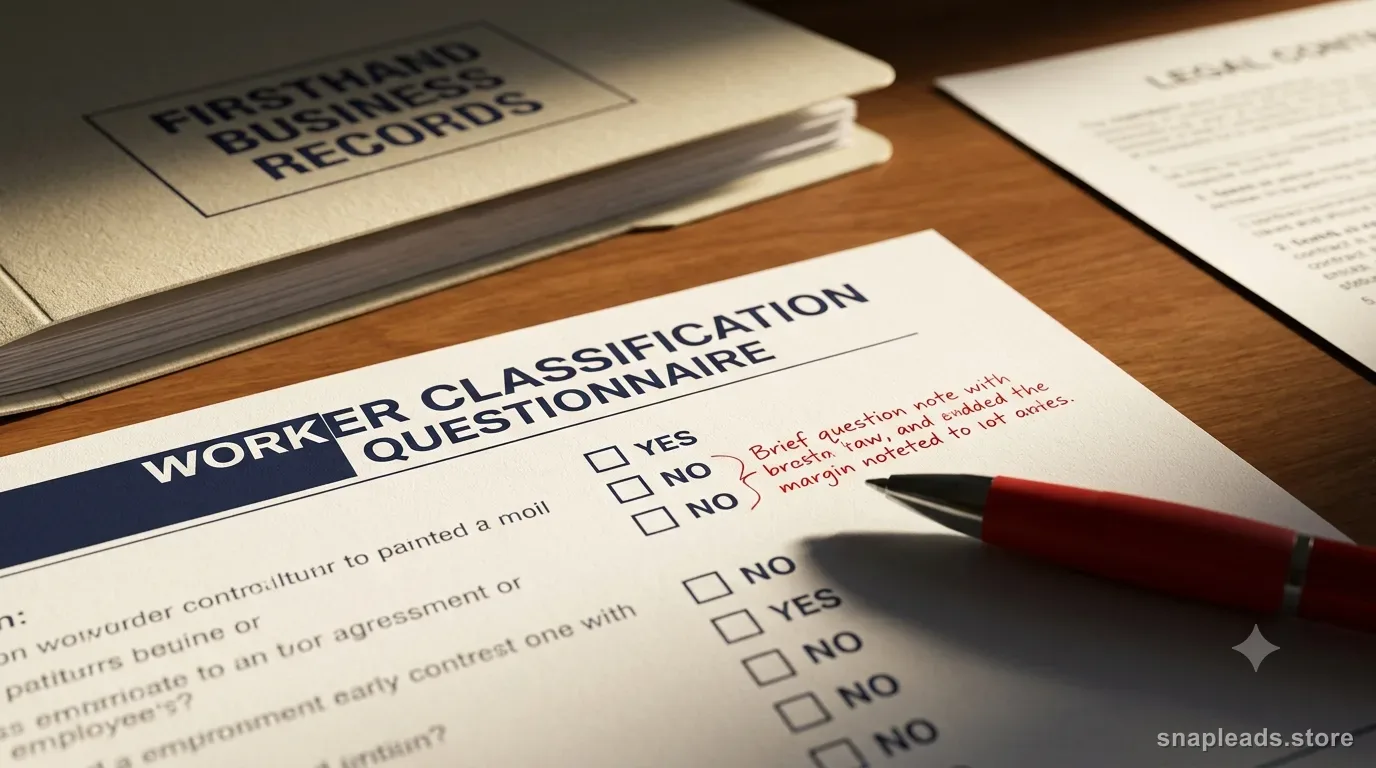
Read the question as a fact request
A classification questionnaire is designed to collect facts that fit the agency’s legal test. The safest approach is to answer the fact being asked, not the conclusion you hope the examiner will draw. If the form asks whether the worker could set hours, determine what actually happened during the period. A contract clause granting flexibility is useful evidence only if managers did not impose a conflicting schedule in practice. Pull calendars, dispatch logs, project tools, or testimony from the person who supervised the work.
Avoid the reflex to answer every question in the most contractor-friendly direction. Internal inconsistency is damaging. A form that says the worker chose all methods while company messages contain detailed mandatory procedures invites follow-up. Accuracy gives the business room to explain nuance: a customer might set a site-access window while the worker still controls the sequence of work; a security policy may be mandatory without dictating professional technique. Those distinctions are more credible when the supporting record is preserved.
Identify who actually knows each answer
Questionnaires often cross departments. HR knows onboarding documents, accounts payable knows payment mechanics, and a line manager knows daily control. One person completing the entire form from memory can create accidental errors. Build an answer sheet with a source person and source record for each material response. If several managers used the same contractor differently, note the difference rather than forcing one generalized answer.
Firsthand knowledge matters especially for questions about training, supervision, ability to refuse assignments, and correction of work. The person who signed the contract may never have observed the relationship after onboarding. Interview the operational owner and record concrete examples. ‘Independent’ and ‘employee-like’ are conclusions; ‘she chose which client projects to accept and proposed her own deadlines’ is a fact an examiner can evaluate.
Use yes or no carefully when the truth changed over time
A box can hide a changing relationship. Suppose a driver initially selected routes from an open board but later was placed on a fixed five-day schedule. The accurate response may depend on which months the question covers. If the form allows explanation, state the dates and change. If it does not, attach a clearly labeled continuation page that references the question number. Do not choose the answer that fits one period and leave the examiner to assume it applies to all periods.
Changes in equipment, exclusivity, pricing, and manager control can be equally important. A marketing consultant may begin with several clients and a project fee, then become economically and operationally integrated into one agency. A good response treats the history as history. It preserves credibility and helps the company identify whether remediation should focus on an entire relationship or only a later phase.
Distinguish customer constraints from employer control
Some work takes place inside constraints the business does not create. A hospital may require credentialing; a construction site may limit access hours; a client may require a final deliverable in a particular format. A questionnaire asking about instructions should be answered with enough context to show whether the company directed the method or merely passed through external requirements. That distinction does not resolve status by itself, but it prevents an inaccurate description of the work.
Similarly, quality standards are not all the same. Requiring a finished roof to meet code differs from giving a worker step-by-step instructions about tools and sequence. Requiring a report to contain specified data differs from daily training on how to perform the analysis. Describe the level of instruction and who had authority to change the method. Concrete examples are more useful than broad statements such as ‘we only controlled results.’
Texas TWC’s published comparative test makes a particularly important procedural point: control does not have to be exercised every day; a right to control can still support employment. When a questionnaire asks who “could” set hours, sequence, location, or methods, answer the contractual right and the actual practice separately. Saying “we rarely supervised” does not fully answer a question about retained authority.
Explain tools, expenses, and payment with amounts in context
A questionnaire may ask who provided tools or reimbursed expenses. List the major items that matter to the role rather than counting office pens. A carpenter who owns a truck, saws, insurance, and job-specific equipment presents a different financial picture from a worker who receives every significant tool and is reimbursed for ordinary operating costs. The state’s test determines how those facts are weighed, but the factual inventory should be specific.
Payment method also deserves context. A project fee can support business independence in some settings, yet it is not conclusive. Hourly payment is common in both employment and legitimate professional services. State whether rates were quoted or set, whether the worker could negotiate, who bore rework costs, whether invoices were submitted, and whether the person could increase profit through business decisions. Those details describe the economic arrangement more faithfully than the label on the payment account.
Do not copy answers from another worker without checking
Companies with a large contractor roster are tempted to complete one form and reuse it. That can be wrong even within one job title. Two bookkeepers may have different client relationships, schedules, software, assistants, or ability to market services. If the agency asks about a particular individual, verify that individual’s facts. For a population audit, define truly similar groups and record any exceptions that could affect the analysis.
This is also a useful internal control. When a copied answer does not fit, the mismatch may reveal that the role has drifted or that managers are using contractors inconsistently. Do not hide the exception simply to make the audit response look uniform. A classification system that depends on operational facts should be able to explain why two superficially similar arrangements are not actually identical.
Review the completed form against the evidence file
Before signing, read the questionnaire side by side with the contracts, invoices, schedules, equipment records, and representative communications you plan to preserve. Flag any answer that a document appears to contradict. Sometimes the answer is wrong; sometimes the document needs context. Resolve the discrepancy before submission instead of waiting for the examiner to find it. Keep dated review notes showing who confirmed each corrected response.
Finally, save the exact submitted version and any continuation pages. If the agency later asks the same question in an interview, the designated company representative can refer to the prior answer. Consistency should come from accurate facts, not rehearsed wording. If new information changes an earlier response, correct the record openly rather than trying to maintain a statement the company now knows was incomplete.
WORKED EXAMPLE
Example: the schedule question is not really yes or no
A creative agency is asked whether a freelance editor set her own hours. For the first four months, she worked whenever she wanted as long as client deadlines were met. After a staffing departure, a manager required her to be online 10 a.m. to 6 p.m. and attend daily production meetings.
The agency answers with a dated explanation rather than checking one box as if the relationship never changed. That response does not decide legal status, but it gives the examiner the actual chronology and alerts management that the later operating model needs a separate classification review.