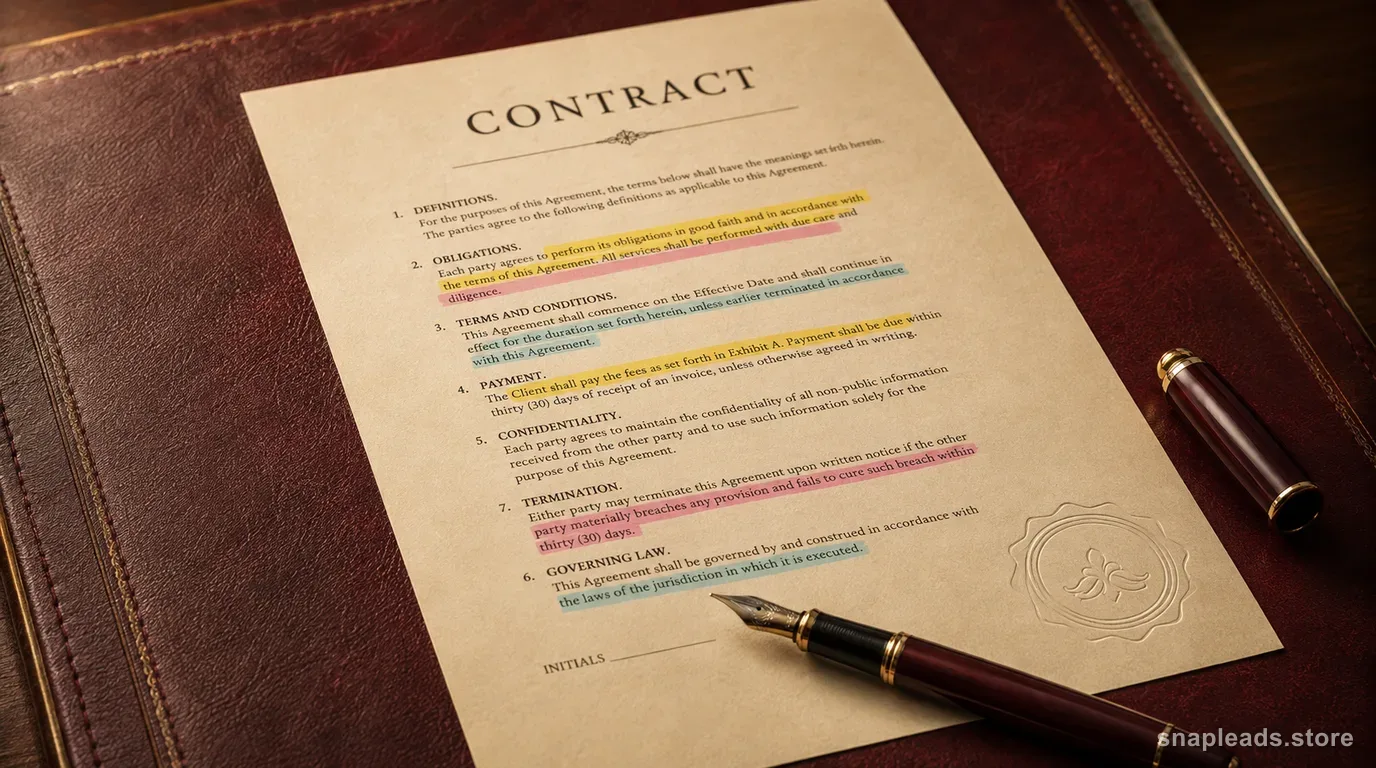
What makes a good independent contractor agreement for tax purposes?
The IRS treats a written contract as one fact showing how the parties intended to relate to each other, but the contract is not sufficient to determine worker status. The IRS says it is not required to follow a document that labels someone an independent contractor because the way the parties actually work together controls the classification analysis. A good agreement is therefore evidence architecture, not a tax-status guarantee.
The most useful clauses describe facts that can later be verified: a defined scope or deliverable, commercial pricing, responsibility for business costs, tools or equipment where relevant, ability to serve other customers, duration, benefits treatment, use of assistants where appropriate, change-order procedures, insurance or licenses where relevant, and contractual remedies. This is employer education, not contract-drafting legal advice.
Clause 1: define a result, not an indefinite job description
A strong scope states what the business is buying and when the result is due: migrate an API, complete a roofing section, prepare a specified report, conduct a defined audit, create a design package, or deliver another bounded service. The agreement can include quality, security, legal, and acceptance requirements without converting every detail into company control over the provider's internal method.
A weak contractor scope reads like an employee job description: 'perform duties assigned by manager,' 'support the department as needed,' or 'work on priorities designated from time to time' with no end point or commercial deliverable. Those terms can be accurate for employees, but they undermine a claim that the business is purchasing an independent service.
Clause 2: state pricing and expense economics accurately
Project fees, milestone pricing, retainers, commissions, hourly professional billing, and time-and-materials arrangements can all exist in legitimate business-to-business relationships. The agreement should state who sets or negotiates the price, when invoices are due, which costs the provider bears, which expenses are reimbursable, and whether rework or scope changes create additional compensation. Do not insert artificial financial risk that the company never enforces.
If every travel cost, tool, subscription, insurance premium, and ordinary business expense is reimbursed automatically, a clause saying the contractor 'bears all expenses' becomes contradicted evidence. Likewise, calling a weekly company-set payment an 'invoice fee' does not create independence. The payment records should match the contract.
Clause 3: describe tools, facilities, security, and method without fiction
The agreement can identify which party provides major tools, equipment, software, materials, facilities, or credentials. It should also separate required security, safety, code, confidentiality, and acceptance standards from control over the provider's ordinary professional method. Many real contractors must use client systems or work on client premises, so a blanket clause saying the provider supplies everything may be false and unnecessary.
When the business genuinely needs to direct the method—such as mandatory internal scripts, step-by-step company procedures, fixed staff schedules, or continuing manager approval—do not disguise those controls in a contractor template. Classification should reflect the operating model instead of forcing the operating model to fit the desired form.
Clause 4: preserve a real independent market where it exists
A contractor agreement can state that the provider may serve other customers, market services, maintain a separate business, and accept or reject work outside the agreed scope. A narrowly tailored confidentiality, conflict, data-security, or customer-protection restriction can coexist with independent business activity, but a broad exclusivity clause can conflict with the claim that the provider operates an independent market.
Do not require the contract to say the provider has other clients if that is not true. The IRS does not impose a magic multiple-client rule. Instead, preserve actual evidence of market activity when it exists—website, proposals, business insurance, other engagements, advertising, or pricing records—and explain a temporary single-client period honestly.
Clause 5: duration, termination, assistants, and benefits should fit the model
A defined project term or renewal tied to new scope can support a project relationship, while an indefinite relationship can point toward employment depending on the whole record. Termination clauses should reflect commercial remedies rather than pretending either party can walk away from a project with no consequences if the actual agreement includes milestones, cure rights, or damages. The right to hire or use assistants should likewise reflect the real service model and any licensing, security, or client-consent constraints.
Benefits language should be accurate but modest. Saying the provider is not eligible for employee vacation, pension, or health benefits can support the parties' intended relationship, but IRS guidance also says lack of benefits does not necessarily mean a worker is an independent contractor. A no-benefits clause cannot overcome staff-like control.
Clauses that look protective but do almost no classification work
Statements such as 'contractor is solely responsible for all taxes,' 'nothing creates an employment relationship,' 'contractor is an independent contractor for all purposes,' or 'contractor waives employee status' are conclusions rather than proof. They can document the parties' intention, but the IRS can disregard the label when the actual relationship is employment. An LLC requirement or invoice requirement has the same limitation.
The best closing control is an operations-to-contract review. At onboarding and renewal, compare the agreement with schedules, pricing, invoices, manager instructions, tools, client access, other customers, benefits, and duration. If the relationship has drifted, fix the operating model or classification rather than copying the same agreement into another year.
Clause evidence matrix
Which contractor clauses create useful evidence?
A clause matters only to the extent that it describes the real relationship and is relevant under the applicable classification test.
| Clause | Useful evidence when true | Red flag when operations disagree |
|---|---|---|
| Scope / deliverable | Business purchases a defined result | Manager assigns indefinite duties |
| Pricing / invoicing | Commercial fee and change-order economics | Company-set wage disguised as invoice |
| Expenses / tools | Real allocation of business costs and assets | Contract says provider pays; company reimburses everything |
| Other clients / market | Provider can operate an independent business | Broad practical exclusivity despite 'nonexclusive' wording |
| Duration / termination | Project term and commercial remedies | Indefinite at-will staff relationship |
| Assistants / substitution | Provider controls staffing where appropriate | Personal service required like an employee despite broad clause |
| Benefits | No employee-benefit expectation | Used as sole contractor evidence |
| Tax-status label | Records parties' intent | Treated as if the label overrides actual control |
WORKED EXAMPLE
Worked example: strong contract, employee-like operations
A startup signs a polished independent-contractor agreement with a product designer. The document says the designer sets hours, bears expenses, may serve other clients, and is paid by milestone. Within two months, the design director requires the designer online from 9 a.m. to 6 p.m., assigns daily tasks unrelated to the original deliverable, approves time off, pays a fixed amount every two weeks, reimburses all ordinary tools, and extends the engagement indefinitely.
At renewal, the startup does not simply re-sign the same template. It compares actual operations with each clause, documents the contradictions, and re-runs classification. The written agreement remains evidence of original intent, but it cannot substitute for the working relationship that developed.
COMMON QUESTIONS
Frequently asked
- Does a contract make someone a 1099 contractor?
- No. IRS guidance says the actual relationship governs and the agency is not required to follow a contract label. Why a contractor agreement does not decide status
- Should a contractor agreement say the worker pays their own taxes?
- It can state the intended tax responsibility, but that clause does not determine worker status if the actual relationship is employment.
- Should an independent contractor be allowed to work for other clients?
- Market freedom can support an independent business, but there is no rule requiring multiple simultaneous clients. Document the actual market facts.
- Is project-based pay required for contractor status?
- No. IRS guidance recognizes that some independent professionals bill hourly. Pricing method is one financial fact, not a standalone test.
- When should the contractor agreement be reviewed again?
- Review it when scope, duration, schedule, control, pricing, tools, client restrictions, or management practices change. Review classification after role changes
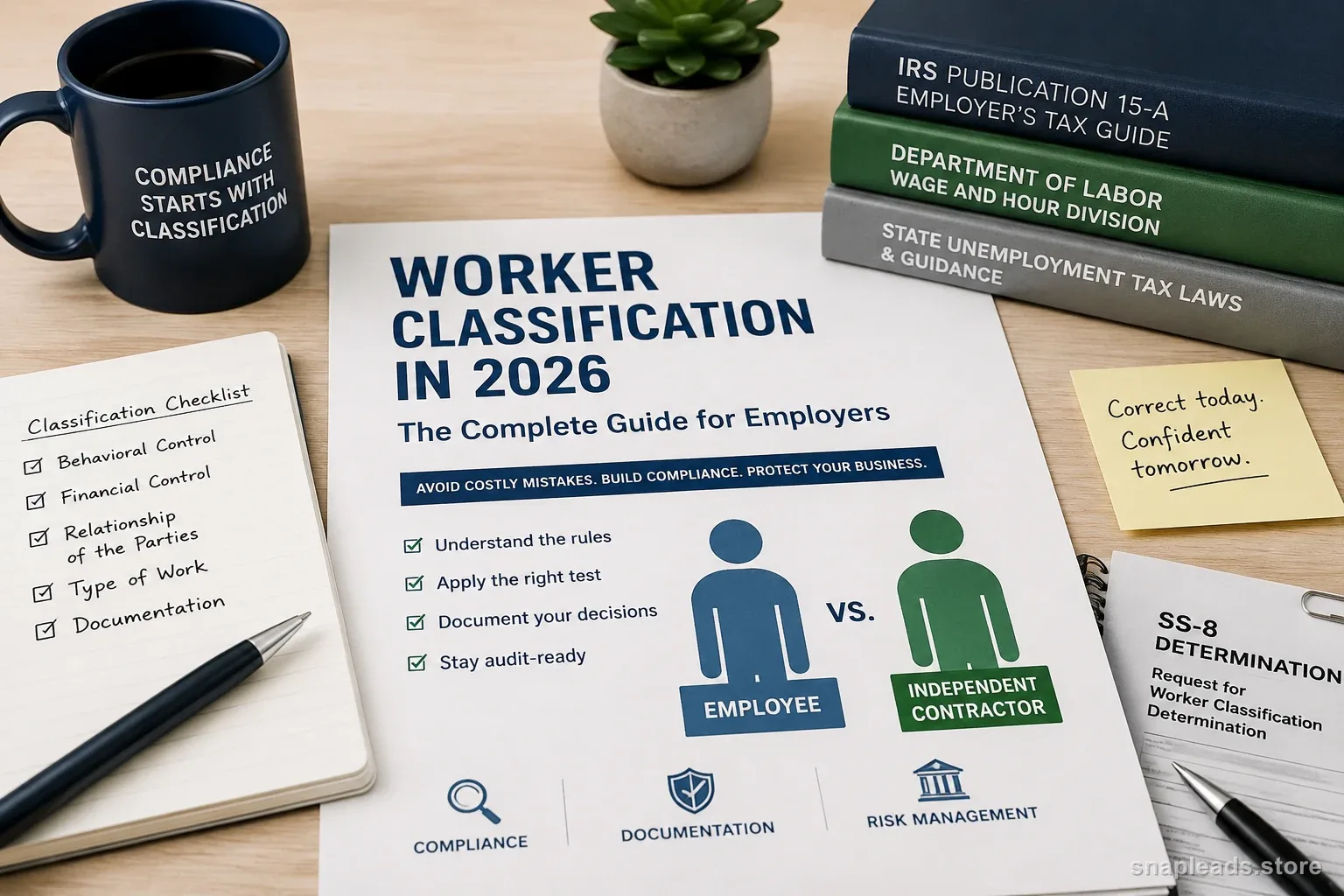 1099 or W-2? Start With the IRS Three-Category Classification Framework
 Employee Classification Audit Checklist for 1099 Workers
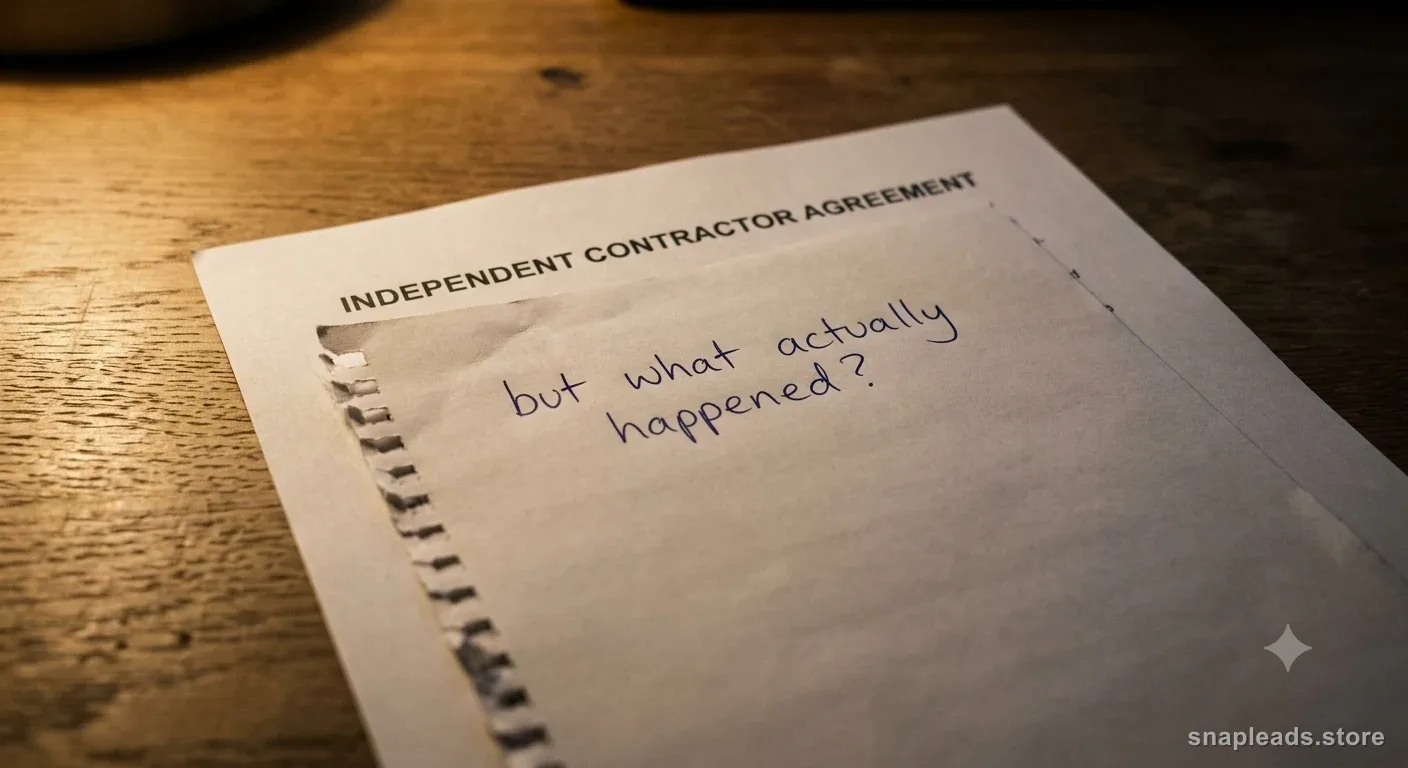 Why an Independent Contractor Agreement Does Not Decide 1099 vs. W-2 Status
 Is a Remote Software Developer a Contractor or Employee?
 Is a Bookkeeper 1099 or W-2?
 Is a Personal Trainer at a Gym an Employee or Contractor?