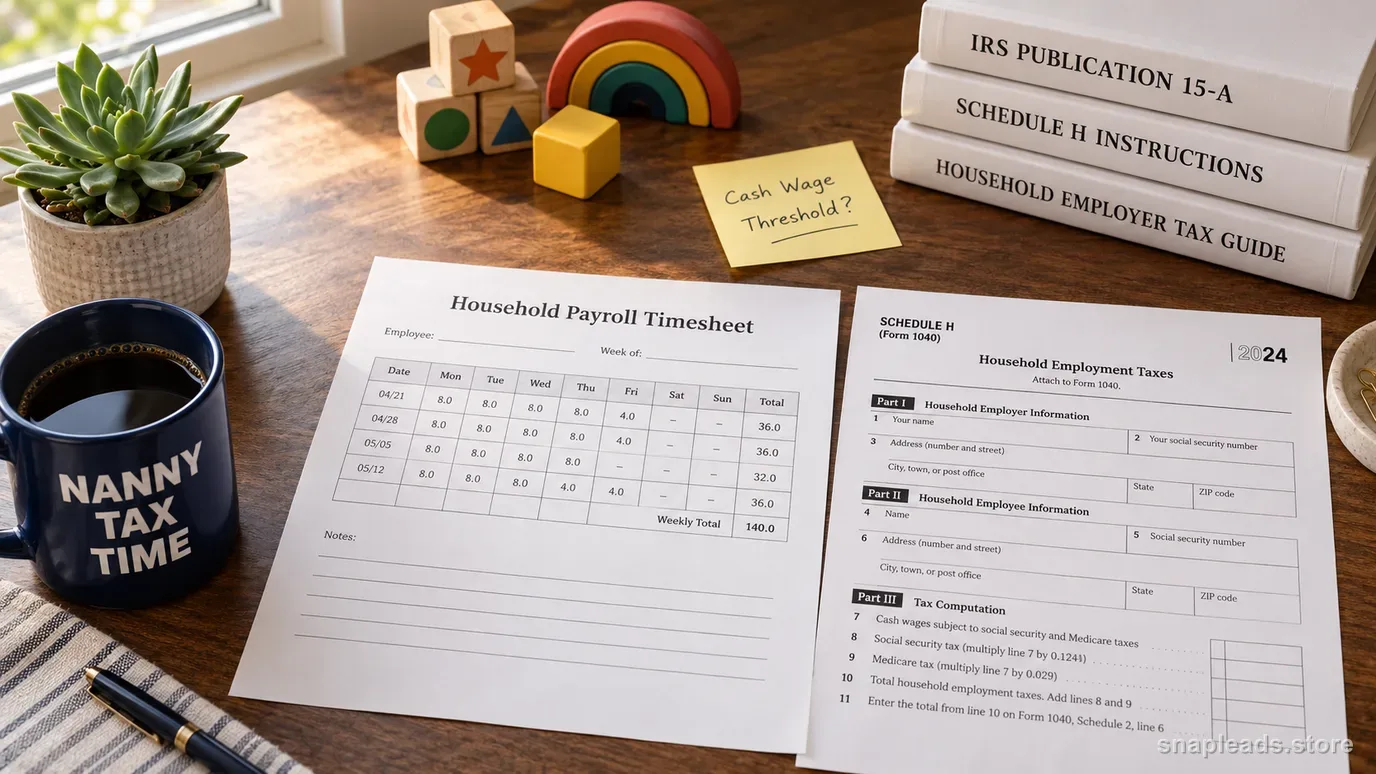
Do you have to put your nanny on payroll?
If you hire a nanny to provide childcare in your private home and you can control not only what work is done but how it is done, IRS Publication 926 says the worker is your household employee. The publication's household-work examples specifically include nannies and babysitters. Employee status does not disappear because the nanny works part time, is paid weekly, signed a contractor agreement, or was found through an agency or referral list.
The practical sequence is classification first, tax thresholds second. Once the nanny is a household employee, determine whether 2026 Social Security and Medicare, federal unemployment, W-2, Schedule H, and other requirements apply. Do not start by asking whether the nanny “wants a 1099.” Federal tax treatment follows the relationship, not the preferred form. This is household-employer education, not individualized tax or legal advice.
The 2026 household-employee FICA threshold is $3,000
Publication 926 states that Social Security and Medicare taxes generally apply to cash wages paid to one household employee when those wages reach $3,000 in 2026. The Social Security and Medicare rates for 2026 are 6.2% and 1.45% for both employer and employee, subject to the Social Security wage base and the publication's rules and exceptions. Household employers should use the current-year publication rather than carrying forward an older $2,700 or other prior-year threshold.
The $3,000 figure is not permission to treat a nanny as an independent contractor below that amount. A nanny can be a household employee even when federal Social Security and Medicare taxes do not apply because pay is below the annual threshold. Classification determines what the relationship is; thresholds determine which tax obligations attach to that employee.
Why a directly hired nanny usually looks different from a childcare business
A nanny in the family's home often works within family-set hours, follows childcare routines, uses the household's supplies and space, and provides personal services to the family. Those facts commonly fit the household-employee concept described in Publication 926. By contrast, a childcare provider who cares for children in the provider's own home generally is not the family's household employee, according to the publication.
Agency arrangements require a factual check. Some agencies employ nannies and provide household staffing services; other agencies primarily recruit or refer candidates whom the family then employs. Publication 926 warns that hiring through an agency does not by itself prevent household-employee status. Read the agency agreement to identify who hires, directs, pays, can terminate, and has payroll responsibility.
What payroll actually means for a household employer
Household payroll is not identical to running a business payroll department. Publication 926 explains when to withhold the employee share of Social Security and Medicare taxes, when the household employer owes the matching employer share, how federal unemployment tax can apply, when Form W-2 is required, and how Schedule H is generally used to report federal household employment taxes with the household employer's individual income-tax return.
Federal income-tax withholding is generally optional for household employment unless the nanny asks for withholding and the household employer agrees, but other payroll taxes have their own rules. The employer should also complete employment-eligibility procedures, obtain the information required for wage reporting, and keep payroll records. A household-payroll service can perform calculations and filings, but outsourcing administration does not change who the employee is.
Do not forget state payroll and domestic-worker rules
Publication 926 specifically directs household employers to check state unemployment obligations. Depending on the state and city, a household employer may also face workers' compensation, paid leave, sick leave, wage-notice, scheduling, overtime, domestic-worker bill-of-rights, or other requirements. Those rules are not replaced by federal Schedule H.
Create a state checklist based on where the nanny works, not only where the family owns a business or files other tax returns. If a nanny accompanies a family for extended work in another state, or the family changes residence during the year, state registration and payroll obligations may need a separate review. Do not generalize a California or New York domestic-worker rule to every state.
Set up the file before the first payroll deadline
Keep the employment agreement, start date, pay rate, normal schedule, overtime arrangement where applicable, time records, reimbursements, payroll calculations, tax deposits or estimated-tax adjustments, W-2 information, and state registration records together. The agreement should describe duties and pay clearly but should not try to manufacture contractor status by calling the nanny self-employed.
Estimate the year's cash wages early. A family paying $650 per week will cross the 2026 $3,000 Social Security and Medicare threshold quickly, so waiting until December to discover household payroll obligations creates unnecessary correction work. Review the arrangement again if hours, residence, agency involvement, or duties materially change.
At year-end, reconcile total cash wages to payroll records before preparing Form W-2 and Schedule H. If the nanny began late in the year or pay changed, use actual cash wages rather than annualized estimates when testing thresholds. Keep reimbursements and wages distinguishable in the ledger so the household can explain what was compensation and what was repayment of a documented expense.
If the family initially treated the nanny as a contractor and later concludes employee treatment was required, do not solve the problem by issuing both a 1099 and W-2 for the same wages without reviewing the correction path. Identify what forms or deposits were missed, what state filings are affected, and whether prior payments need reclassification before year-end information returns are prepared.
2026 household-payroll path
Nanny payroll setup in the right order
This sequence prevents the common mistake of using a tax threshold as the classification test.
| Step | Question | Record |
|---|---|---|
| 1. Status | Is the nanny a household employee under the actual control facts? | Duties, schedule, direction, agency agreement |
| 2. Cash wages | Will wages to this employee reach the 2026 household FICA threshold? | Projected and actual cash-wage ledger |
| 3. Federal payroll | Which Social Security, Medicare, FUTA, W-2, and Schedule H rules apply? | Payroll worksheet and current Pub. 926 |
| 4. State | What unemployment, workers' compensation, leave, or domestic-worker rules apply? | State registration and compliance file |
| 5. Year-end | Do payroll records reconcile to W-2 and Schedule H? | Year-end reconciliation |
WORKED EXAMPLE
Worked example: $650 per week nanny beginning in September 2026
A family hires Nina directly to care for two children in the family's home four days a week. The parents set the schedule and childcare routine, provide the home and supplies, and direct the work. Nina will earn $650 per week beginning September 8, 2026. The family first documents household-employee status and then projects that Nina's 2026 cash wages will exceed $3,000.
Instead of issuing a year-end 1099, the family reviews Publication 926, sets up household payroll records, checks state unemployment and domestic-worker requirements, and prepares for W-2 and Schedule H reporting where required. The $3,000 threshold determines a federal tax step after status; it is not what makes Nina an employee.
COMMON QUESTIONS
Frequently asked
- Can I give my nanny a 1099 instead of a W-2?
- Not simply by choice. If the nanny is your household employee, the applicable household-employment reporting rules govern.
- What is the nanny tax threshold for 2026?
- IRS Publication 926 states that Social Security and Medicare taxes generally apply when you pay one household employee $3,000 or more in cash wages in 2026.
- Is a nanny from an agency automatically the agency's employee?
- No. Publication 926 says hiring through an agency does not by itself determine household-employee status. Read the agreement and identify who actually employs and directs the nanny.
- What is the difference between a nanny and an independent childcare provider?
- A nanny working in your home under your direction often fits the household-employee framework. A childcare provider caring for children in the provider's own home generally is not your household employee under Publication 926. Review the IRS classification framework
- Is a house cleaner subject to similar household-employee rules?
- Yes, housecleaning workers are also listed in Publication 926 as household workers when the employment relationship exists. House cleaner 1099 or W-2
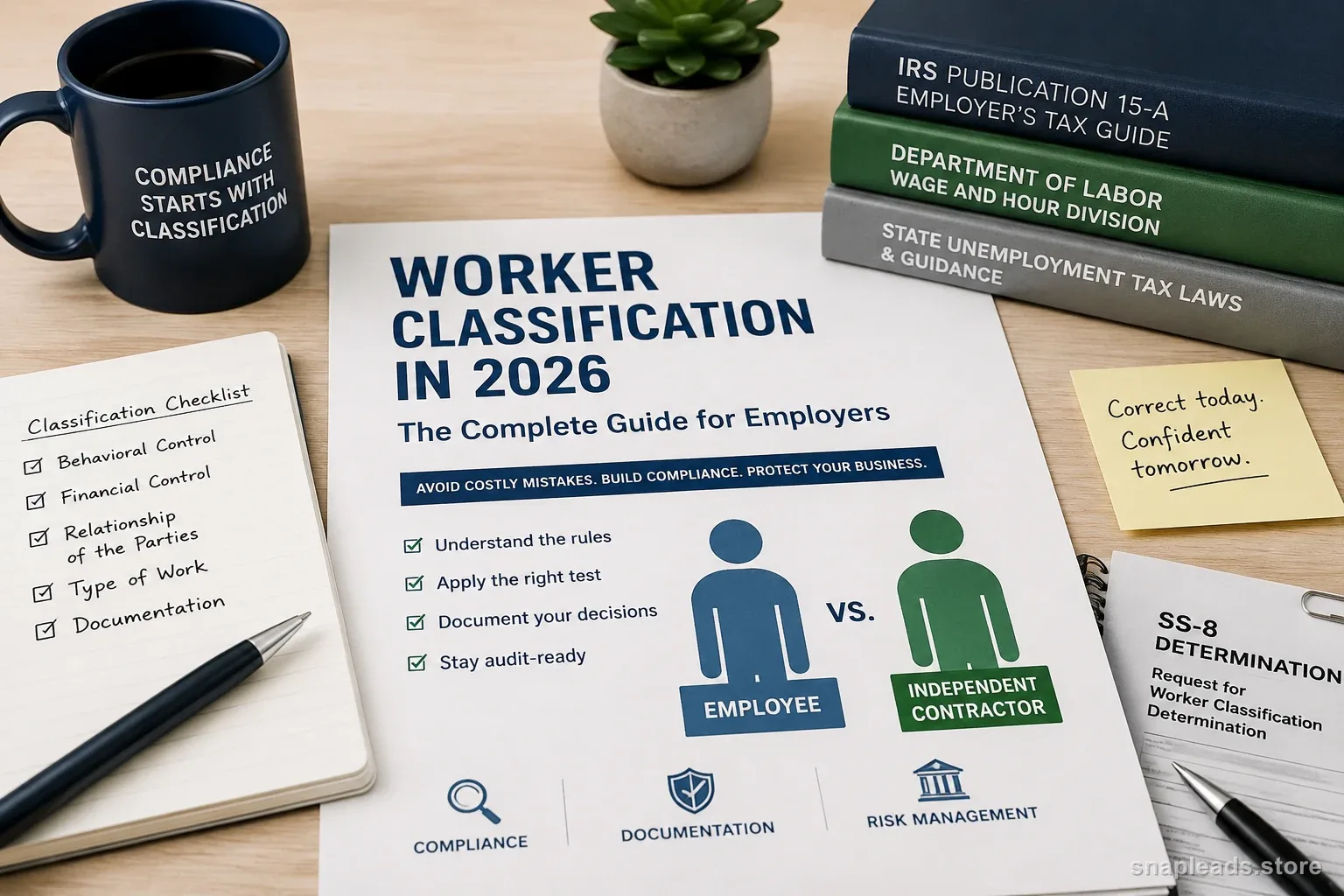 1099 or W-2? Start With the IRS Three-Category Classification Framework
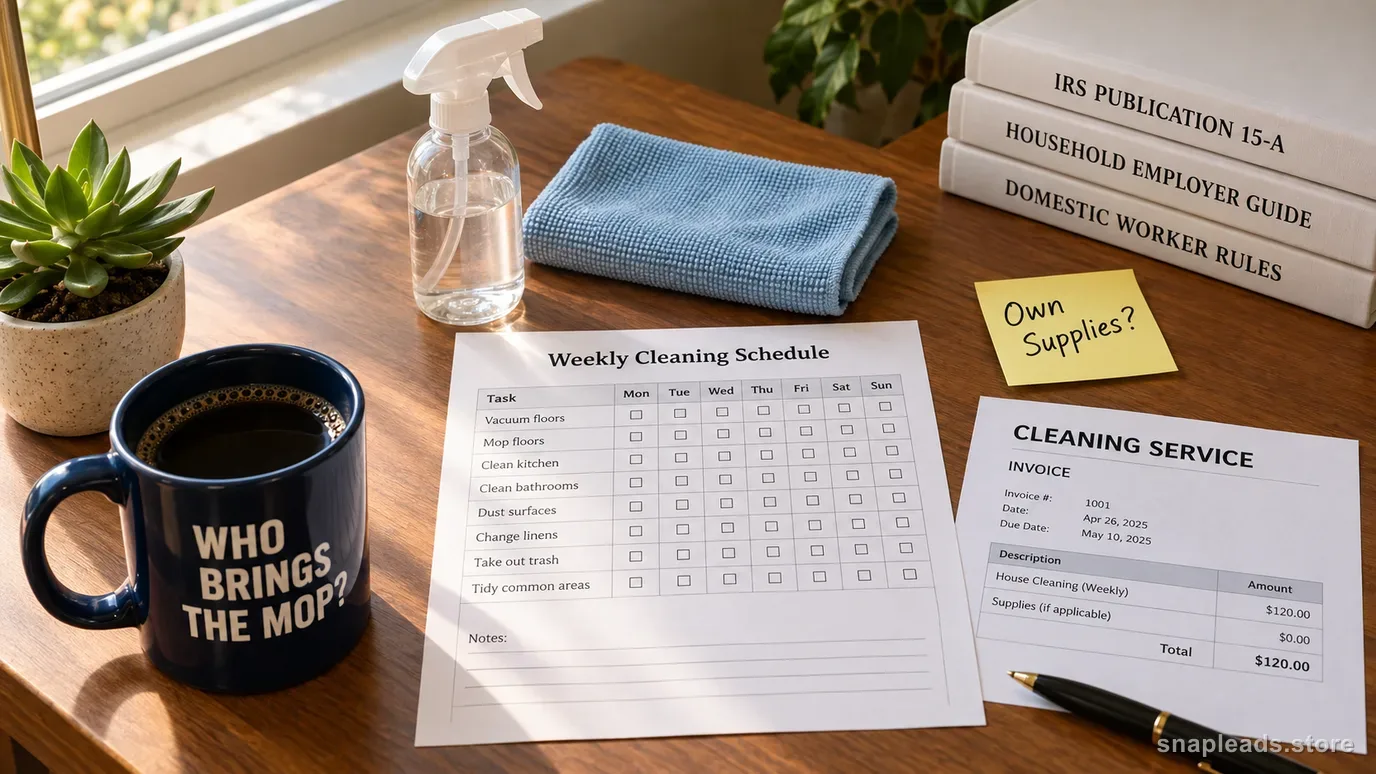 Should I Pay My House Cleaner as 1099 or W-2?
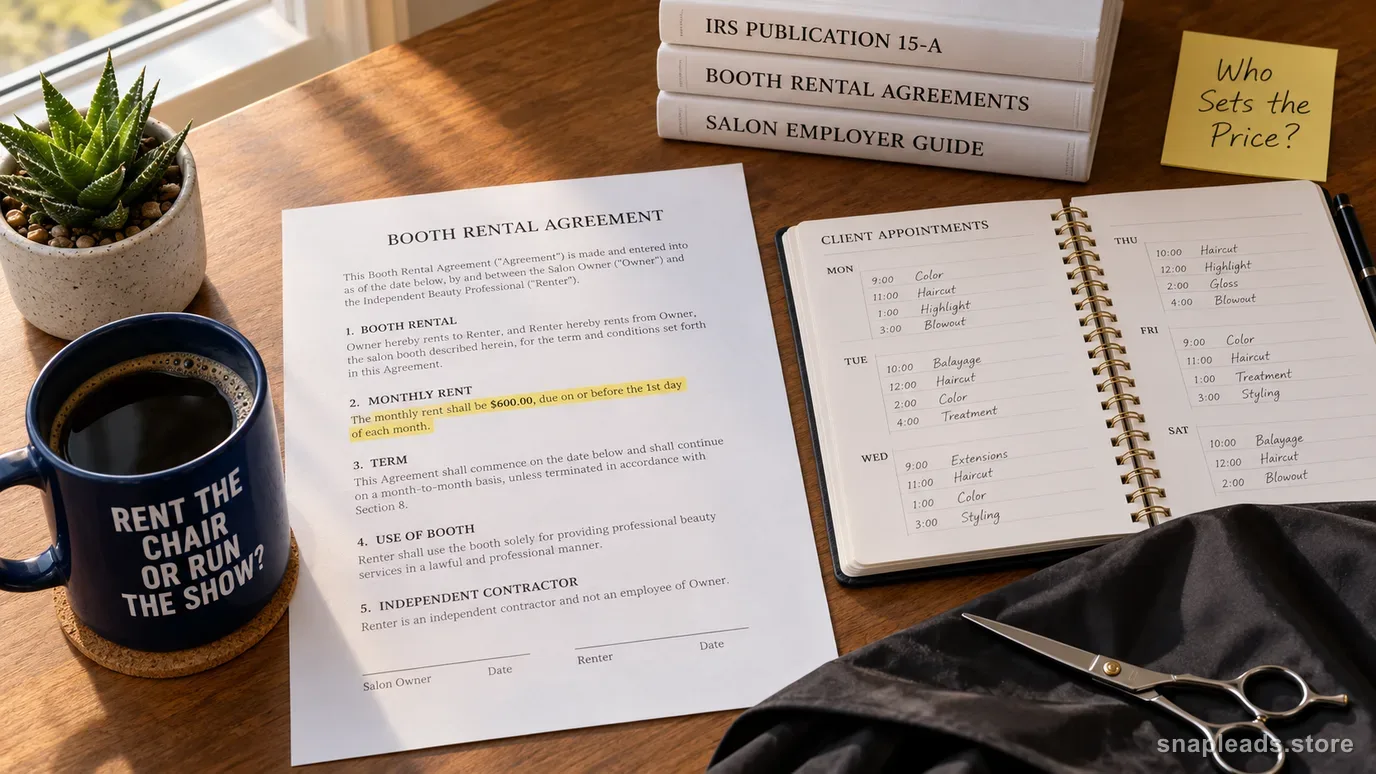 Salon Booth Renter vs. Employee Stylist
 Statutory Employee Examples: The Four IRS Categories
 Is a Personal Trainer at a Gym an Employee or Contractor?
 Does Using a PEO Fix Worker Misclassification?