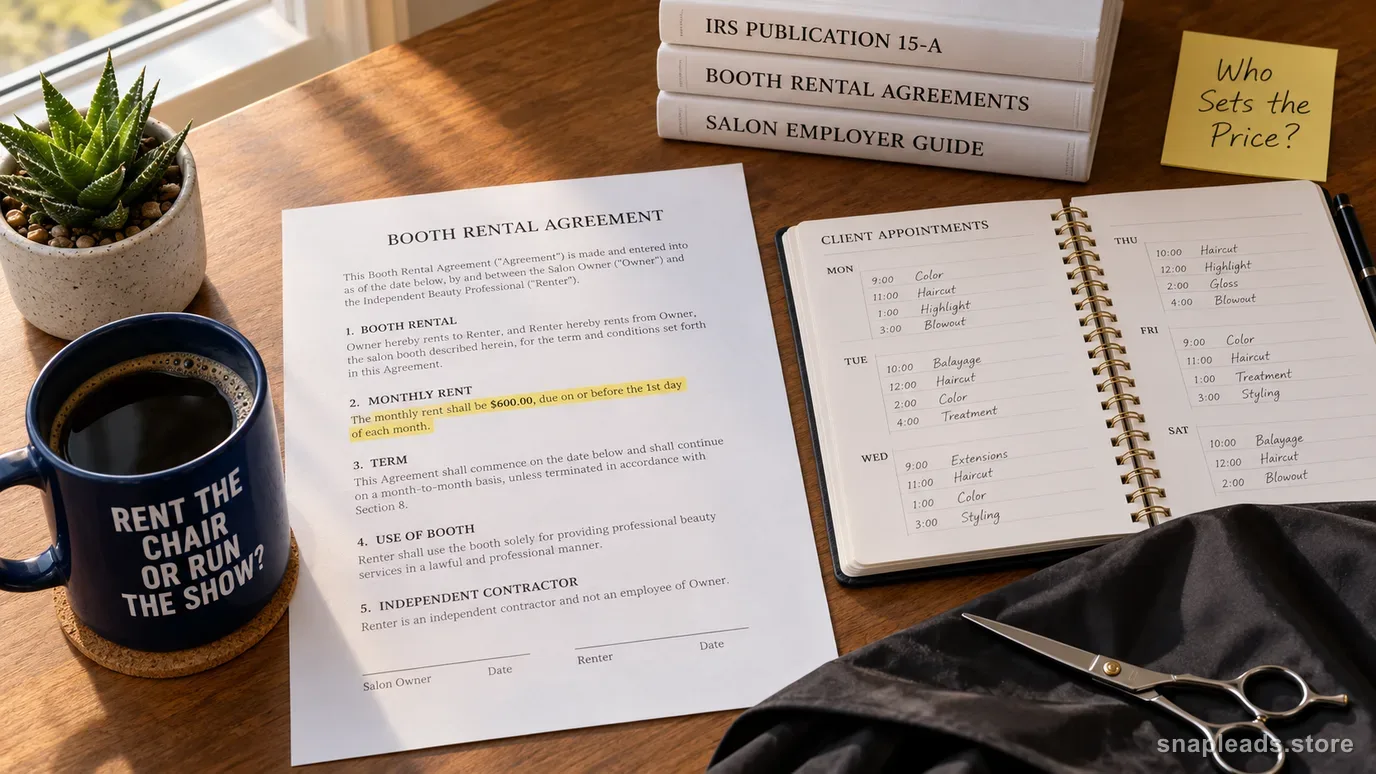
Are salon booth renters employees or independent contractors?
The phrase “booth renter” describes a business model, not a nationwide automatic tax status. Under federal employment-tax rules, the IRS still looks at control and independence. A stylist who truly leases space, runs a separate business, sets prices and hours, handles clients and payments, buys products, and bears business costs presents a different relationship from a stylist who is called a renter but follows the salon's schedule, service menu, prices, product rules, training, and management.
California's Board of Barbering and Cosmetology provides a useful industry-specific example. Its worker-classification materials describe an independent booth renter as a separate business and identify facts such as setting hours and prices, keeping an appointment book, supplying tools and products, and collecting client payments. The same material warns that a renter required to work fixed days and hours, use only salon products, provide a salon-set service menu, and charge salon-set prices may no longer look independent. California guidance is not a nationwide test. This is employer education, not legal advice.
A rent check is not enough; follow the client revenue
In a strong rental model, the stylist's business generally earns the service revenue and pays the salon a stated rent or facility fee. The stylist controls the service price, maintains business records, and bears the upside or downside of the stylist's own client volume. A salon that instead collects all customer revenue, sets prices, pays the stylist a percentage, and treats the payment as compensation should carefully examine whether the arrangement functions more like employment even if a document is titled “booth lease.”
Do not reduce the analysis to commission versus flat rent. Compensation structure is important but not conclusive. Review who controls pricing, discounts, refunds, tips, packages, memberships, rebooking, and client records. If the salon owns every meaningful revenue decision and can change the stylist's economics unilaterally, the practical relationship may contradict the independent-business story.
Schedule, products, and training show how much business autonomy exists
A salon can impose rules needed to maintain a safe licensed establishment without necessarily directing every stylist as an employee. California's Board notes that the establishment owner remains responsible for specified establishment compliance even when independent contractors or booth renters work in the salon. That means health, sanitation, licensing, and facility rules should not automatically be treated as employment control. The classification file should distinguish regulatory requirements from salon management preferences.
The more revealing facts are business controls unrelated to mandatory facility compliance: required shifts, mandatory team meetings, salon-set vacation approval, prescribed service technique, required retail quotas, compulsory use of salon-selected products where not legally necessary, salon-set prices, and manager approval of ordinary client work. A booth-rental model should be reviewed when day-to-day operations drift toward those controls.
Client ownership is a practical dividing line
A separate beauty business commonly maintains its own appointment book or booking account, client contact information, service menu, pricing, payment records, and marketing presence. The stylist may benefit when the client base grows and suffer when bookings fall. By contrast, an employee salon may assign walk-ins, centralize client records, control rebooking, run promotions, and treat the customer relationship as a salon asset.
Client ownership is not a magic legal element, but it helps explain who is actually running the service business. A hybrid salon should document how renters and employees differ. If both groups use the same central booking system, that is not necessarily fatal, but the salon should be able to show whether renters still control availability, price, service offerings, payment economics, and client relationships.
State beauty-industry rules can be unusually specific
Beauty professionals operate under occupational licensing and state employment laws that can overlay federal tax rules. California's Board uses booth-renter examples in its educational materials, while other states may define booth rental, impose establishment responsibilities, or apply different unemployment or wage tests. Do not export one state's salon model to every location.
The correct compliance file therefore has at least two layers: the federal employment-tax classification analysis and the state-specific salon/employment analysis. Add local business-license, sales-tax, establishment, and professional-license requirements where relevant, but do not imply that obtaining those licenses automatically proves independent-contractor status.
Audit the written lease against a normal week in the salon
Take the booth agreement and test every important clause against actual operations. If the lease says the renter sets hours, compare it with the booking system and manager messages. If it says the renter sets prices, compare it with the published menu. If it says the renter provides products, inspect who actually buys and mandates the backbar. If it says the renter collects revenue, reconcile payment processing and deposits. Operational evidence should match the written structure.
Repeat the review after promotions, software changes, management changes, or a shift from rental to hybrid commission arrangements. Misclassification often develops through operational drift: the original renter may have been independent, but salon owners gradually add mandatory schedules, pricing controls, training, meetings, and client policies until the daily relationship no longer resembles the lease.
Booth-renter reality check
Compare the booth lease with daily salon operations
This is an evidence table, not a point test. State law may impose additional or different requirements.
| Fact | Separate booth-renter business | Employee-style salon operation |
|---|---|---|
| Revenue | Stylist earns client revenue and pays facility rent | Salon collects service revenue and pays compensation |
| Prices | Stylist sets service prices | Salon sets mandatory price/menu |
| Hours | Stylist controls availability | Salon assigns required shifts |
| Products / tools | Stylist chooses and bears meaningful business costs | Salon mandates ordinary products and supplies work tools |
| Clients | Stylist maintains own clientele and records | Salon owns booking, promotions, and customer relationship |
| Management | Facility/regulatory rules without routine work supervision | Training, quotas, method control, and manager approval |
WORKED EXAMPLE
Worked example: two stylists in one salon
A salon rents Chair 4 to Mia for $325 per week. Mia sets her prices and hours, has her own booking account and business name, buys her color and retail products, collects client payments, has a key, and serves clients she developed herself. The salon enforces sanitation and establishment rules but does not dictate Mia's ordinary service methods. The owner documents both the rental terms and actual operations.
At Chair 5, the salon calls Zoe a booth renter but sets Zoe's Tuesday-through-Saturday schedule, service prices, required product line, training sessions, discounts, and retail targets, processes every client payment, and pays Zoe 45% of service revenue. The owner should not assume that the identical “booth renter” contract controls both relationships; Zoe's operating facts require a separate classification review.
COMMON QUESTIONS
Frequently asked
- Does paying booth rent automatically make a stylist an independent contractor?
- No. The actual business relationship still matters. Rent is one financial fact, not a nationwide safe harbor.
- Can a salon set prices for a booth renter?
- Salon-set prices can be evidence of control over the renter's business. State law and the full relationship must be reviewed; California's Board materials specifically identify price-setting as an independence fact.
- Can booth renters use the salon booking system?
- They can, but the important question is what control the system gives the salon. Central software is different from mandatory salon control over availability, pricing, clients, and service decisions.
- Does a booth-rental agreement decide worker status?
- No. Compare the agreement with actual operations. Why contracts do not decide status
- Do salon classification rules vary by state?
- Yes. Occupational licensing, unemployment, wage, and tax rules can differ by state. Worker-classification state guides
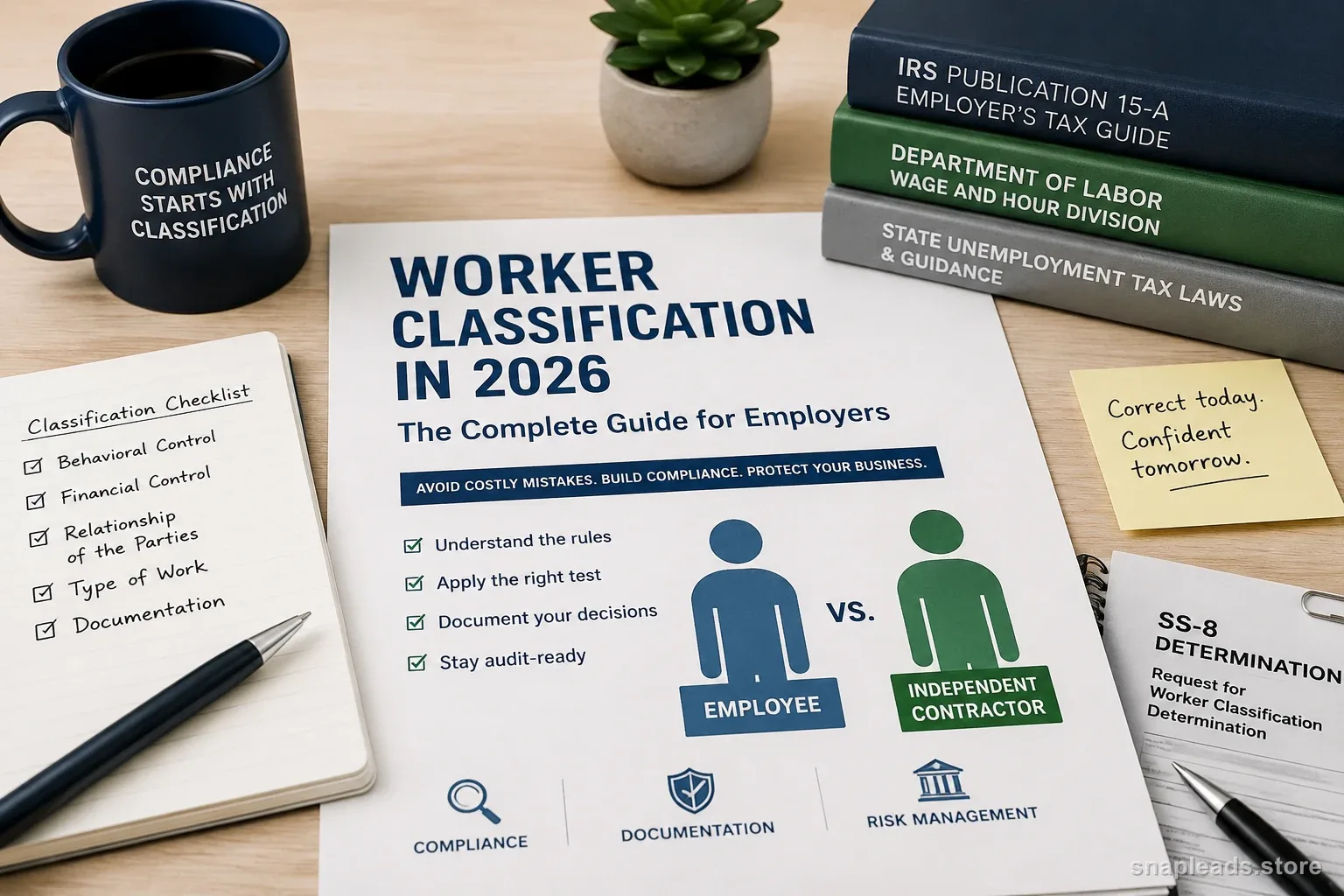 1099 or W-2? Start With the IRS Three-Category Classification Framework
 Employee Classification Audit Checklist for 1099 Workers
 Is a Personal Trainer at a Gym an Employee or Contractor?
 Independent Contractor Agreement Clauses That Matter for Tax
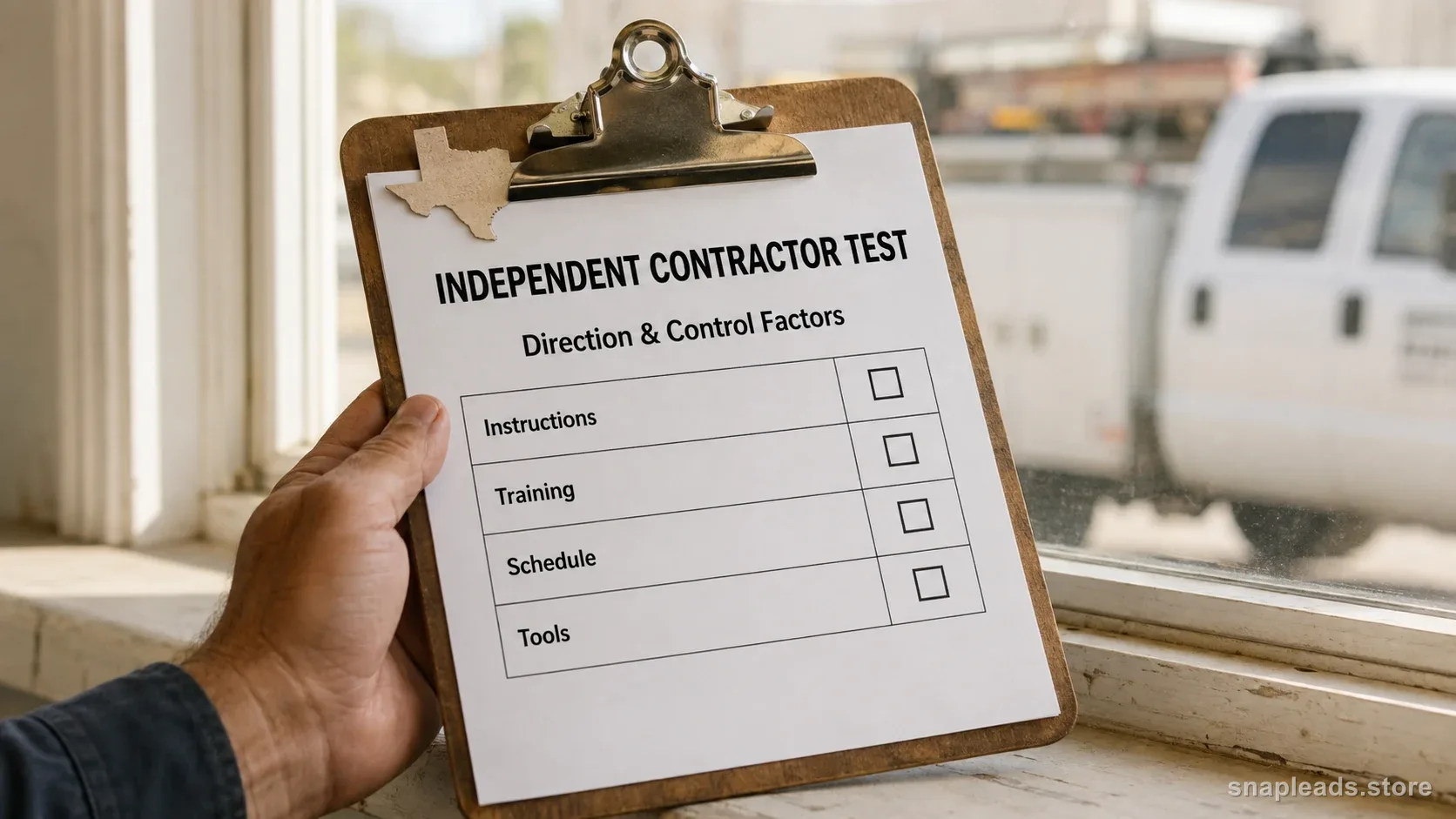 Texas Workforce Commission Contractor Test: Review the Actual Direction and Control
 Is a Bookkeeper 1099 or W-2?