
What is a common-law employee?
For federal employment-tax purposes, the IRS says a person is a common-law employee when the person performs services for a business and the business has the right to control what will be done and how it will be done. Actual day-to-day micromanagement is not required. A skilled worker can exercise substantial professional discretion and still be an employee if the service recipient retains the legal right to control the important details of the work.
The label does not control the answer. Calling someone a consultant, freelancer, agent, 1099 worker, or LLC does not override an employer-employee relationship. The IRS also states that full-time versus part-time status does not determine the result. This is a federal employment-tax concept; state unemployment, wage, workers' compensation, and industry laws can define employee differently. This is employer education, not legal or tax advice.
Right to control is broader than a manager giving daily instructions
The common-law inquiry looks at the right to direct and control, not only whether the company exercised that right every hour. A senior salesperson may need little coaching but still work within company-assigned schedules, customer lists, pricing approvals, reporting requirements, and benefit programs. The IRS's own common-law employee example uses an experienced commissioned salesperson who needs minimal help yet remains subject to company approval and operating controls.
For an audit file, document the legal and practical right to control: who can assign work, change priorities, prescribe methods, approve time off, require training, set customer terms, discipline performance, and terminate the relationship. Then compare those rights with the worker's ability to operate independently.
Current IRS evidence falls into three categories
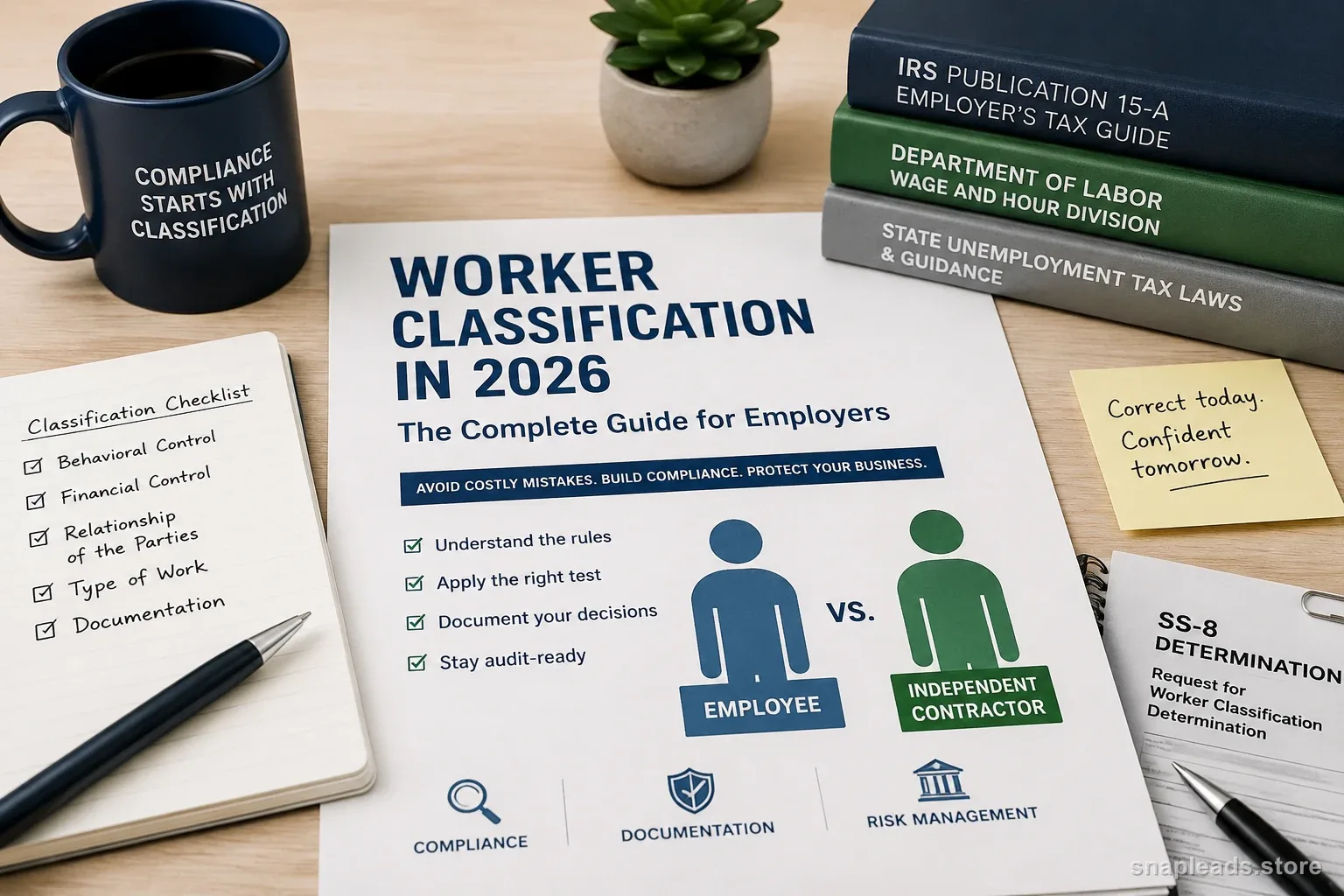
Behavioral control asks whether the business has the right to direct how the work is done, including instructions, training, evaluation systems, schedules, sequence, and other method controls relevant to the occupation. Financial control examines the business side of the relationship: investment, unreimbursed expenses, payment method, opportunity for profit or loss, and whether services are made available to a market.
Type of relationship looks at written contracts, employee benefits, permanency, and whether the worker's services are a key aspect of the business, among other relationship facts. The IRS expressly says there is no magic number of factors and no one factor stands alone. A common-law determination should synthesize the whole relationship rather than score three headings.
Common-law employee is not the same as statutory employee
A common-law employee is an employee because the service relationship meets the common-law right-to-control standard. A statutory employee is different: the person may not be a common-law employee, but federal law treats certain workers in four specified categories as employees for Social Security and Medicare tax purposes when additional conditions are met. Those categories include certain drivers, full-time life insurance sales agents, specified homeworkers, and full-time traveling or city salespeople.
This distinction matters on Form W-2. Box 13 contains a 'statutory employee' checkbox. An ordinary common-law employee is not marked as a statutory employee merely because the person is an employee. Checking Box 13 means the worker falls under the statutory-employee treatment, not that the employer has confirmed common-law employee status.
Once common-law employee status is established, ordinary federal employee reporting rules generally follow: the employer handles wage reporting and applicable income-tax withholding, Social Security, Medicare, and FUTA under the normal employment-tax rules. That payroll consequence is separate from whether the worker receives benefits under an employer plan or has rights under another employment law.
Common-law employee is also different from statutory nonemployee
Federal law separately treats certain qualified workers as statutory nonemployees, including qualifying licensed real estate agents, direct sellers, and certain companion sitters. Those rules can override the usual federal tax treatment when the statutory conditions are met. A business therefore should not force every worker into a two-box 'common-law employee or independent contractor' analysis without first checking whether a special statutory category applies.
Use a routing sequence: identify the service and worker type, screen for statutory employee or statutory nonemployee rules, then apply the common-law framework when that is the governing test. State law needs its own routing step because a federal statutory category does not automatically dictate state unemployment or wage treatment.
How to document a common-law employee decision
Create a fact memo using concrete evidence rather than conclusions. For behavioral control, cite schedules, written instructions, training, performance systems, and manager rights. For financial control, cite pricing, expenses, tools, investment, client market, and profit-or-loss evidence. For relationship facts, cite contract terms, benefits, expected duration, termination rights, and whether the service is central to ongoing operations.
Then record conflicting facts rather than hiding them. A worker can have a written contractor agreement but also receive employee benefits and work indefinitely under company direction. Another worker can use company systems for security reasons but operate a separate project business. The final conclusion should explain why the most relevant facts show the degree of control and independence in that occupation.
At year-end, make the classification memo reconcile to payroll. Confirm the worker appears in the correct employee population, wages reconcile to the W-2 and payroll ledger, and the statutory-employee Box 13 checkbox is not being used as a generic marker for 'employee.' A tax-form review is a useful regression check on the legal conclusion.
Category map
Common-law employee vs. other federal worker categories
Use the correct federal category before deciding what the tax form should look like.
| Category | Why status applies | Typical federal reporting cue |
|---|---|---|
| Common-law employee | Right-to-control relationship under common law | Regular employee wage reporting; no statutory-employee Box 13 check merely for common-law status |
| Independent contractor | Independent business under the applicable common-law analysis | Nonemployee reporting when required |
| Statutory employee | One of four statutory categories + required conditions | W-2 with statutory employee Box 13 treatment |
| Statutory nonemployee | Specific federal statute treats qualifying worker as self-employed | Follow category-specific nonemployee rules |
| State employee category | State statute/test may differ | State UI/wage treatment must be checked separately |
WORKED EXAMPLE
Worked example: experienced commissioned salesperson
A wholesaler pays Dana entirely by commission. Dana has ten years of experience, rarely needs coaching, and works remotely most days. The company nevertheless requires Dana to cover assigned territories, use company customer lists, obtain manager approval for major price concessions, submit weekly pipeline reports, attend required sales meetings, and follow the company's sales process. The absence of hourly wages or close supervision does not end the common-law analysis.
The company documents behavioral, financial, and relationship evidence and concludes that its retained right to direct important parts of the sales work supports common-law employee treatment. It issues a normal W-2 and does not check the statutory-employee box simply because Dana is an employee.
COMMON QUESTIONS
Frequently asked
- What makes someone a common-law employee?
- For federal employment tax, the key is the business's right to control what work is done and how it is done, considered with all evidence of control and independence.
- Can a part-time worker be a common-law employee?
- Yes. IRS guidance says full-time versus part-time status does not decide the relationship. Part-time worker classification
- Is a common-law employee the same as a statutory employee?
- No. Common-law status comes from the right-to-control relationship; statutory employee treatment comes from specific federal categories and conditions. Statutory employee examples
- Should Box 13 be checked for every common-law employee?
- No. The Box 13 statutory-employee checkbox is for statutory employees, not ordinary common-law employees.
- Does a contractor agreement prevent common-law employee status?
- No. IRS guidance says the substance of the working relationship controls. Why the contract label does not decide status
 1099 or W-2? Start With the IRS Three-Category Classification Framework
 Corporate Officers, Shareholder-Employees, and Directors: Who Is an Employee for Federal Employment Taxes?
 Revenue Ruling 87-41: The 20-Factor Test Explained
 Arizona UI Worker Classification: Right to Control and the “Regular Part of the Business” Signal
 Florida Reemployment Tax Classification: How to Prepare for the RTS-6061 Ten-Factor Review
 Are Delivery Drivers 1099 or W-2?